Table of Contents
Context
The Ministry of Health and Family Welfare released the findings of the National Family Health Survey-6 (NFHS-6), conducted during 2023-24.
What is NFHS?
The National Family Health Survey (NFHS) is a large-scale, multi-round survey conducted across India to collect data on population health, nutrition, fertility, family planning, maternal and child health, and socio-economic indicators. The survey serves as an important tool for evidence-based policymaking and monitoring national health goals.
Read Also: UPSC Daily Current Affairs 2026
NFHS-5 vs NFHS-6: Key Highlights
Improvements in Child Health and Nutrition
India has made remarkable progress in reducing child malnutrition and disease burden.
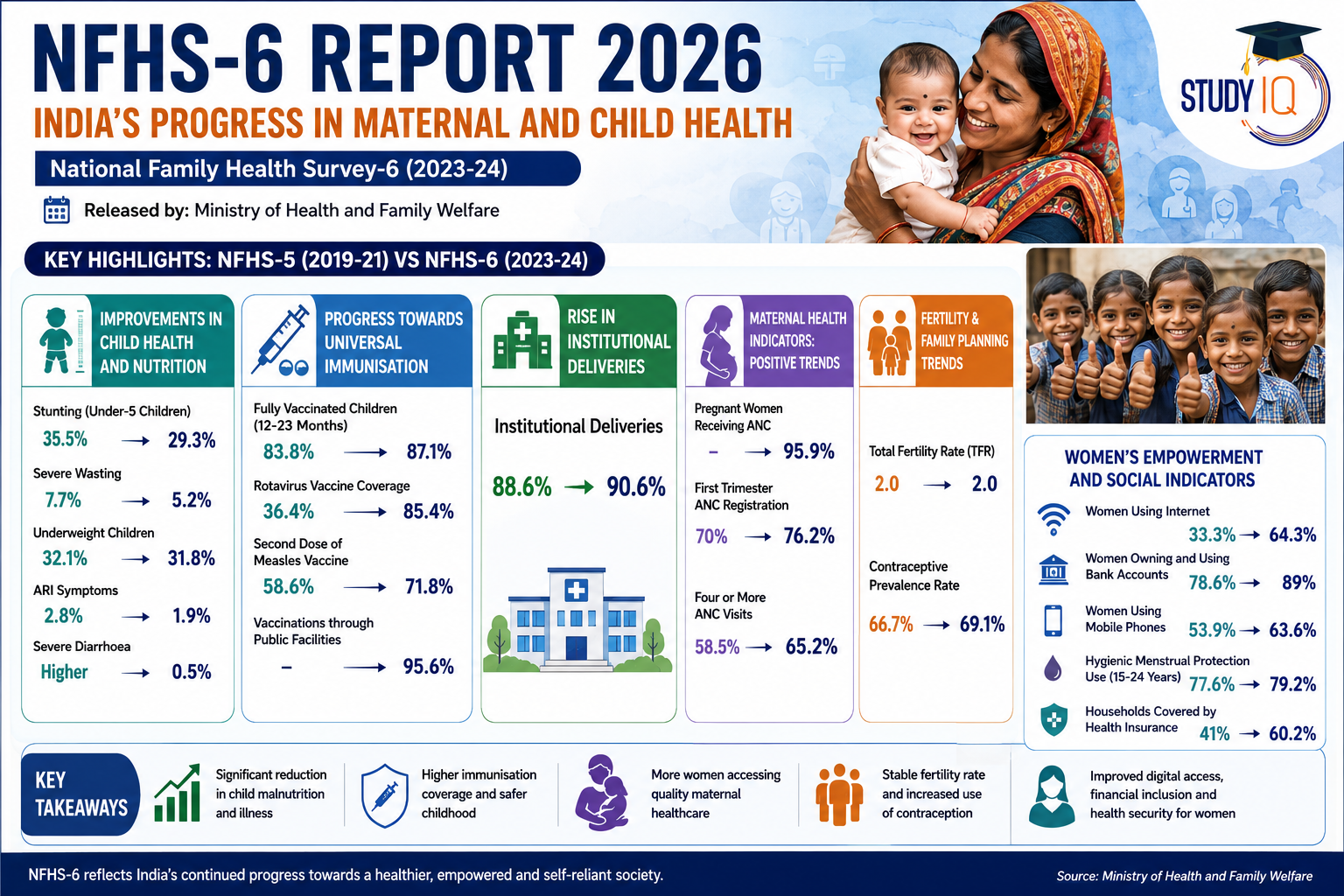
| Indicator | NFHS-5 (2019-21) | NFHS-6 (2023-24) |
|---|---|---|
| Stunting (Under-5 Children) | 35.5% | 29.3% |
| Severe Wasting | 7.7% | 5.2% |
| Underweight Children | 32.1% | 31.8% |
| Acute Respiratory Infection Symptoms | 2.8% | 1.9% |
| Severe Diarrhoea | Higher | 0.5% |
Key Takeaways
- Stunting declined by more than 6 percentage points.
- Severe wasting witnessed a significant reduction.
- Child morbidity due to respiratory infections and diarrhoea has decreased considerably.
- Improved nutrition interventions and healthcare access contributed to better child health outcomes.
Progress Towards Universal Immunisation
The survey highlights strong gains in vaccine coverage across the country.
| Indicator | NFHS-5 | NFHS-6 |
| Fully Vaccinated Children (12-23 Months) | 83.8% | 87.1% |
| Rotavirus Vaccine Coverage | 36.4% | 85.4% |
| Second Dose of Measles Vaccine | 58.6% | 71.8% |
| Vaccinations Through Public Facilities | – | 95.6% |
Significance
- India is moving closer to universal immunisation coverage.
- Rotavirus vaccine coverage more than doubled during the period.
- Improved vaccination rates are expected to reduce infant and child mortality.
Rise in Institutional Deliveries
Institutional deliveries continue to increase, ensuring safer childbirth and reducing maternal mortality.
| Indicator | NFHS-5 | NFHS-6 |
| Institutional Deliveries | 88.6% | 90.6% |
Impact
- More women are opting for deliveries in healthcare facilities.
- Access to skilled birth attendants has improved.
- Maternal and neonatal health outcomes are expected to improve further.
Maternal Health Indicators Show Positive Trends
Maternal healthcare services have expanded significantly.
| Indicator | NFHS-5 | NFHS-6 |
| First Trimester ANC Registration | 70% | 76.2% |
| Four or More ANC Visits | 58.5% | 65.2% |
| Pregnant Women Receiving ANC | – | 95.9% |
Why It Matters
- Early antenatal registration helps identify high-risk pregnancies.
- Regular antenatal care improves maternal and child health outcomes.
- Better healthcare awareness has encouraged women to seek timely medical care.
Fertility and Family Planning Trends
India’s demographic transition continues to stabilize.
| Indicator | NFHS-5 | NFHS-6 |
| Total Fertility Rate (TFR) | 2.0 | 2.0 |
| Contraceptive Prevalence Rate | 66.7% | 69.1% |
Analysis
- India’s fertility rate remains at replacement level.
- Increased contraceptive use indicates greater awareness and acceptance of family planning methods.
- Population growth is gradually stabilizing across most regions.
Women’s Empowerment and Social Development
NFHS-6 highlights major progress in digital inclusion and financial empowerment of women.
| Indicator | NFHS-5 | NFHS-6 |
| Women Using Internet | 33.3% | 64.3% |
| Women Owning and Using Bank Accounts | 78.6% | 89% |
| Women Using Mobile Phones | 53.9% | 63.6% |
| Hygienic Menstrual Protection Use (15-24 Years) | 77.6% | 79.2% |
| Households Covered by Health Insurance | 41% | 60.2% |
Major Achievements
- Internet access among women nearly doubled.
- Financial inclusion has expanded significantly.
- Health insurance coverage increased sharply, improving healthcare affordability.
- Menstrual hygiene awareness continues to improve.
Factors Driving Improvement
Several government programmes have contributed to these positive outcomes:
- Poshan Abhiyaan
- Mission Indradhanush
- Janani Suraksha Yojana
- Ayushman Bharat – PM-JAY
- Pradhan Mantri Matru Vandana Yojana
- National Health Mission
- Digital Health Initiatives
Challenges That Remain
Despite substantial progress, certain challenges require continued attention:
- Child underweight prevalence remains high.
- Regional disparities in healthcare access persist.
- Anaemia among women and children remains a concern.
- Quality of healthcare services needs further strengthening.
- Last-mile delivery of nutrition services requires improvement.
|
Read More Notes |
|
| Environment Notes | Art and Culture Notes |
| Science and Tech | History Notes |
| Geography Notes | Indian Polity Notes |
| General Knowledge | International Relation |
|
Explore StudyIQ Courses |
|
 India–Poland Relations 2026: Strategic...
 Supreme Court on Children's Right to Int...
 Daily Current Affairs PDF 2026: Download...














 WhatsApp