
Table of Contents
Context
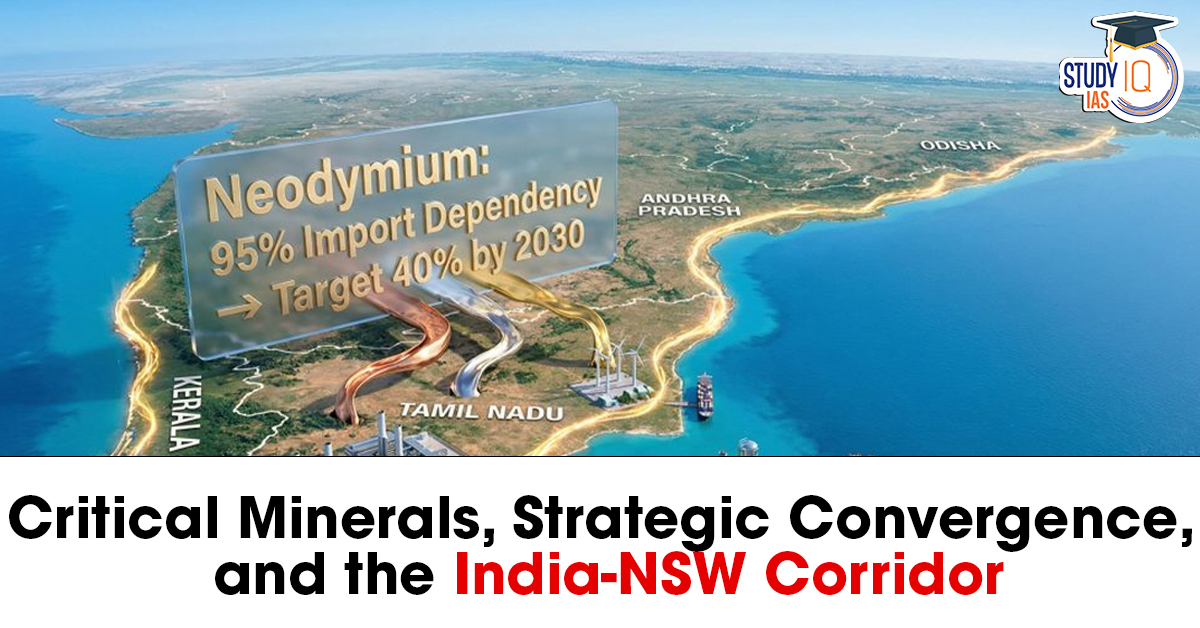
The worldwide shift to clean energy and modern technology has profoundly transformed the geopolitical and economic importance of natural resources. Minerals, including lithium, cobalt, rare earth elements, and other critical resources, have become essential components for electric vehicles, renewable energy systems, and defensive technology. In this changing environment, dominance over the supply chains of these resources is swiftly emerging as a critical aspect of national industrial policy.
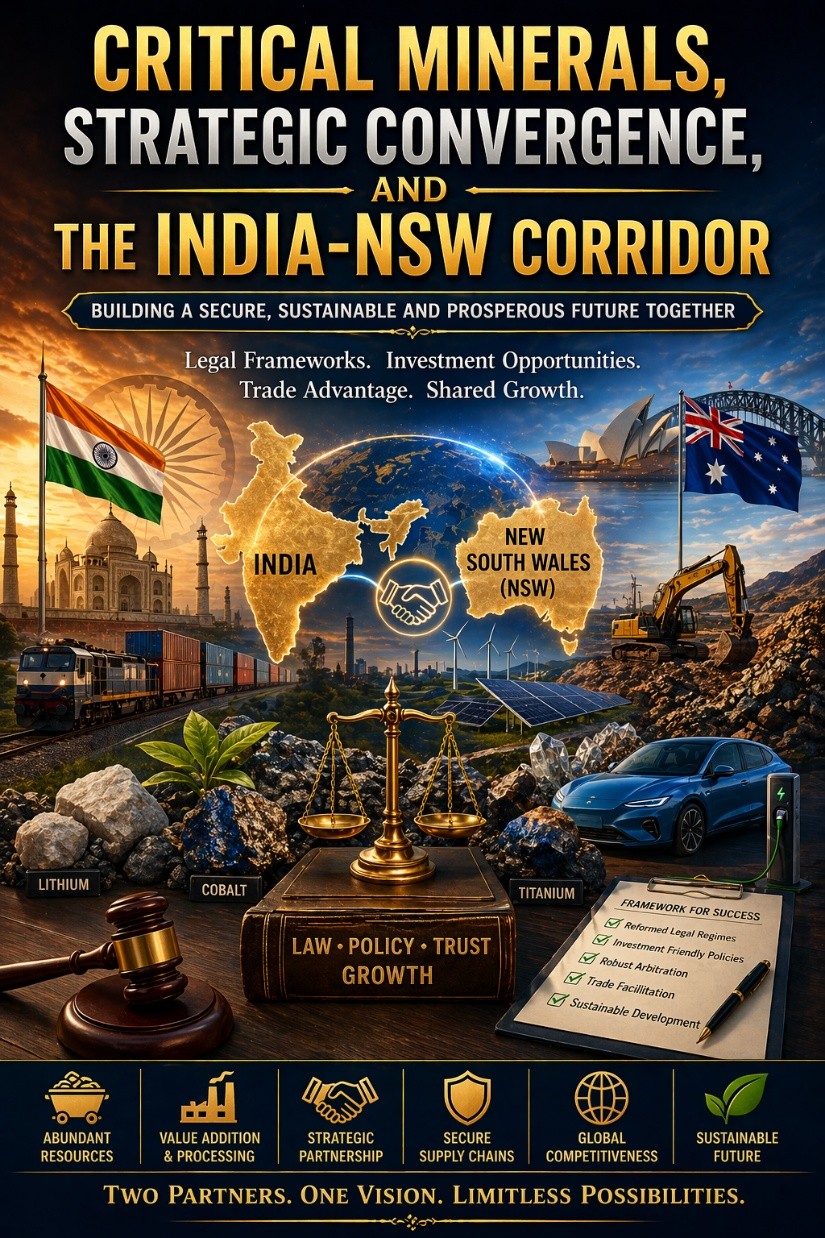
In this context, the developing alliance between India and New South Wales (NSW), a pivotal state in Australia, signifies a strategically important avenue for collaboration in essential minerals. The “India-NSW Corridor“ represents not just a financial prospect but also a meticulously designed legal and policy framework intended to promote enduring partnership throughout the extraction, processing, and manufacturing phases.
The India-New South Wales Corridor: Conceptualisation and Strategic Underpinnings
The India-NSW Corridor exemplifies a convergence of synergistic strengths. India has a swiftly growing industrial sector, a substantial domestic market, and enhanced competencies in manufacturing and technical advancement. New South Wales possesses substantial reserves of essential minerals and has implemented a progressive policy to ascend the value chain by promoting domestic processing.
The Australia-India Economic Cooperation and Trade Agreement (ECTA) further solidify this alliance by eliminating tariffs on essential minerals, reducing them to zero. The agreement removes fiscal barriers, establishing a fluid trading environment that enables the transfer of raw materials and processed commodities between the two jurisdictions.
Nonetheless, the tunnel lacks self-execution. Its success hinges on traversing intricate legal systems, obtaining regulatory permissions, and establishing investment arrangements. The interaction of local legislation, international trade agreements, and arbitration frameworks constitutes the foundation of this bilateral opportunity.
Chronological Development of India’s Mining Industry
The mining sector in India has experienced a substantial transition in recent years. Historically, the sector was marked by significant state regulation, especially with strategic and nuclear minerals. This strategy demonstrated apprehensions regarding national security and resource sovereignty, although it frequently led to inefficiencies and restricted private involvement.
A significant milestone occurred with the implementation of the Mines and Minerals (Development and Regulation) Amendment Act, 2023. This change signified a pivotal transition towards deregulation and private sector involvement. Six essential minerals– lithium, beryllium, titanium, niobium, tantalum, and zirconium- were excluded from the classification of atomic minerals, thus permitting private and foreign investment.
The Central Government adopted a more proactive approach by directly auctioning blocks for 24 specified key minerals. This action circumvented the traditionally sluggish state-level procedures and enhanced transparency and efficiency in resource allocation. The implementation of an Exploration Licence system, granted via competitive bidding, seeks to entice specialised geological corporations and junior mining enterprises.
Investment Liberalisation and Regulatory Framework in India
India’s investment framework in the mining sector has been substantially liberalised to entice global participation. The nation allows 100% foreign direct investment (FDI) through the automatic route for the majority of mining operations, thereby obviating the necessity for previous governmental consent. Nevertheless, limitations persist for investments from adjacent nations, as regulated by Press Note 3.
Another significant reform pertains to the rationalisation of royalties. The Government of India has systematically decreased royalty rates for essential minerals, enhancing the economic viability of investments. Lithium currently incurs a royalty of 3% of the London Metal Exchange price, but rare earth elements are subjected to a considerably lower rate of 1% of the average sale price.
The formation of the National Essential Mineral Mission in 2025 highlights the government’s dedication to cultivating a strong environment for essential minerals. This program facilitates a platform for collaboration between the public and commercial sectors, especially in downstream processing and value enhancement.
Constraints in the Rare Earth Sector
Notwithstanding these improvements, specific parts of the mining sector continue to be stringently regulated. In India, rare earth elements are primarily located in monazite, a mineral linked to radioactive materials like uranium and thorium. These compounds are regulated by the Department of Atomic Energy and are prohibited from private or international extraction.
This regulatory differentiation is essential for investors. The 2023 changes have liberalised access to certain essential minerals; nonetheless, the upstream extraction of rare earth elements continues to be a government monopoly. Nonetheless, prospects are present in downstream processing and refining, where collaborative frameworks are progressively developing.
New South Wales: Legal and Policy Structure
New South Wales functions within a bifurcated regulatory structure. Mining operations are regulated under the Mining Act of 1992, whereas environmental authorisations are managed by the Environmental Planning and Assessment Act of 1979. This dual system guarantees resource use and environmental conservation.
In contrast to India’s centralised auction system, New South Wales has a sequential allocation methodology. Investors must initially acquire an Exploration Licence, subsequently followed by a Mining Lease. The procedure relies on a “first-in-time” or targeted expression-of-interest methodology and incorporates rigorous fit-and-proper-person assessments.
The state has recognised five priority minerals- rare earth elements, scandium, copper, silver, and cobalt- and has enacted laws to promote their extraction and processing. The Central West Critical Minerals Hub is a significant endeavour designed to provide a cohesive ecosystem for mining and processing operations.
Monetary Incentives and Investment Environment in New South Wales
To augment project feasibility, NSW has implemented various financial incentives. The Royalty Deferral Scheme, initiated in July 2025, permits qualifying projects to postpone up to $250 million in royalties over the initial five years of operation. This technique is especially advantageous for early-stage investors, as it mitigates cash flow limitations during the crucial initial phase of project development.
Foreign investors must contend with an extra tier of regulatory oversight at the federal level. The Foreign Acquisitions and Takeovers Act 1975 regulates foreign investments in Australia and is overseen by the Foreign Investment Review Board (FIRB). Investments in essential minerals undergo a rigorous national interest assessment, especially concerning state-owned firms and entities from non-allied countries.
Mandatory FIRB notification is a prerequisite, and prompt cooperation with the regulatory process is crucial. Noncompliance may lead to considerable delays or outright rejection of the investment project.
Trade Framework and the Function of ECTA
The Australia-India Economic Cooperation and Trade Agreement is fundamental to the India–NSW Corridor. The agreement eliminates tariffs on essential minerals, promoting unobstructed trade and improving the economic feasibility of cross-border supply chains.
The agreement incorporates stipulations for dispute settlement via a binding panel procedure for interstate disputes. This approach enhances the institutional framework but does not encompass investor-state disputes, which represent a significant deficiency in the legal structure.
Investor Safeguarding Without a Bilateral Investment Treaty
A significant legal limitation in the India-New South Wales (NSW) vital minerals corridor is the lack of a current Bilateral Investment Treaty (BIT) between India and Australia. The previous treaty, annulled by India on 23 March 2017, nevertheless safeguards only those investments made before its expiration, owing to its 15-year survival clause, which would expire in 2032. As a result, new investments do not have access to investor-state dispute resolution (ISDS), a process historically utilised by foreign investors to obtain redress from host states for treaty infringements.
This absence substantially alters the legal risk framework for investors. In capital-intensive industries like mining and mineral processing- marked by prolonged development timelines, regulatory reliance, and variable global commodity prices- the absence of treaty-based protection subjects investors to increased sovereign and regulatory risks. Decisions on licensing, environmental compliance, taxation, or export controls can significantly impact project viability, and in the absence of ISDS, remedies are confined to domestic courts or contractual arrangements.
India’s developing BIT policy, as seen by its 2016 Model BIT, emphasises state sovereignty and restricts the extent of investor protections. This transition highlights the necessity of creating resilient contractual frameworks to offset the lack of treaty protections. Consequently, the legal framework governing cross-border investments in the India–NSW corridor must be founded on meticulously structured agreements that foresee and alleviate risks stemming from regulatory ambiguity.
Contractual Arbitration as the Principal Risk Mitigation Strategy
Within the existing bilateral framework, international business arbitration serves as the primary method for resolving disputes. Contracts regulating joint ventures, supply chains, and project financing must include meticulously crafted arbitration clauses to guarantee neutrality, enforceability, and procedural efficiency.
Preferred arbitral institutions comprise the Singapore International Arbitration Centre and the Hong Kong International Arbitration Centre. These institutions provide established procedural regulations, seasoned arbitrators, and impartiality- elements essential in conflicts involving state-affiliated entities or politically sensitive industries. Their awards are enforceable in India and Australia pursuant to the New York Convention, guaranteeing cross-border legal certainty.
Judicial precedents have bolstered India’s pro-arbitration position in recent years. In BALCO v. Kaiser Aluminium, the Supreme Court held that Indian courts have limited supervisory authority over foreign-seated arbitral proceedings, thereby bolstering investor confidence. In Bharat Aluminium Company v. Kaiser Aluminium Technical Services Inc., the Court underscored the importance of party autonomy in establishing the seat of arbitration, a fundamental concept for international treaties.
Additionally, in Vijay Karia v. Prysmian Cavi, the Court embraced a restrictive interpretation of public policy exceptions under the New York Convention, thus promoting the execution of international arbitral verdicts. These trends indicate judicial conformity with international arbitration standards and strengthen arbitration as a credible alternative to treaty-based rights.
Regulatory and Compliance Obstacles Across Jurisdictions
The India-NSW corridor entails a multifaceted regulatory framework necessitating rigorous adherence to many legal systems. In India, notwithstanding liberalisation, mining operations are still governed by multiple approvals, including environmental clearances, land acquisition regulations, and adherence to the Mines and Minerals (Development and Regulation) Act. Moreover, regulations concerning rare earth elements linked to monazite- due to their association with uranium and thorium- require meticulous legal organization of projects to circumvent forbidden upstream activities.
The regulatory system in NSW is equally stringent. The Mining Act 1992 regulates mineral rights, whilst environmental approvals are governed by the Environmental Planning and Assessment Act 1979. Investors must traverse a progressive licensing framework, commencing with exploration licenses and concluding with mining leases, all contingent upon “fit and proper person” standards.
At the federal level in Australia, the Foreign Investment Review Board (FIRB) assumes a pivotal function. Investments in important minerals undergo a rigorous national interest assessment, especially with state-owned firms or entities from regions regarded as strategic rivals. FIRB approval is not only a procedural matter; it constitutes a significant evaluation of national security ramifications. Timely interaction with FIRB and clear organisation of ownership and control are so necessary.
Trade Facilitation Pursuant to the Economic Cooperation and Trade Agreement (ECTA)
The Australia-India Economic Cooperation and Trade Agreement establishes a strong business basis for the corridor. By abolishing tariffs on essential minerals such as titanium, zirconium, cobalt, and copper ores, ECTA improves cost efficiency and competitiveness throughout the supply chain. This tariff liberalisation facilitates strategic arbitrage between extraction in New South Wales and processing or manufacturing in India.
Chapter 13 of ECTA establishes a state-to-state dispute resolution framework, guaranteeing that trade disagreements between the two countries are resolved through formal adjudicatory procedures. This system, although not applicable to private investors, enhances overall stability in bilateral economic relations.
The pact also corresponds with wider geopolitical aims, such as diversifying supply chains from concentrated sources and enhancing economic cooperation in the Indo-Pacific region. The India–NSW corridor is not only a bilateral undertaking but also a component of a broader strategic realignment in global resource control.
Socio-Economic and Strategic Implications of the Corridor
The establishment of the India-NSW critical minerals corridor has substantial socio-economic ramifications. India’s access to dependable supplies of lithium, cobalt, and rare earth elements is crucial for meeting its renewable energy objectives and enhancing its electric vehicle infrastructure. Domestic processing capabilities, bolstered by initiatives like the National Critical Mineral Mission, can create jobs, stimulate technological innovation, and diminish import reliance.
For New South Wales, the corridor signifies a potential to shift from a resource-export economy to a value-added processing centre. Government incentives, such as the Royalty Deferral Scheme, aim to stimulate investment in downstream processing, thereby promoting local economic development and industrial diversification.
The corridor advances global environmental objectives by facilitating the shift to clean energy technology. Nonetheless, it also elicits apprehensions regarding environmental consequences, indigenous land entitlements, and fair allocation of economic advantages. These concerns require a balanced regulatory framework that harmonises economic development with social and environmental protections.
Conclusion
The India-NSW vital minerals corridor signifies a fusion of strategic interests, economic potential, and legal advancement. The commercial potential is significant, but its realisation relies on an intricate understanding of the legal frameworks that regulate investment, commerce, and dispute resolution.
The lack of treaty-based protections requires a transition to precise contracts and arbitration-focused risk management. The regulatory intricacies in both jurisdictions necessitate meticulous navigation, while judicial institutions are essential for upholding legal certainty and equity.
Ultimately, the corridor demonstrates the dynamic character of global economic alliances in the twenty-first century, where legal frameworks are as significant as natural resources. The success of this endeavour will rely not only on resource availability but also on stakeholders’ capacity to utilise the law as a facilitating tool for sustainable and equitable development.

 Supreme Court Dowry Enforcement Order 20...
 Supreme Court Modifies 3-Year Practice R...
 Doctrine of Per Incuriam Explained: Supr...








 WhatsApp





