
Table of Contents
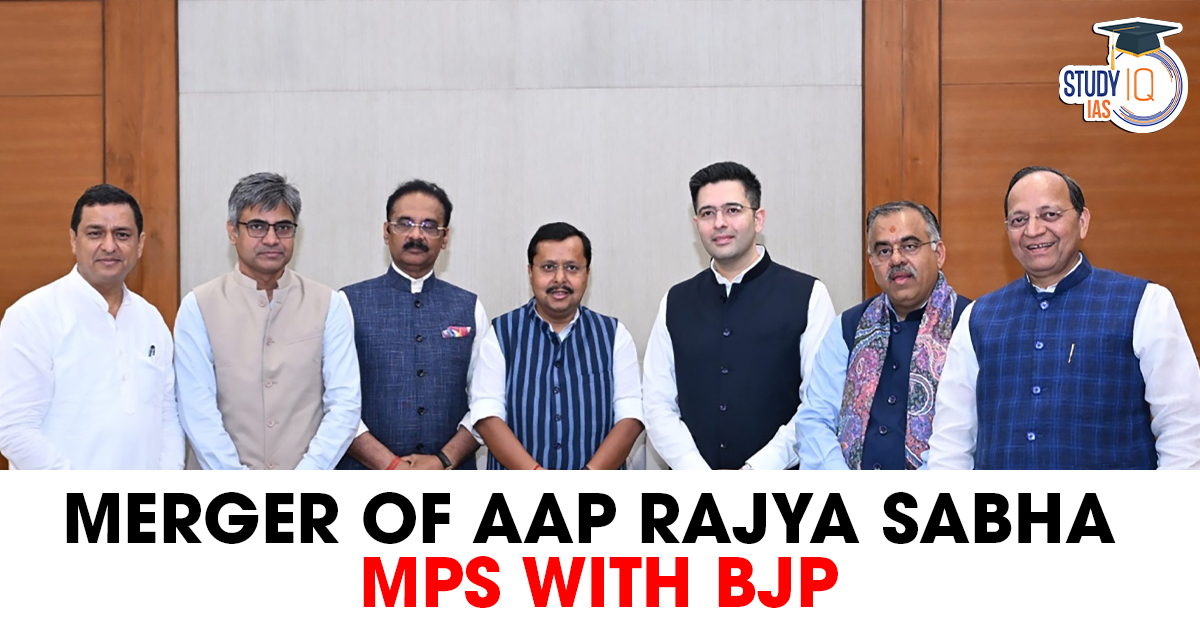
Context: The Chairman of the Rajya Sabha accepted the merger of seven Members of Parliament (MPs) from the Aam Aadmi Party with the Bharatiya Janata Party. The development has triggered political and constitutional debate regarding the Anti-Defection Law.
Issue
- Seven Rajya Sabha MPs from AAP were recognised as merged with the BJP.
- The Chairman accepted their claim under provisions related to merger in the Tenth Schedule of the Constitution.
- AAP’s representation in the Rajya Sabha reduced sharply from 10 MPs to 3 MPs.
- This weakens the party’s influence in parliamentary discussions and legislative processes.
Constitutional and Legal Basis of Merger of AAP Rajya Sabha MPs with BJP
Tenth Schedule and Anti-Defection Law
- The Tenth Schedule deals with the disqualification of legislators who defect from their parties.
- It was added through the 52nd Constitutional Amendment Act, 1985, to prevent political defections.
- A merger is considered valid if at least two-thirds of members of a legislative party agree to join another party.
- Such members are protected from disqualification under the Anti-Defection Law.
Key Features of the Tenth Schedule
- Definitions: Clarifies terms such as “legislature party” and “original political party.”
- Grounds for Disqualification: Applies when a member voluntarily leaves their party or violates the party whip without permission.
- Independent Members: Disqualified if they join a political party after the election.
- Merger Clause: Protects members from disqualification if at least two-thirds of the legislative party agrees to merge with another party.
- Exemptions: Presiding officers (Speaker/Chairman) can resign from their party and rejoin later.
- Decision Authority: The Speaker or Chairman decides on disqualification.
- Judicial Review: Courts can review decisions after they are made.
- Rule-Making Power: The presiding officer can frame procedural rules.
When Does Disqualification Apply?
Leads to Disqualification:
- Leaving one’s party and joining another
- Voting against the party whip without approval
- Independent members joining a party post-election
- Nominated members joining a party after six months
Protected Situations:
- Mergers backed by at least two-thirds of members
- Speaker resigning from party for neutrality
- Voting against the whip if condoned within 15 days
- Elections where party whips are not applicable (e.g., Presidential polls)
Penalty for Defection:
- A disqualified member loses their seat for the remainder of the term and is barred from holding ministerial or remunerative political positions until re-elected.

 Skyroot Vikram-1 Mission Aagaman: India'...
 Oor Pare Prehistoric Site: Location, Roc...
 Assam Election 2026: Exit Poll, Result D...













 WhatsApp





