
Table of Contents
What is the Government of India Act 1935?
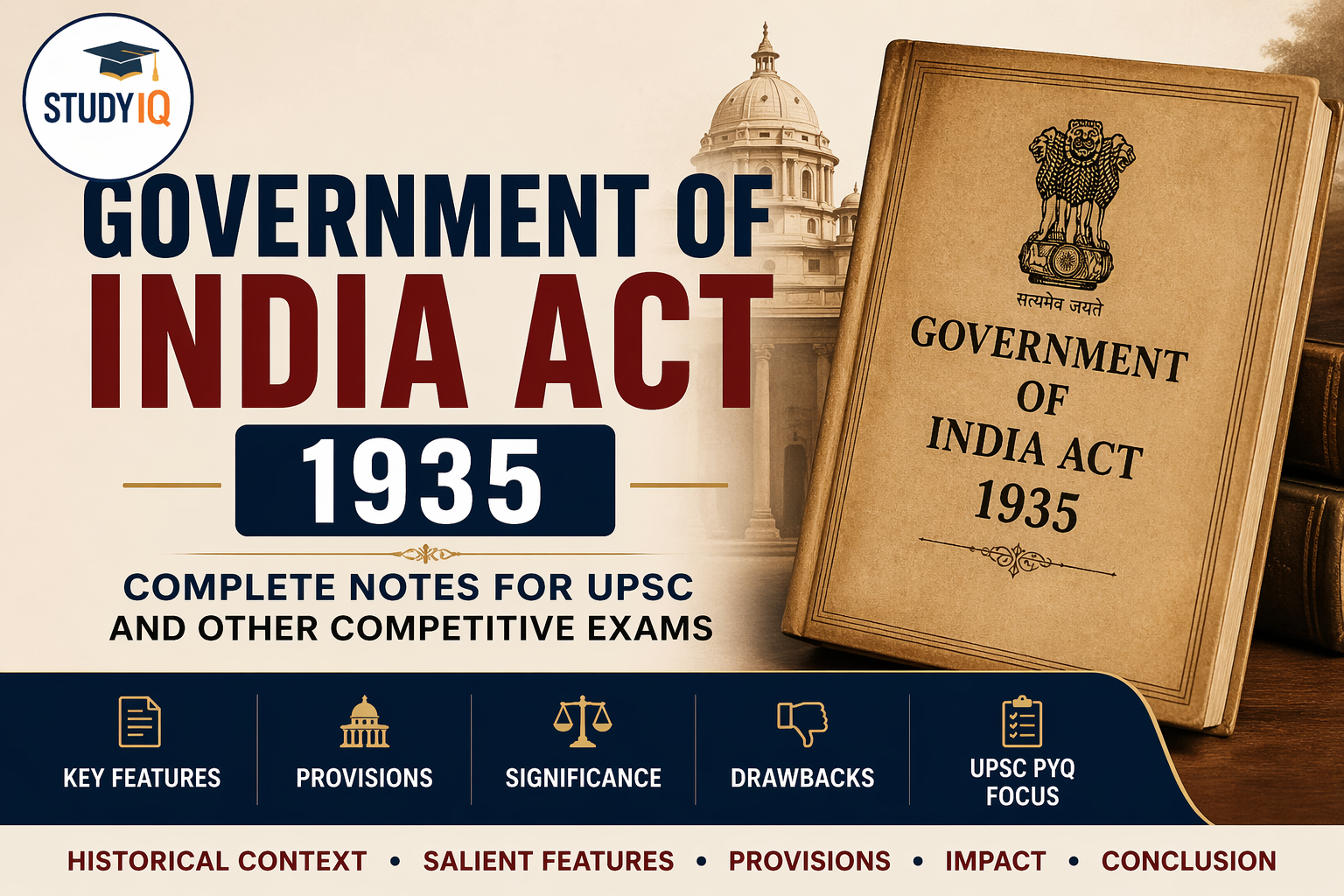
The Government of India Act, 1935 was the most comprehensive and lengthy piece of legislation ever enacted by the British Parliament for India. Consisting of 321 sections and 10 schedules, it replaced the Government of India Act 1919 and served as the constitutional framework for British India right up to Independence in 1947.
This Act is one of the most important topics for UPSC, State PCS, SSC CGL, and all other competitive examinations because a large portion of the Indian Constitution of 1950 is directly borrowed from its provisions. Understanding this Act thoroughly is non-negotiable for anyone serious about cracking competitive exams.
Historical Background: Why Was the Government of India Act 1935 Needed?
The Government of India Act 1919, which had introduced the concept of “dyarchy” at the provincial level, proved highly unsatisfactory. Growing nationalist sentiment, the Non-Cooperation Movement, and widespread civil unrest made it clear that a new constitutional arrangement was necessary. The following chain of events led to the enactment of the 1935 Act:
Simon Commission (1927): A statutory commission was appointed to review the working of the 1919 Act. Since no Indian member was included, the Indian National Congress boycotted it under the slogan “Go Back Simon.”
Nehru Report (1928): The All-Parties Conference drafted the Nehru Report, demanding Dominion Status for India — the first major constitutional blueprint prepared entirely by Indians.
Irwin Declaration (1929): Lord Irwin declared that Dominion Status was the goal of British policy in India, though without any fixed timeline.
Round Table Conferences (1930–1932): Three Round Table Conferences were held in London to discuss India’s constitutional future. These laid the groundwork for the eventual legislation.
Communal Award (1932): Prime Minister Ramsay MacDonald announced the Communal Award, providing separate electorates for minorities. The Poona Pact (1932) between Dr. B.R. Ambedkar and Mahatma Gandhi modified it specifically for the depressed classes.
White Paper (1933): The British Government published a White Paper containing constitutional proposals, which was then refined by a Joint Select Committee of Parliament.
Royal Assent (August 2, 1935): The Government of India Act received Royal Assent on August 2, 1935. It was simultaneously split into two separate Acts — the Government of India Act 1935 and the Government of Burma Act 1935.
Key Features of the Government of India Act 1935
1. All-India Federation
The Act proposed an All-India Federation comprising 11 British Indian Provinces, 6 Chief Commissioners’ Provinces, and the willing Princely States. This was a pioneering constitutional experiment — the first time a formal federation of British India and the Indian Princely States was envisaged.
Important: The Federal Part of the Act never came into operation because the required number of Princely States (50% of all states representing 50% of the total population of all states) never acceded to the federation.
2. Provincial Autonomy
This is the most significant aspect of the Act that was actually enforced. From April 1, 1937, provinces were no longer subordinate agents of the central government. The dyarchical system introduced by the 1919 Act was abolished at the provincial level, and all provincial subjects were transferred to elected popular ministers.
3. Dyarchy Introduced at the Centre
While dyarchy was abolished in the provinces, the Act introduced it at the Central level, dividing central subjects into:
- Reserved subjects — under the direct control of the Governor-General
- Transferred subjects — under the control of ministers responsible to the federal legislature
This provision also never came into operation since the federal structure itself was never established.
4. Bicameral Federal Legislature
The Act established a bicameral legislature at the Centre, consisting of:
- Council of State (Upper House) — 260 members
- Federal Assembly (Lower House) — 375 members
5. Federal Court of India
The Act established the Federal Court of India, which came into existence on October 1, 1937, with a Chief Justice and not more than six other judges. It served as the highest court of the land and was the direct predecessor of the Supreme Court of India (established in 1950).
6. Three Legislative Lists
The Act introduced a formal, three-tier division of legislative powers — a framework directly adopted by the Indian Constitution:
| List | Number of Subjects | Jurisdiction |
|---|---|---|
| Federal List | 59 subjects | Federal Legislature exclusively |
| Provincial List | 54 subjects | Provincial Legislature exclusively |
| Concurrent List | 36 subjects | Both; Federal law prevails in conflict |
| Residuary Powers | — | Governor-General’s discretion |
7. Abolition of the Council of India
The Act abolished the Council of India, which had been advising the Secretary of State for India since 1858. It was replaced by a body of advisors, reducing the formal check on the Secretary of State’s power.
8. Separation of Burma
Burma was formally separated from British India and made a separate colony under the Government of Burma Act 1935, operative from April 1, 1937.
9. New Provinces Created
- Sind was separated from the Bombay Presidency and made an independent province.
- Orissa was carved out of Bihar and made a new province (effective April 1, 1936).
- North-West Frontier Province (NWFP) was granted full Governor’s Province status.
10. Emergency Provisions
The Governor-General was empowered to declare an emergency and take direct control of provincial administration, suspending the provincial constitution. This framework was directly borrowed by the Indian Constitution under Articles 352, 356, and 360.
11. Extension of Communal Representation
The system of separate electorates was extended to cover depressed classes (Scheduled Castes), women, and labour groups in addition to the religious minorities already covered.
12. Reserve Bank of India
The Act reinforced the statutory framework for the Reserve Bank of India, separating it from direct government control and establishing it as India’s central monetary authority. The RBI had been formally established on April 1, 1935, under the Reserve Bank of India Act 1934.
13. Federal and Provincial Public Service Commissions
The Act provided for the establishment of a Federal Public Service Commission for the Centre and Provincial Public Service Commissions for each province, along with Joint Public Service Commissions for groups of provinces. These are the direct predecessors of today’s UPSC and State PSCs.
14. Expanded Franchise
The electorate was expanded from approximately 7 million voters under the 1919 Act to about 35 million voters — roughly 14% of the total population of India at the time.
Provincial Autonomy Under the Government of India Act 1935
Provincial autonomy was the only part of the 1935 Act that was actually enforced, from April 1, 1937. Its key features were:
- Provincial governments now operated independently of central control in their designated sphere of subjects.
- A Council of Ministers responsible to the provincial legislature was formed, with the Governor bound to act on their advice in ordinary circumstances.
- Six provinces — Bombay, Bengal, Madras, Bihar, Assam, and the United Provinces — received bicameral legislatures (an upper and a lower house).
- General elections were held in 1937 under the new Act. The Indian National Congress won majorities in 7 of 11 provinces and formed governments in those provinces.
- This experience of governance proved invaluable to Indian leaders when they later took charge of an independent India and drafted its Constitution.
Federal Structure: Why It Never Worked
The proposed All-India Federation under the 1935 Act required the accession of a sufficient number of Princely States to trigger implementation. The Princely States, wary of losing their autonomy and fearing domination by a democratically elected legislature, refused to join in adequate numbers. As a result, the entire federal part of the Act — including the bicameral federal legislature and dyarchy at the Centre — remained a dead letter.
This is one of the most frequently tested facts in competitive examinations: the federal part of the GoI Act 1935 never came into operation.
Special Powers of the Governor-General and Governors
One of the most controversial aspects of the Act was the extensive discretionary powers retained by the Viceroy (Governor-General) and Governors. These included:
Special Responsibilities: Governors-General and Governors could act on their own discretion in matters relating to the prevention of grave menace to peace and tranquility, protection of minorities, safeguarding the legitimate interests of minorities, and securing certain government revenues.
Certification of Bills: They could certify and pass any bill as law even if it was rejected by the legislature.
Reserving Bills: Governors could reserve any provincial bill for the consideration of the Governor-General.
Emergency Powers: The Governor-General could declare an emergency, suspend the provincial constitution, and assume direct control of the province.
Defence and External Affairs: These subjects were entirely outside the purview of the Federal Legislature and remained exclusively with the Governor-General.
Criticism of the Government of India Act 1935
The Act was widely criticised by Indian political leaders across the spectrum:
Jawaharlal Nehru famously described it as “a machine with all brakes and no engine.” He pointed out that while it gave the appearance of self-governance, real power remained firmly in British hands.
Muhammad Ali Jinnah called the Act “thoroughly rotten, fundamentally bad and totally unacceptable,” objecting particularly to the communal provisions and the concentration of power in the Governor-General’s hands.
Indian National Congress rejected the Act as falling far short of the demand for complete Swaraj (self-rule). Congress accepted office in 1937 only after the British assured them that Governors would not ordinarily use their special powers.
The main criticisms of the Act are summarised below:
- The federal structure was never implemented, rendering a major portion of the Act meaningless.
- The Governor-General and Governors retained excessive discretionary and emergency powers.
- Defence and external affairs — the most important portfolios — were kept entirely outside the control of Indian legislators.
- No provision was made for a responsible government at the Centre.
- The continuation and extension of communal separate electorates deepened religious and social divisions.
- No fundamental rights were guaranteed to citizens.
- The Act was described as “responsible government without responsibility” because ministers could be overruled at any time by the Governor.
Legacy and Influence on the Indian Constitution
Despite its many criticisms, the Government of India Act 1935 is by far the most important source document of the Indian Constitution. The Constituent Assembly debated and borrowed extensively from its provisions:
| Provision from GoI Act 1935 | Corresponding Provision in Indian Constitution |
|---|---|
| Federal Scheme (Centre-State relations) | Part XI — Relations between Union and States |
| Three Legislative Lists | Seventh Schedule — Union, State, and Concurrent Lists |
| Emergency Powers of Governor-General | Articles 352, 356, 360 — National, State, and Financial Emergency |
| Federal Court of India | Supreme Court of India (Articles 124–147) |
| Federal Public Service Commission | Union Public Service Commission (Articles 315–323) |
| Provincial Governors | Governors of States (Articles 153–167) |
| Provisions for Finance and Audit | Comptroller and Auditor General (Articles 148–151) |
| High Courts retained and reorganised | High Courts in India (Articles 214–231) |
| Administrative structure of provinces | Structure of State Governments in the Constitution |
Comparison with Previous Acts
| Feature | GoI Act 1858 | GoI Act 1919 | GoI Act 1935 |
|---|---|---|---|
| Governance System | Crown Rule via Secretary of State | Dyarchy at Province | Autonomy at Province; Dyarchy at Centre (never enforced) |
| Legislative Lists | None | None | Three formal lists introduced |
| Federal Structure | None | None | Proposed (never implemented) |
| Electorate | No elections | ~7 million voters | ~35 million voters |
| Apex Court | High Courts (from 1861) | High Courts continued | Federal Court established (1937) |
| Public Service Commission | None | None | Established formally |
| Burma | Part of India | Part of India | Separated (1937) |
| India Council | Created | Continued | Abolished |
10 Most Important One-Liners for Competitive Exams
- The Government of India Act 1935 had 321 sections and 10 schedules — the longest British legislation for India.
- The Act received Royal Assent on August 2, 1935.
- The Federal Part never came into operation because Princely States refused to accede.
- Provincial Autonomy came into effect on April 1, 1937.
- The Act introduced three legislative lists — Federal (59), Provincial (54), and Concurrent (36).
- The Federal Court of India was established on October 1, 1937 and replaced by the Supreme Court in 1950.
- Burma was separated from India under the Government of Burma Act 1935 from April 1, 1937.
- The electorate expanded from 7 million (1919) to 35 million (1935).
- Jawaharlal Nehru called it “a machine with all brakes and no engine.”
- The Government of India Act 1935 is the single largest source of the Indian Constitution of 1950.
Conclusion
The Government of India Act 1935 was a landmark — and deeply paradoxical — piece of legislation. On one hand, it was the most detailed and elaborate constitutional framework ever designed for British India, introducing provincial autonomy, the three legislative lists, the Federal Court, and the Federal Public Service Commission. On the other hand, it retained enormous power in British hands through the Governor-General’s sweeping discretionary and emergency powers, and its most ambitious provision — the All-India Federation — never saw the light of day.
For UPSC and other competitive exam aspirants, this Act deserves thorough and repeated revision. It bridges the gap between colonial constitutional history and the Indian Constitution of 1950, and questions on it appear consistently across Prelims, Mains, and State-level examinations. Master this Act, and you have mastered a significant portion of the Polity and Modern History syllabus.
Read Other Acts: Evolution of the Constitution
 Chief Election Commissioner Removal 2026...
 Fundamental Duties of Indian Constitutio...
 Anti-Defection Law: Origin, Provisions o...














 WhatsApp





