Table of Contents
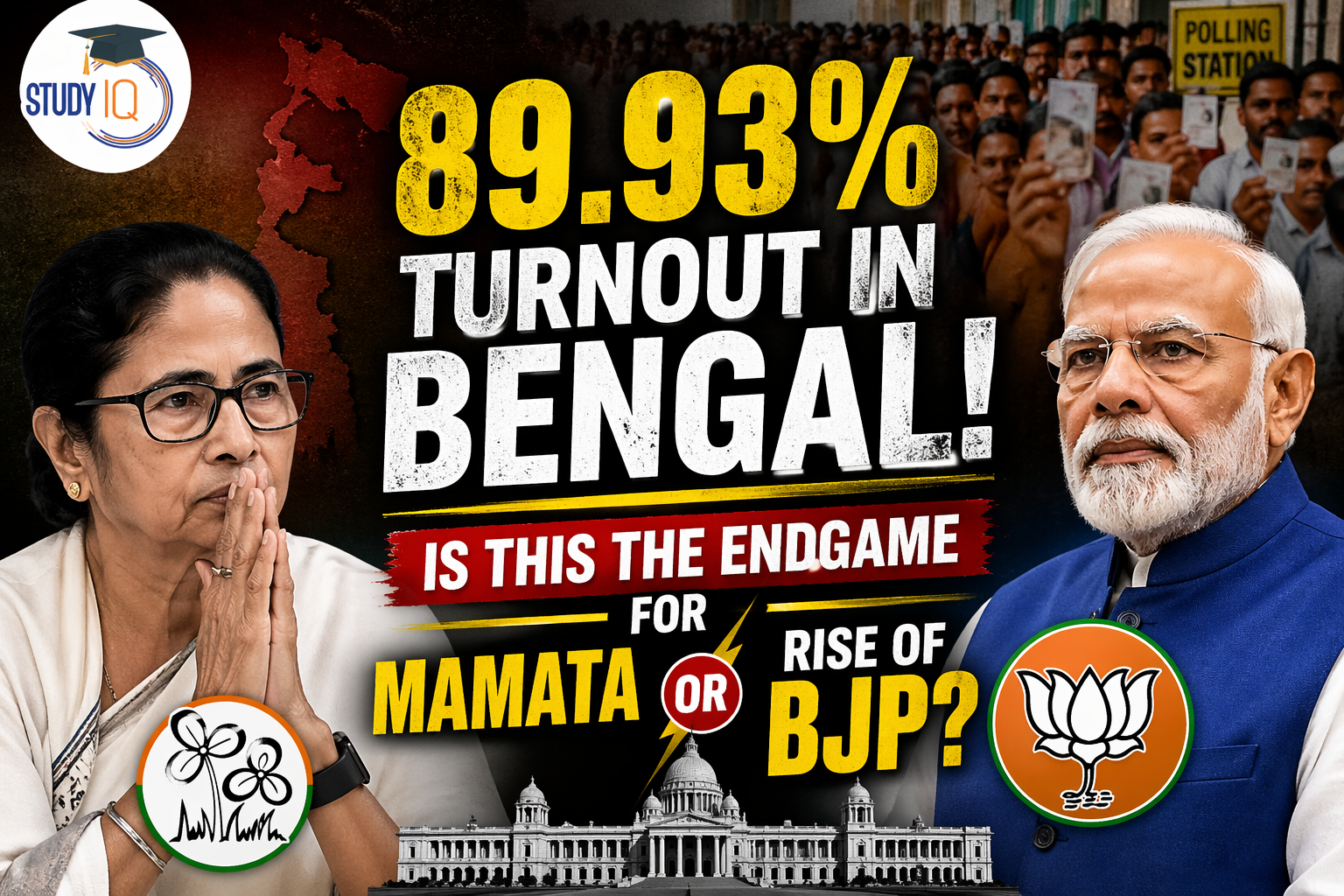
The first phase of the West Bengal Legislative Assembly Election 2026 has delivered a stunning political signal, a massive 89.93% turnout (till 5 PM), one of the highest in recent electoral history. As voting unfolded across 152 constituencies, the scale of participation has raised a critical question: Is West Bengal witnessing a political shift or reinforcing the status quo?
Record 89.93% turnout sets the Tone
Polling began at 7 AM and continued till 6 PM under tight security arrangements. With over 6.8 crore eligible voters and nearly 7 lakh new voters added, the enthusiasm on the ground translated into a near-90% turnout.
- Voter turnout: ~89.93% turnout (till 5 PM) → exceptionally high
- Polling time: 7 AM – 6 PM
- Phase 1 coverage: ~152 constituencies (out of 294)
- Electorate: ~6.8 crore voters
- New voters added: ~7 lakh
Such high participation is often interpreted as:
- Strong political mobilization
- Possible anti-incumbency wave
- Heightened polarization among voters
However, the final verdict remains uncertain until counting on May 4.
Mamata Banerjee vs BJP: A Defining Contest
At the center of this high-voltage election is:
- Mamata Banerjee — seeking a fourth consecutive term
- Suvendu Adhikari — leading BJP’s aggressive expansion bid
The campaign has seen intense involvement from national figures like Narendra Modi and Amit Shah, turning the election into a prestige battle with national implications.
Narrative Clash: Welfare vs Change
The election campaign has revolved around two competing narratives:
TMC’s Pitch
- Welfare schemes (e.g., Lakshmir Bhandar)
- Bengali identity and cultural pride
BJP’s Strategy
- Governance change and anti-incumbency
- Employment generation
- Illegal infiltration and border security
This ideological divide has sharpened voter choices across regions.
Violence, EVM Glitches & Allegations
Despite extensive deployment of security forces, the day was not without disruptions:
- Reports of clashes and political violence in districts like Murshidabad and Purulia
- Allegations of voter intimidation
- EVM malfunctions at multiple polling booths
- Attacks on candidates and party workers
The Election Commission had deployed:
- Central forces
- Flying squads and surveillance teams
- CCTV coverage at polling stations
Yet, opposition parties raised concerns over fairness and neutrality in the process.
Electoral Roll Controversy: A Key Flashpoint
A major political debate has centered around the Special Intensive Revision (SIR) of voter lists:
- Allegations of 58 lakh names being removed
- Lack of transparency in newly added voters
This issue has fueled claims of voter suppression vs electoral cleansing, adding another layer of complexity to the election.
Wealth Factor in Elections
Data from candidate affidavits shows a high concentration of wealth among contestants, particularly from the ruling party. This again highlights the growing role of money power in Indian elections, a recurring concern flagged by electoral watchdogs.
Key Battlegrounds to Watch
Certain regions are expected to play a decisive role:
- Murshidabad – Multi-cornered contest (TMC, BJP, Congress, Left)
- Bankura – Neck-to-neck fight
- Purulia – Swing region
- East Midnapore – High-profile leadership battle
These constituencies could significantly influence the overall outcome.
What Happens Next?
- Phase 2 Voting: April 29, 2026
- Counting of Votes: May 4, 2026
The results will determine whether:
- Mamata Banerjee secures another term
OR - BJP achieves a historic breakthrough in Bengal
Big Picture: What Does 89.93% Turnout Really Mean?
While high turnout is often seen as a sign of democratic strength, it does not automatically indicate a change in power. Instead, it reflects:
- High political awareness
- Strong voter mobilization
- Deep electoral polarization
The real answer will only emerge when votes are counted.
 Species in News: Cheetah | Project Cheet...
 Quantum Computing: RRI Scientists Demons...
 Artificial Intelligence in Warfare: How ...












 WhatsApp