
Table of Contents
Context: Increasing use of unilateral sanctions by the United States is impacting India’s economy through higher energy costs, disrupted trade and supply chains.
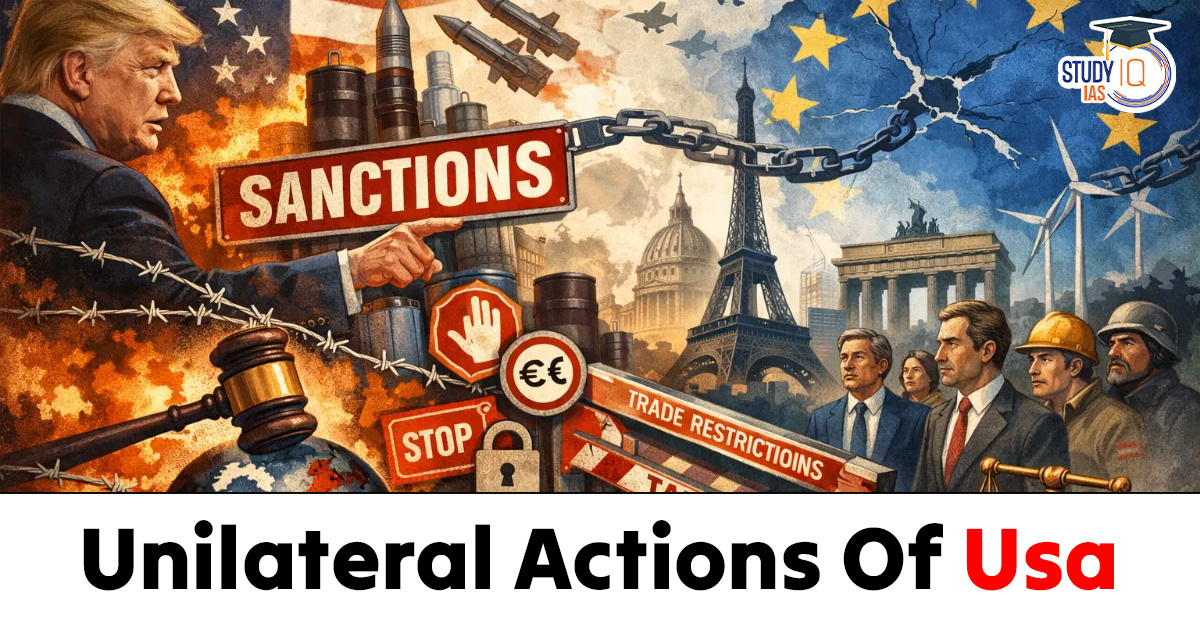
Unilateral Sanctions of USA
- Sanctions on Energy Trade: The U.S. imposed secondary sanctions targeting countries importing oil from Iran, Russia and Venezuela.
- Penalty Tariffs and Economic Coercion: The U.S. imposed additional tariffs and penalties (e.g. 25% penalty linked to Russian oil trade) to pressure India into compliance with its geopolitical objectives.
- Impact: India reduced Russian oil imports (from ~2 million bpd to ~1 million bpd temporarily, showing partial compliance.
- Sanctions on Strategic Projects: Threats of sanctions on projects like Chabahar Port and INSTC have constrained India’s connectivity and regional outreach.
- Impact: Progress on projects like Chabahar Port and INSTC slowed due to fear of sanctions and policy uncertainty.
- Financial & Currency Pressure: The U.S. has warned of sanctions on countries adopting non-dollar payment systems (e.g. BRICS arrangements), reinforcing global financial dominance.
- Defence-Related Sanctions (CAATSA): Under CAATSA, the U.S. threatened sanctions on countries purchasing defence equipment from Russia (e.g. India’s S-400 deal).
- Policy Uncertainty (Waivers & Reversals): Frequent use of waivers and sudden policy changes creates instability in global markets and uncertainty for countries like India.
- Impact: resuming imports from Venezuela only when temporary waivers were granted.
Cost of Compliance vs Benefits of Non-Compliance
| Dimension | Cost of Compliance vs Benefit of Non-Compliance |
| Energy Security | Compliance forced India to stop importing cheaper Iranian/Venezuelan oil, increasing dependence on volatile markets, whereas non-compliance (as seen in Russian oil imports 2022–25) ensured access to discounted crude, saving billions and stabilising supply. |
| Economic Impact | Compliance led to higher energy bills, inflation, export decline (~7%) and currency pressure, while non-compliance would reduce costs, improve fiscal stability and protect growth prospects. |
| Strategic Connectivity | Compliance slowed projects like Chabahar Port and INSTC, increasing reliance on risky routes like the Strait of Hormuz, whereas non-compliance would enable alternative corridors, reducing geopolitical vulnerability. |
| Foreign Policy Autonomy | Compliance constrained India’s decision-making and aligned it with U.S. interests, while non-compliance (e.g. S-400 deal despite CAATSA) strengthened strategic autonomy without necessarily triggering penalties. |
| Global Positioning | Compliance indirectly supports unilateralism and weakens the multilateral order, whereas non-compliance allows India to emerge as a leader of the Global South resisting coercive economic measures. |
| Long-term Energy Strategy | Compliance disrupted diversification of energy sources and reserve-building, whereas non-compliance would enable stockpiling of cheaper oil and long-term energy resilience (as seen in China’s strategy to increase strategic oil reserve despite sanctions). |
India’s experience shows that while compliance ensures short-term diplomatic balance, it imposes high economic and strategic costs, whereas calibrated non-compliance can enhance energy security, autonomy and global leadership.

 War Powers Act: Origin, Purpose, Provisi...
 China–Pakistan Space Cooperation: Proj...
 Strait of Hormuz Crisis: Causes, History...














 WhatsApp





