
Table of Contents
Context: The International Air Transport Association (IATA) has emphasised that India must prioritise biofuels for aviation, as sectors like road transport have alternatives (e.g. electrification), while aviation does not.
About Sustainable Aviation Fuel (SAF)
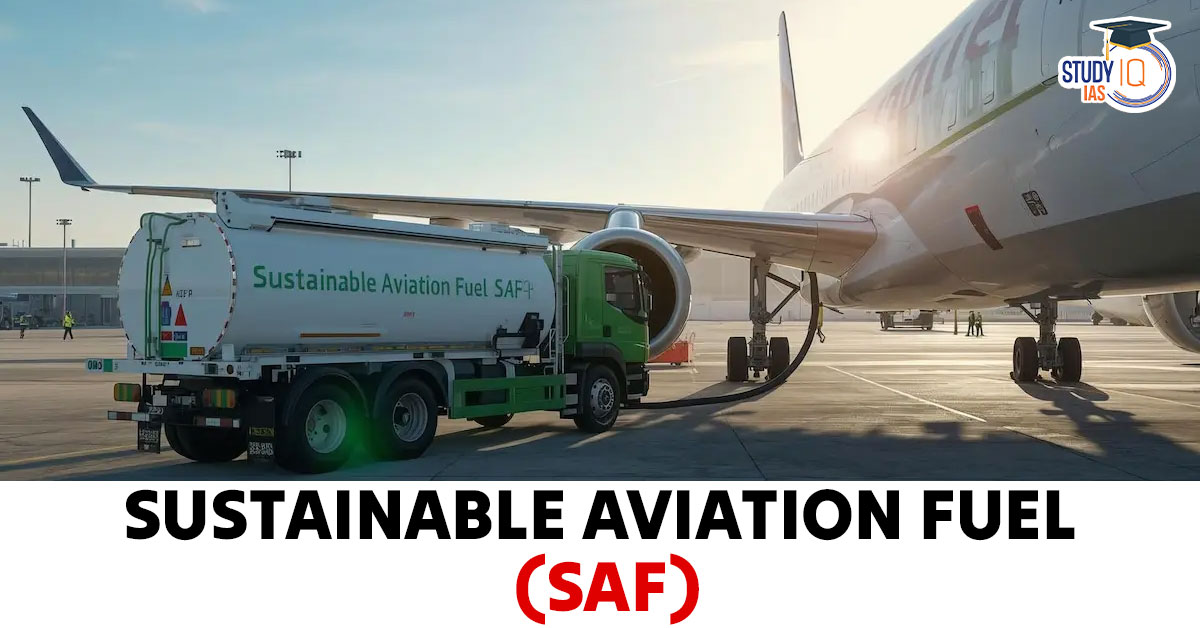
- Definition: Sustainable Aviation Fuel (SAF) is a low-carbon aviation fuel made from sustainable sources (waste, biomass, CO₂) that reduces emissions.
- Drop-in Fuel: SAF has similar chemical properties to conventional jet fuel and can be used in existing aircraft without modification.
- Eg. blended with conventional jet fuel up to 50% today
- Feedstock Sources: Derived from waste oils, crop residue, municipal waste, algae, and industrial CO₂.
- Different from Traditional Biofuel: SAF avoids first-generation biofuels derived from food crops (corn, sugarcane) to prevent food security issues and environmental stress.
Types of SAF
- Waste Oils & Fats: Made from used cooking oil and animal fats, currently the most common feedstock.
- Municipal Solid Waste (MSW): Produced from household and commercial waste, reducing landfill and pollution.
- Cellulosic Biomass: Derived from agricultural and forestry residues using chemical conversion processes.
- Energy Crops (Non-food): Crops like camelina and jatropha are grown on non-arable land, avoiding food competition.
- Algae-based SAF: Uses fast-growing algae with high oil yield, promising but still developing.
- Power-to-Liquid (PtL): Made from captured CO₂ and green hydrogen, offering a long-term sustainable supply.
- Halophytes: Use of Salt-tolerant plants grown in saline areas, requiring minimal freshwater.
- Alcohol-to-Jet (AtJ): Converts ethanol into jet fuel, important for ethanol-rich economies like India.
Benefits of Sustainable Aviation Fuel (SAF)
- Emission Reduction: SAF can reduce lifecycle emissions by ~70–80% (up to 100% potential), making it crucial for achieving net-zero aviation targets.
- Waste Utilisation: SAF converts waste materials into fuel, reducing landfill burden and environmental pollution (e.g. municipal solid waste → jet fuel).
- Energy Security: SAF reduces dependence on imported crude oil and promotes domestic fuel production using local resources.
- Economic Benefits: SAF supports rural economies and job creation (~14 million jobs globally) by creating value chains for agricultural residue and biomass (e.g. farmers supplying crop waste).
- Infrastructure Compatibility: As a drop-in fuel, SAF enables faster transition without requiring new aircraft or fuel systems.
Key Challenges
- High Cost: SAF is currently 3–5 times more expensive than conventional jet fuel, increasing airline operational costs and potentially airfares.
- Feedstock Allocation: Limited feedstock, like ethanol, must be prioritised, as competing sectors (road transport) can divert resources despite aviation having fewer alternatives.
- Supply Constraints: Scaling up production requires large volumes of sustainable feedstock and low-carbon energy sources.
- Policy & Regulatory Gaps: Lack of strong incentives, mandates and clear frameworks slows adoption and industry scaling.
- Technological Limitations: Advanced production pathways (e.g. algae, power-to-liquid) are still developing and not yet commercially viable at scale.
| SAF Roadmap of India |
|

 Ramsar Sites in India 2026 List: Names, ...
 Skyroot Vikram-1 Mission Aagaman: India'...
 Oor Pare Prehistoric Site: Location, Roc...














 WhatsApp





