Table of Contents
Context: Sri Lanka’s Tamil parties have urged India to ensure full implementation of the Indo–Sri Lanka Accord (1987), stating that its spirit remains unfulfilled even today.
More about the News:
- Tamil leaders argue that, despite decades, meaningful power-sharing has not been realised, with key provisions like land and police powers still not devolved.
- The issue remains sensitive due to Sinhala-majoritarian opposition and concerns over sovereignty, while Tamil groups demand a federal-style arrangement within a united Sri Lanka.
About the Indo–Sri Lanka Accord (1987)
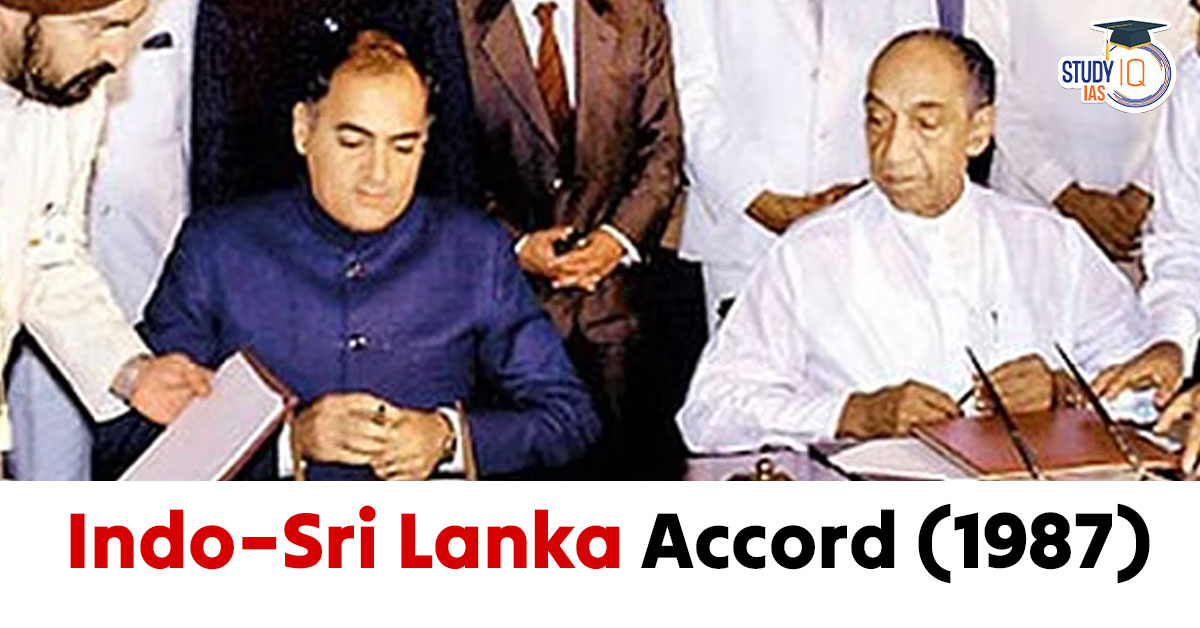
- Agreement Overview: The Indo–Sri Lanka Accord was a bilateral treaty signed in 1987 by Rajiv Gandhi and J. R. Jayewardene to resolve the ethnic conflict between Tamils and Sinhalese.
- Objective: The Accord aimed to ensure peace, unity in Sri Lanka, and a political solution through the devolution of power to Tamil-majority regions.
- 13th Amendment:
- The accord led to the 13th Constitutional Amendment, creating Provincial Councils for power-sharing across all 9 provinces (including Northern & Eastern provinces).
- Devolution of Powers: Subjects like education, health, agriculture, housing, land and police were intended to be transferred to provincial governments, ensuring local self-governance.
- Merger Proposal: Proposed temporary merger of Northern and Eastern provinces (Tamil-majority areas) to address regional aspirations (later reversed).
- Indian Role: India acted as a guarantor of Tamil rights and political settlement, reflecting its strategic and regional interests.
Check Here: India-Sri Lanka Relations
Significance of the Accord & 13th Amendment
- Political Solution Framework: It remains the only constitutional mechanism addressing Tamil autonomy demands in Sri Lanka.
- Devolution Model: Provides a limited federal-type structure within a unitary state, ensuring some regional governance.
- India–Sri Lanka Relations: Serves as a key pillar of bilateral relations and India’s regional diplomacy.
Issues & Non-Implementation
- Incomplete Devolution: Critical powers like police and land have never been fully implemented, limiting the effectiveness of provincial councils.
- Centralised Control: Strong powers of the Sri Lankan President override provincial autonomy, weakening decentralisation.
- Sinhala Opposition: Nationalist groups oppose it, viewing it as a threat to unity and Indian interference.
- Tamil Dissatisfaction: Tamil groups argue that councils lack real authority and meaningful autonomy.
- Political Delays: Provincial councils have been inactive for years (no elections), further weakening the system.

 Skyroot Vikram-1 Mission Aagaman: India'...
 Oor Pare Prehistoric Site: Location, Roc...
 Assam Election 2026: Exit Poll, Result D...













 WhatsApp