Table of Contents
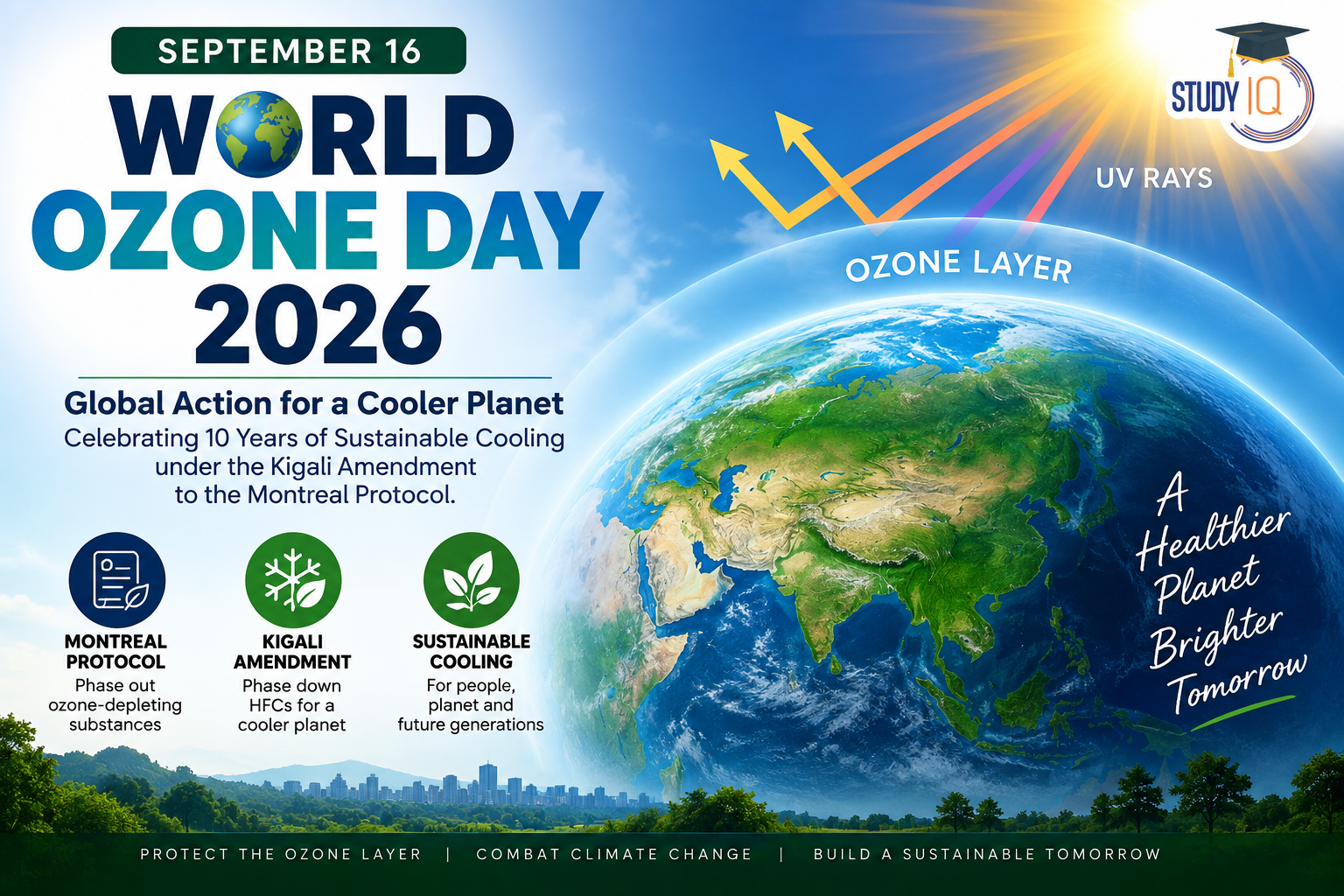
World Ozone Day 2026 is observed on September 16 to raise awareness about the importance of the ozone layer and global efforts to protect it. The day highlights the role of international environmental cooperation, particularly through the Vienna Convention, Montreal Protocol and Kigali Amendment.
The 2026 observance is significant because it marks 10 years since the adoption of the Kigali Amendment in 2016, which aims to phase down hydrofluorocarbons (HFCs), potent greenhouse gases widely used in refrigeration and air-conditioning.
Read Also: UPSC Daily Current Affairs 2026
World Ozone Day 2026: Key Facts
| Particular | Details |
|---|---|
| Date | September 16, 2026 |
| Official observance | International Day for the Preservation of the Ozone Layer |
| 2026 Theme | “Global Action for a Cooler Planet – Celebrating 10 Years of Sustainable Cooling under the Kigali Amendment to the Montreal Protocol.” |
| Ozone protection framework | Vienna Convention and Montreal Protocol |
| Montreal Protocol adopted | 1987 |
| Kigali Amendment adopted | 2016 |
| Kigali Amendment entered into force | 2019 |
What is the Ozone Layer?
The ozone layer is a region of the stratosphere containing relatively high concentrations of ozone (O₃). It acts as a natural protective shield by absorbing most of the Sun’s harmful ultraviolet (UV) radiation, particularly UV-B and UV-C radiation.
Excessive exposure to UV radiation can contribute to:
- Skin cancers
- Cataracts and other eye damage
- Suppression of the immune system
- Damage to crops and terrestrial vegetation
- Disruption of aquatic ecosystems and phytoplankton
Thus, protecting the ozone layer is important for human health, agriculture and ecosystems.
What Causes Ozone Layer Depletion?
Ozone depletion is primarily associated with certain ozone-depleting substances (ODS) released through human activities.
Important ODS include:
- Chlorofluorocarbons (CFCs)
- Halons
- Carbon tetrachloride
- Methyl chloroform
- Methyl bromide
- Certain hydrochlorofluorocarbons (HCFCs)
These substances can reach the stratosphere, where ultraviolet radiation releases chlorine or bromine atoms. These atoms participate in catalytic reactions that destroy ozone molecules.
Antarctic Ozone Hole
The most prominent seasonal ozone depletion occurs over Antarctica, commonly referred to as the Antarctic ozone hole.
Extremely low temperatures in the polar stratosphere facilitate the formation of polar stratospheric clouds. Chemical reactions on these clouds convert relatively stable chlorine compounds into reactive forms. When sunlight returns during Antarctic spring, these compounds contribute to rapid ozone destruction.
Vienna Convention for the Protection of the Ozone Layer
The Vienna Convention was adopted in 1985 and entered into force in 1988.
It created an international framework for cooperation on:
- Scientific research
- Monitoring of the ozone layer
- Exchange of information
- Assessment of human impacts on atmospheric ozone
The Convention itself did not establish detailed phase-out schedules for ozone-depleting chemicals. That role was subsequently undertaken by the Montreal Protocol.
Montreal Protocol
The Montreal Protocol on Substances that Deplete the Ozone Layer was adopted on September 16, 1987.
It established legally binding controls on the production and consumption of major ozone-depleting substances.
Why is the Montreal Protocol Important?
The Protocol has:
- Reduced global production and consumption of major ODS.
- Encouraged the development of safer alternatives.
- Supported developing countries in meeting their obligations.
- Been strengthened through subsequent amendments and adjustments.
- Produced major climate benefits because many ODS are also powerful greenhouse gases.
The agreement is frequently cited as a major example of multilateral environmental cooperation.
Kigali Amendment
The Kigali Amendment was adopted in Kigali, Rwanda, in October 2016 and entered into force on January 1, 2019.
Its principal objective is to phase down the production and consumption of HFCs.
Why Target HFCs?
HFCs were introduced as alternatives to several ozone-depleting substances, particularly CFCs and HCFCs.
However, many HFCs have a high global-warming potential (GWP).
Therefore, although HFCs generally do not deplete the ozone layer, their reduction can provide significant climate benefits.
Ozone Protection vs Climate Protection
This distinction is important:
- CFCs/HCFCs → Ozone depletion + climate impact
- HFCs → Generally no ozone depletion + potentially high climate impact
The Kigali Amendment therefore extends the environmental benefits of the Montreal Protocol into the area of climate-change mitigation.
Sustainable Cooling and World Ozone Day 2026
The cooling sector—including air conditioners, refrigerators and refrigeration equipment—has two important environmental dimensions:
- Refrigerants can affect the ozone layer or contribute to global warming.
- Energy consumption by cooling equipment contributes to greenhouse-gas emissions when electricity is generated from fossil fuels.
The transition toward energy-efficient equipment and climate-friendly refrigerants is therefore central to sustainable cooling.
The 2026 theme places particular emphasis on this connection while marking 10 years of the Kigali Amendment.
Montreal Protocol and Kigali Amendment: Difference
| Basis | Montreal Protocol | Kigali Amendment |
|---|---|---|
| Adopted | 1987 | 2016 |
| Main concern | Ozone-depleting substances | HFCs |
| HFCs | Not originally the principal target | Phasedown specifically addressed |
| Ozone impact | Directly addresses ozone depletion | HFCs generally do not deplete ozone |
| Climate relevance | Significant co-benefits | Strong climate-mitigation component |
| Key sector | Chemicals, refrigeration, aerosols and other applications | Primarily refrigeration and air-conditioning among other uses |
India’s Role in Ozone Layer Protection
India is a Party to the Vienna Convention and Montreal Protocol and has implemented measures to phase out or phase down substances covered by the international regime.
India’s ozone-protection efforts involve:
- Phasing out ozone-depleting substances.
- Promoting alternatives and alternative technologies.
- Supporting environmentally sound refrigeration and air-conditioning practices.
- Implementing commitments under the Montreal Protocol and its amendments.
- Gradually transitioning toward technologies with lower environmental impacts.
The Ozone Cell under the Ministry of Environment, Forest and Climate Change (MoEFCC) coordinates India’s implementation of the Montreal Protocol.
Significance for India
The transition to sustainable cooling is particularly relevant for India because of:
- Rising cooling demand.
- Rapid urbanisation.
- Increasing use of air conditioners and refrigeration.
- The need for energy-efficient cooling infrastructure.
- India’s climate-change mitigation commitments.
Sustainable cooling can therefore simultaneously address energy efficiency, climate change and environmental protection.
Global Significance of World Ozone Day
World Ozone Day highlights how international environmental problems can require collective action.
The ozone regime demonstrates the importance of:
- Scientific evidence
- International treaties
- Technology transfer
- Financial and technical assistance
- Periodic review and strengthening of environmental agreements
- Cooperation between developed and developing countries
The experience of the Montreal Protocol also provides lessons for addressing other global environmental challenges.

 Places in News: Mayun Island- Why Is Per...
 UPI MDR Charges 2026: Who Will Pay How M...
 Place in News: Auli – Location, Geogra...














 WhatsApp