
Table of Contents
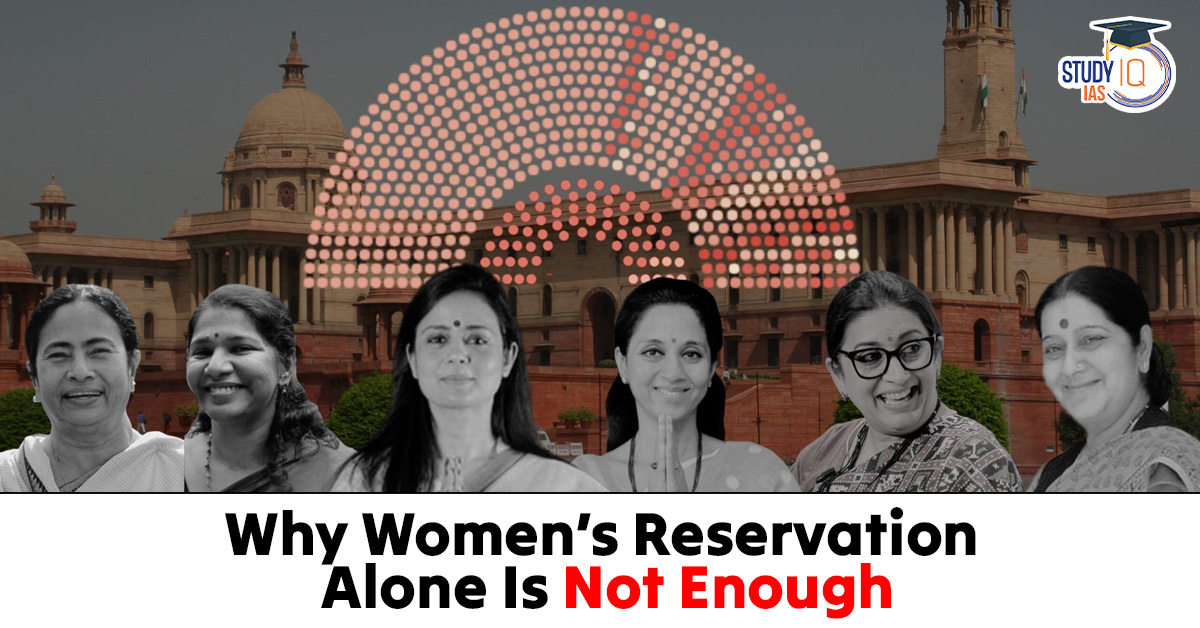
Context: Women’s Reservation in legislatures is often seen as a historic corrective to gender imbalance in politics. India, for instance, has one of the largest democratic electorates with high female voter participation, yet women’s representation in the Lok Sabha has hovered around 14–15% (2024).
Women constitute nearly half of the global population, yet their presence in legislative bodies remains disproportionately low. Worldwide, they occupy only about one-fourth of parliamentary seats. In India too, women’s representation in the Lok Sabha has remained modest, even after gradual improvements over the years.
Core argument
A reservation acts like an entry pass to a high-stakes arena. It gets women inside the stadium, but does not guarantee they get to play the match, call the shots, or change the scoreboard. Substantive empowerment requires capacity, autonomy, and structural change beyond quotas.
Key Limitations of Women’s Reservation
- Persistence of Patriarchal Control: Power: In many cases, elected women representatives operate under the shadow of male relatives or local elites. This phenomenon, often termed “proxy representation,” is widely documented in local governance.
- Eg: A study by the Ministry of Panchayati Raj found that in several states, women sarpanches were informally replaced by “sarpanch pati” (husbands acting as de facto decision-makers)
- Lack of Political support: Reservation does not automatically equip women with the skills needed to navigate politics.
- Eg: According to UNDP reports, women candidates often face deficits in:
- Legislative knowledge
- Public speaking and negotiation skills
- Campaign management
- Eg: According to UNDP reports, women candidates often face deficits in:
- Structural Barriers Remain Intact: Even with reservations, the political ecosystem itself remains skewed as political parties act as gatekeepers. Women receive only 8–10% of total party tickets in major elections.
- Eg: Despite decades of advocacy, no major national party consistently fields more than one-third women candidates voluntarily.
- Risk of Tokenism: Reservation can sometimes create symbolic representation rather than substantive change.
- Eg: A report by the Inter-Parliamentary Union notes that higher representation does not always translate into gender-sensitive policymaking.
- Intersectional Inequalities Ignored: Women are not a uniform category. Social hierarchies shape access to power.
- Eg: Data from Oxfam shows that marginalised women (Dalit, Adivasi, rural) face compounded barriers.
- Political Party Dynamics: Parties decide who contests and who wins. Without internal reform, reservation becomes a surface-level fix.
- The Invisible Cage: Deep-rooted gender norms discourage women from entering politics.
- Eg: According to Pew Research Centre surveys, a significant share of Indians still believe men make better political leaders.
Arguments Supporting Women’s Reservation
- Constitutional backing and substantive equality: The Constitution permits special provisions for women under Article 15(3). Reservation is viewed as a corrective tool to achieve real equality, not just formal equality.
- Strengthening representative democracy: A democratic system should reflect the composition of its population. With women forming nearly half of society, their underrepresentation creates a democratic imbalance.
- Addressing historical disadvantages: Long-standing social norms have restricted women’s access to education, property, and public participation. Reservation acts as a compensatory mechanism to offset this structural exclusion.
- Shift in policy priorities: Studies show that women leaders often focus more on essential services such as healthcare, sanitation, drinking water, and nutrition, thereby improving grassroots welfare outcomes.
- Greater attention to gender-specific issues: Women representatives are more likely to highlight concerns like maternal health, gender violence, and child welfare in legislative debates.
- Achieving critical mass: Political theory suggests that women need at least one-third representation to influence policy effectively. Reservation helps achieve this threshold faster.
- Inspirational impact: Increased visibility of women in leadership roles motivates younger generations, encouraging education, ambition, and participation in public life.
Arguments Opposing Women’s Reservation
- Concerns over meritocracy: Critics argue that reservations may compromise merit by prioritizing gender over capability, potentially creating perceptions of unfair advantage.
- Proxy representation issue: At the local level, there have been instances where elected women representatives are influenced or controlled by male family members, limiting genuine empowerment.
- Question of capability: Some argue that reserving seats may unintentionally signal that women require special assistance to succeed, undermining their competence.
- Unequal benefits among women: There is a risk that reservation may primarily benefit privileged sections (urban, educated women), leaving marginalized groups underrepresented unless sub-quotas are ensured.
- Lack of homogeneity: Women are not a uniform group; their interests vary across caste, class, and region. Hence, a single quota may not address diverse realities.
- Limitation on voter choice: Reserving constituencies restricts voters from choosing candidates freely, as options become limited to a specific gender.
Way Forward
- Capacity Building: Structured training programs can transform participation into leadership.
- Leadership academies, governance workshops, and mentorship networks can bridge skill gaps.
- Political Party Reforms: Mandating internal party quotas and transparent candidate selection can deepen inclusion.
- Ensuring Autonomy: Legal and institutional safeguards are needed to prevent informal power capture.
- Addressing Social Norms: Long-term change requires shifting mindsets through education and media.
- Intersectional Approach: Reservation must account for caste, class, and regional disparities.
- Dual-member constituencies: Electing two representatives (one man and one woman) from a constituency could ensure inclusion without excluding male candidates.
- Proportional representation system: Adopting a party-list system with alternating male and female candidates can ensure balanced representation without reserving constituencies.
- Mandatory party-level quotas: Political parties can be required to allocate a fixed percentage of tickets to women, promoting competition and broader participation.
- Strengthening grassroots participation: Encouraging women’s involvement in student politics, civil society, and local governance can build a strong pipeline of future leaders.

 Classification of Left-Wing Extremism (L...
 NGT Mandates Mitigation of Arsenic &...
 Pathogen Access and Benefit Sharing (PAB...











 WhatsApp





