
Table of Contents
Context
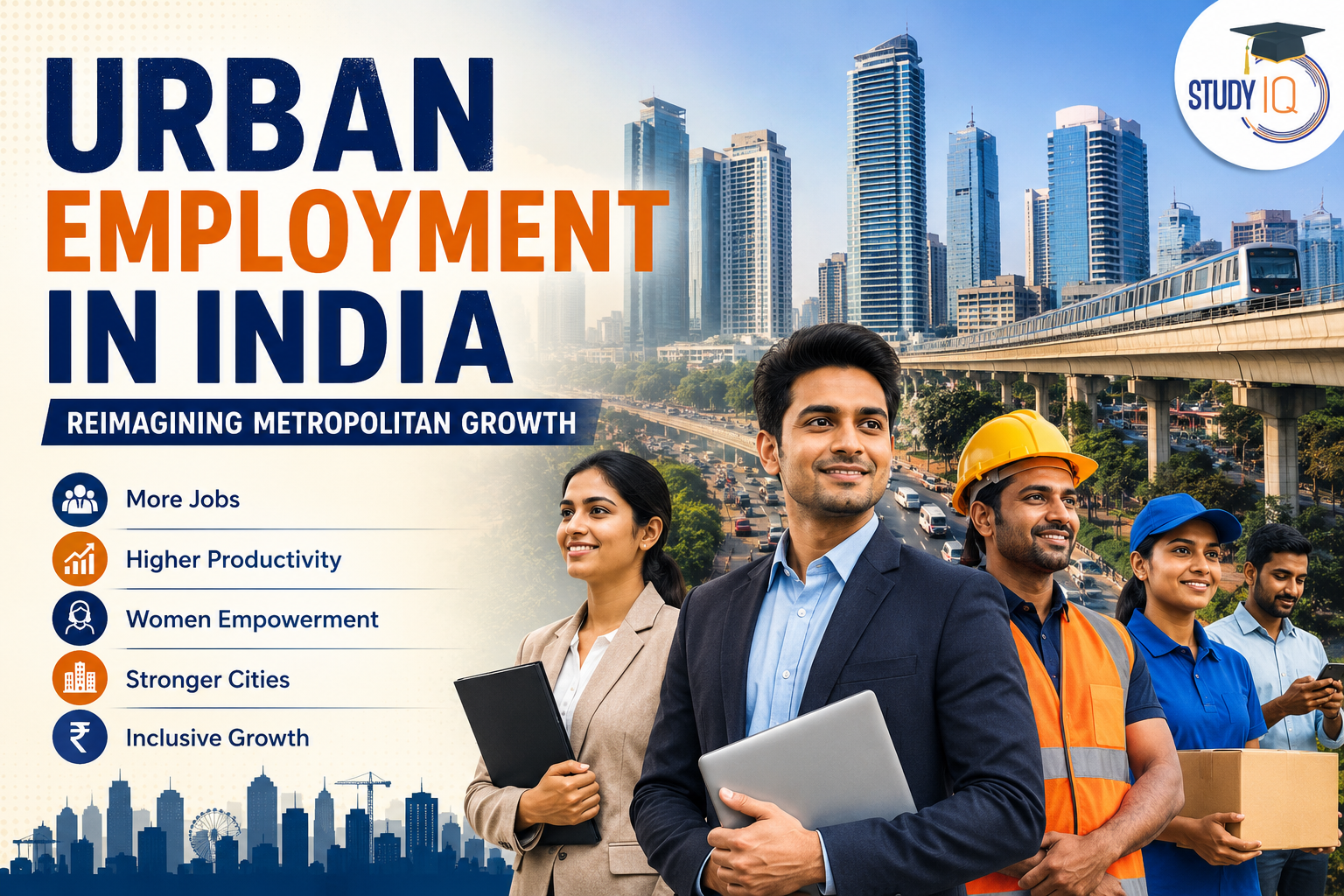
Recent PLFS 2025 and ASUSE 2025 data show that India’s million-plus cities are emerging as major centres of formal employment, higher wages, enterprise growth and productivity, reshaping the country’s urban labour market.
How are Indian Cities Driving Employment-Led Growth?
- Agglomeration Economies and Productivity Gains: The concentration of firms, skilled labour and supporting industries creates economies of scale, knowledge spillovers and innovation, enhancing productivity and expanding employment opportunities.
- g.ASUSE 2025 shows that 46 million-plus cities contribute 21% of Gross Value Added (GVA) despite accounting for only 13% of unincorporated establishments, reflecting higher productivity.
- Expansion of Diverse Urban Labour Markets: Cities support employment across organised industries, modern services and informal urban enterprises, enabling labour absorption for workers with diverse skill levels.
- g. More than half of the workforce in million-plus cities is engaged in regular wage or salaried employment, while urban logistics, platform work and local services continue to absorb a large workforce.
- Enterprise Clustering and Innovation Ecosystems: Dense business networks, startup ecosystems and institutional linkages foster entrepreneurship, innovation and business expansion, creating new employment opportunities.
- g.Bengaluru, Hyderabad, Pune and Gurugram have emerged as leading hubs for startups, Global Capability Centres (GCCs) and knowledge-intensive industries.
- Harnessing the Female Demographic Dividend: Cities expand women’s access to education, formal employment and service-sector jobs, enabling greater utilisation of human capital and broadening the labour force.
- g. Female Labour Force Participation Rate (LFPR) in million-plus cities increased from 19.8% (2017–18) to 27.2% (2025).
- Consumption-Driven Employment Multipliers: Large urban populations generate sustained demand for housing, retail, logistics, healthcare and hospitality, stimulating employment across multiple labour-intensive sectors.
- g. The construction sector, driven largely by urban housing and infrastructure demand, is India’s second-largest employer, while trade, hotels and transport remain among the largest urban employment generators.
What are the Socio-Economic Implications of Metropolitan-Led Employment Growth?
Social Implications
- Accelerates Rural–Urban Migration and Labour Mobility: Expanding employment opportunities in metropolitan cities attract workers from rural and smaller urban areas, facilitating labour mobility and structural transformation. However, much of this migration remains circular, reflecting persistent livelihood insecurity and seasonal employment patterns.
- g. The 2011 Census identifies employment as a leading driver of rural-to-urban migration, while recent PLFS trends indicate increasing circular migration.
- Enhances Women’s Economic Empowerment and Social Mobility: Greater access to education, formal employment and modern workplaces improves women’s financial independence, decision-making power and labour-force participation, while gradually weakening traditional occupational and social barriers.
- g. Female Labour Force Participation Rate (LFPR) in million-plus cities increased from 19.8% (2017–18) to 27.2% (2025), according to PLFS 2025.
- Deepens Spatial Inequality and Social Stratification: Rapid employment concentration often outpaces affordable housing and urban infrastructure, leading to slums, informal settlements and unequal access to public services, thereby reinforcing socio-spatial inequalities.
- g.NITI Aayog’s Report on Urban Planning Capacity in India (2021) highlights significant deficits in urban planning and infrastructure across Indian cities.
Economic Implications
- Expands Urban Consumption and Employment Multipliers: Metropolitan employment raises incomes across both formal and informal sectors, generating demand for housing, retail, healthcare, logistics, hospitality and digital services, thereby creating multiplier effects across the urban economy.
- g. The Economic Survey 2024–25 identifies domestic consumption as a key driver of India’s economic growth, while metropolitan demand sustains employment in retail trade, transport and hospitality.
- Deepens Regional Economic Divergence: The concentration of investment, enterprises and quality employment in metropolitan centres widens disparities with smaller towns and economically lagging regions, reinforcing uneven regional development.
- g.Delhi, Bengaluru, Hyderabad, Pune and Surat continue to attract a disproportionate share of investment, enterprises and high-value employment.
- Accelerates Structural Transformation with Persistent Informalisation: Metropolitan employment facilitates the movement of labour from low-productivity agriculture towards manufacturing and services. However, a significant share of workers continue to enter low-productivity informal and gig employment, limiting the pace of quality job creation.
- g. While the Lewis Dual Sector Model envisages labour shifting into formal industry, India’s urban transition has largely been characterised by expanding construction, informal services and platform-based employment.
How Can Urban Employment Catalyse Rural Transformation?
- Reduces Disguised Unemployment and Accelerates Structural Transformation: Urban employment absorbs surplus rural labour, facilitating the shift from low-productivity agriculture to higher-productivity manufacturing and services, thereby improving overall economic efficiency.
- g. The Lewis Dual Sector Model explains how labour migration from traditional agriculture to modern urban sectors drives structural transformation.
- Strengthens Rural Household Incomes through Remittances: Urban workers transfer part of their earnings to rural households, supporting consumption, education, healthcare and productive investments in farm mechanisation, irrigation and rural enterprises, thereby reducing poverty and strengthening rural capital formation.
- g.RBI studies identify migrant remittances as a significant source of income for rural households, particularly in Bihar, Uttar Pradesh and Odisha.
- Expands Rural Non-Farm Employment: Growing urban demand stimulates rural industries such as construction materials, rural MSMEs, handicrafts, logistics and business services, creating diversified livelihood opportunities beyond agriculture.
- g. Rapid urban construction has boosted employment in brick kilns, stone quarries and rural building-material enterprises, while PMEGP supports rural manufacturing and micro-enterprises.
- Transforms Rural Gender Roles through Feminisation of Agriculture: Migration of male workers to metropolitan centres increasingly shifts agricultural management and household decision-making to women, necessitating greater institutional support through land rights, institutional credit and gender-responsive farm mechanisation.
- g. The Agriculture Census 2015–16 shows women account for nearly 30% of operational landholders and over 40% of the agricultural workforce—a trend further reinforced by recent PLFS findings indicating rising female participation in agriculture.
- Integrates Rural Producers with Urban Value Chains: Expanding urban markets create sustained demand for agricultural produce and rural products, encouraging value addition, market integration and higher farm incomes.
- g.e-NAM and the Open Network for Digital Commerce (ONDC) connect farmers, FPOs and rural enterprises with urban consumers, reducing market intermediation and improving price realisation.
How Can India Build Inclusive and Employment-Centric Cities?
- Strengthen Metropolitan Governance and Municipal Finances: Empower Metropolitan Planning Committees (MPCs) and Urban Local Bodies (ULBs) under the 74th Constitutional Amendment to integrate spatial and economic planning, supported by fiscal devolution, property tax reforms and municipal bond financing.
- g.NITI Aayog’s Report on Urban Planning Capacity in India (2021) recommends strengthening metropolitan governance, while Indore, Pune and Ahmedabad have successfully raised capital through Municipal Bonds.
- Develop Peri-Urban Manufacturing and MSME Clusters: Promote labour-intensive industries through peri-urban industrial corridors and MSME clusters, leveraging lower land costs and integrated logistics to generate large-scale employment while decongesting metropolitan cores.
- g. The National Industrial Corridor Development Programme (NICDP) and PM Gati Shakti National Master Plan support integrated industrial and logistics ecosystems beyond major metropolitan centres.
- Integrate the Informal Economy into Urban Planning: Transition from regulating the informal sector to enabling it through designated vending zones, social security, affordable credit and climate-resilient public infrastructure, ensuring inclusive livelihoods for vulnerable urban workers.
- g. The Street Vendors (Protection of Livelihood and Regulation of Street Vending) Act, 2014, PM SVANidhi, and the Code on Social Security, 2020 strengthen livelihood security for street vendors and gig workers.
- Strengthen Inclusive Skill Ecosystems: Expand industry-linked skilling while institutionalising Recognition of Prior Learning (RPL) to certify informal workers, improving employability, productivity and labour mobility across urban sectors.
- g. Under the Skill India Mission, Recognition of Prior Learning (RPL) certifies the existing skills of construction workers, electricians, plumbers and other informal workers.
- Promote Affordable Housing and Transit-Oriented Development (TOD): Expand affordable housing, integrated public transport and Transit-Oriented Development to reduce commuting costs, improve labour mobility and enhance equitable access to employment opportunities.
- g.PMAY (Urban) and the Metro Rail Policy, 2017 promote integrated housing and mobility through Transit-Oriented Development (TOD).
- Foster Balanced Regional Urbanisation: Strengthen Tier-II and Tier-III cities through quality urban infrastructure, local enterprise development and diversified employment opportunities, reducing excessive migration pressures on metropolitan centres.
- g.AMRUT 2.0 improves urban infrastructure and service delivery, while the One District One Product (ODOP)initiative promotes region-specific enterprises and local employment ecosystems.
Latest UPSC Updates
| Resource | Link |
|---|---|
| UPSC Prelims Result 2026 | Check Here |
| UPSC Exam Calendar 2027 | View Calendar |
| UPSC Question Paper 2026 | Download PDF |
| UPSC Prelims Answer Key 2026 | Check Answer Key |
| UPSC Cut Off 2026 | View Cut Off |
| UPSC Syllabus 2026 | Read Syllabus |
| Daily Current Affairs 2026 | Read Updates |
| StudyIQ UPSC IAS Foundation 2027 (English) | Join Course |
| StudyIQ UPSC IAS Foundation 2027 (Hindi) | Join Course |
| StudyIQ UPSC IAS Foundation 2027 (Bilingual) | Join Course |
 World Snake Day 2026: Date, History, The...
 World Youth Skills Day 2026: Theme, Date...
 Reimagining India's Cooperative Movement...













 WhatsApp





