Table of Contents
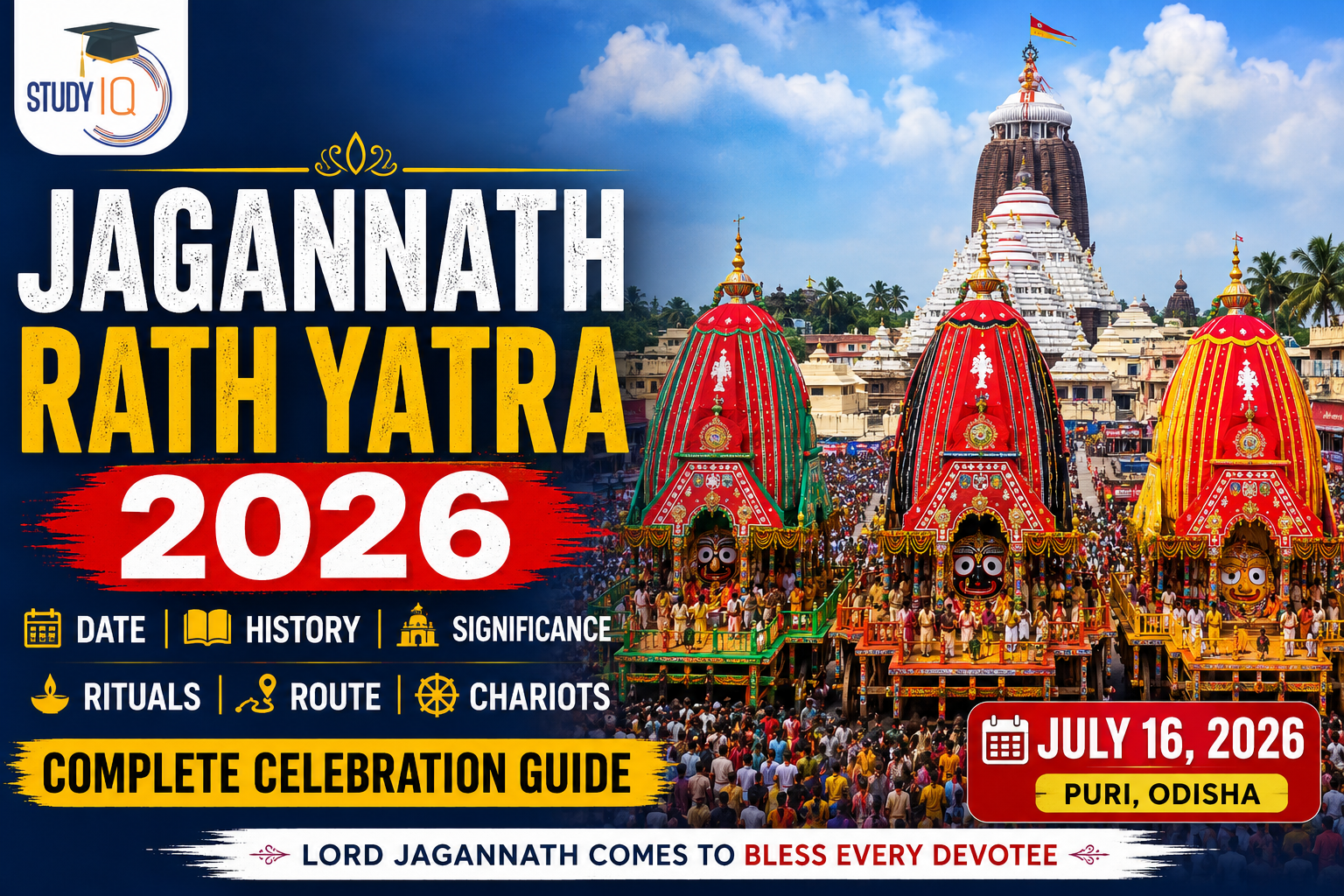
Jagannath Rath Yatra, popularly known as the Festival of Chariots, is one of the oldest, largest, and most revered Hindu festivals in the world. Celebrated annually in Puri, Odisha, the festival witnesses millions of devotees gathering to witness Lord Jagannath, Lord Balabhadra, and Devi Subhadra embark on their sacred journey from the Jagannath Temple to the Gundicha Temple.
Unlike most temple festivals where devotees visit the deity, Jagannath Rath Yatra symbolizes the Lord coming out to meet His devotees, making divine blessings accessible to everyone irrespective of caste, creed, gender, or social status. This philosophy of inclusiveness has made the festival a global symbol of devotion, equality, and spiritual unity. The 2026 Rath Yatra will begin on Thursday, 16 July 2026, corresponding to Ashadha Shukla Dwitiya.
Jagannath Rath Yatra 2026 Highlights
| Particular | Details |
|---|---|
| Festival Name | Jagannath Rath Yatra 2026 |
| Date | 16 July 2026 (Thursday) |
| Hindu Tithi | Ashadha Shukla Dwitiya |
| Venue | Puri, Odisha |
| Main Deities | Lord Jagannath, Lord Balabhadra & Devi Subhadra |
| Duration | About 9 days (16–24 July 2026) |
| Main Route | Jagannath Temple to Gundicha Temple |
| Distance | Approximately 3 km |
| Famous Ritual | Chhera Pahanra |
| Return Journey | Bahuda Yatra |
What is Jagannath Rath Yatra?
Jagannath Rath Yatra is the annual ceremonial procession of Lord Jagannath (a form of Lord Vishnu/Krishna), Lord Balabhadra, Devi Subhadra, and Sudarshana Chakra from the Jagannath Temple to the Gundicha Temple.
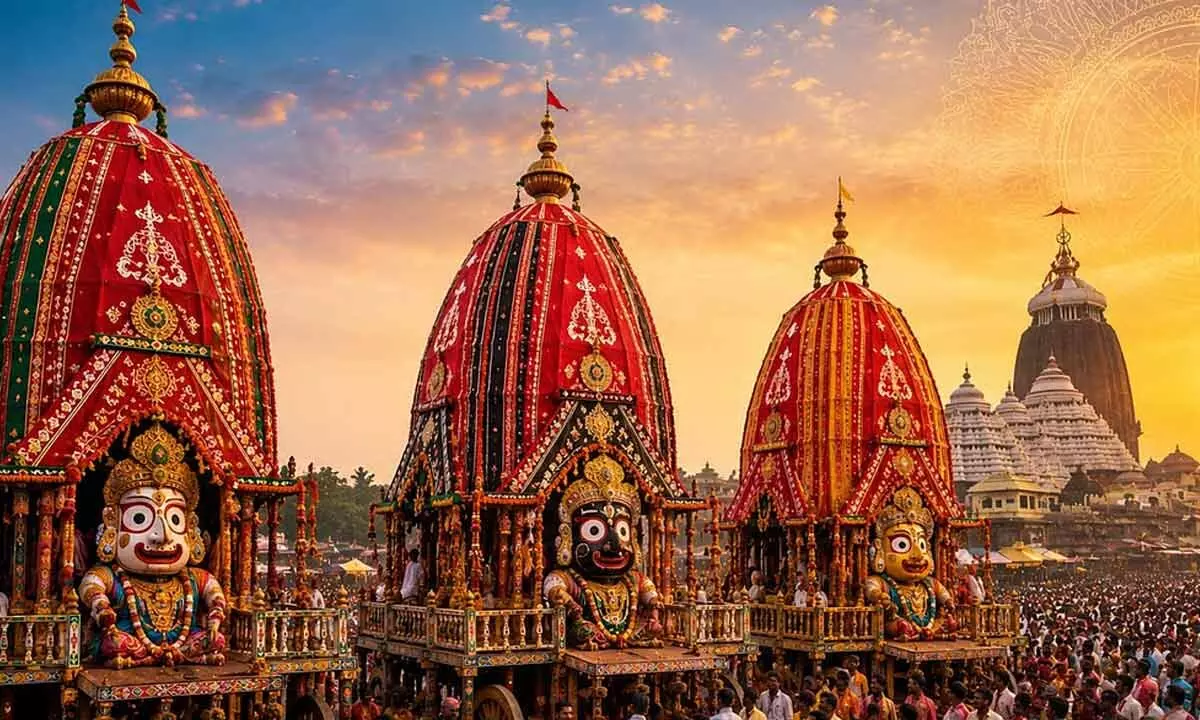
The deities are seated on three gigantic handcrafted wooden chariots, which are pulled through the streets of Puri by thousands of devotees using massive sacred ropes.
The festival signifies:
- God’s unconditional love for humanity
- Equality among all devotees
- Universal brotherhood
- Humility before the Divine
- The soul’s journey toward liberation (Moksha)
The English word “Juggernaut” is believed to have originated from the gigantic chariot (Jagannath’s Rath) witnessed by European travelers in Puri centuries ago.
Jagannath Rath Yatra 2026 Date
The Jagannath Rath Yatra 2026 will be celebrated on:
Date: Thursday, 16 July 2026
Occasion: Ashadha Shukla Dwitiya
The grand procession marks the beginning of a nine-day festival culminating with the return journey (Bahuda Yatra) and the ceremonial re-entry (Niladri Bije) of the deities into the Jagannath Temple.
History of Jagannath Rath Yatra
The origins of Rath Yatra date back to the 12th century CE, after the construction of the Jagannath Temple by King Anantavarman Chodaganga Deva of the Eastern Ganga dynasty. References to the festival are also found in ancient Hindu scriptures, including the Skanda Purana, Padma Purana, and Brahma Purana.
According to tradition:
- Lord Jagannath visits the Gundicha Temple, believed to be the home of His aunt (Mausi Maa).
- The deities remain there for nine days.
- They return in another grand procession called Bahuda Yatra.
Over the centuries, Rath Yatra has evolved into one of the world’s largest annual religious gatherings.
Why is Jagannath Rath Yatra Celebrated?
The festival commemorates Lord Jagannath’s annual visit to the Gundicha Temple. Spiritually, it symbolizes:
- God’s desire to bless every devotee.
- The victory of devotion over ego.
- The journey of the soul toward salvation.
- The importance of humility and surrender.
- Unity beyond caste and social divisions.
Unlike temple worship, Rath Yatra emphasizes that the Divine reaches out to humanity.
Complete Rituals of Jagannath Rath Yatra
1. Akshaya Tritiya
Construction of the three sacred chariots begins with special rituals.
2. Snana Purnima
The deities are bathed with 108 pots of sacred water.
3. Anavasara
Following the ceremonial bath, the deities remain out of public view for about 15 days, symbolically recovering from illness.
4. Netrotsava (Nava Jaubana Darshan)
The deities reappear before devotees after the Anavasara period.
5. Pahandi Bije
The idols are ceremonially carried out of the sanctum amid devotional chanting, music, and dance.
6. Chhera Pahanra
One of the most distinctive rituals, the Gajapati Maharaja of Puri sweeps the chariots with a golden broom, demonstrating that everyone—including the king—is equal before Lord Jagannath.
7. Rath Yatra
The three chariots are pulled from the Jagannath Temple to the Gundicha Temple.
8. Hera Panchami
Goddess Lakshmi symbolically visits Gundicha Temple to inquire why Lord Jagannath has not yet returned.
9. Bahuda Yatra
The return journey of the deities to the Jagannath Temple.
10. Suna Besha
The deities are adorned with magnificent gold ornaments, attracting lakhs of devotees.
11. Adhara Pana
A unique ritual in which a sacred sweet drink is offered in large earthen pots on the chariots. The pots are then ceremonially broken as an offering to unseen spiritual beings accompanying the procession, symbolizing Lord Jagannath’s compassion for all forms of existence.
12. Niladri Bije
The deities ceremonially re-enter the Jagannath Temple, marking the conclusion of the festival.
Route of Jagannath Rath Yatra
| Starting Point | Jagannath Temple |
|---|---|
| Destination | Gundicha Temple |
| Distance | Around 3 km |
| Main Road | Bada Danda (Grand Road) |
Lakhs of devotees line the Grand Road to witness the sacred procession.
The Three Divine Chariots
Every year, entirely new wooden chariots are constructed using sacred neem wood (Daru) by hereditary artisans following centuries-old traditions.
| Chariot | Deity | Height | Wheels | Canopy |
|---|---|---|---|---|
| Nandighosha | Lord Jagannath | About 45 feet | 16 | Yellow & Red |
| Taladhwaja | Lord Balabhadra | About 44 feet | 14 | Green & Red |
| Darpadalana (Devadalana) | Devi Subhadra | About 43 feet | 12 | Black & Red |
Each chariot is decorated with wooden horses, charioteers, flags, carvings, and traditional cloth canopies.
Chariot Construction: A Centuries-Old Tradition
One of the most fascinating aspects of Rath Yatra is that:
- New chariots are built every year.
- Construction starts on Akshaya Tritiya.
- Thousands of wooden components are assembled without modern engineering techniques.
- Sacred neem trees are selected according to strict religious criteria.
- The work is carried out by hereditary carpenter families known as Maharanas.
Jagannath Temple Kitchen: The World’s Largest Temple Kitchen
An extraordinary feature of the Jagannath Temple is its massive temple kitchen, widely regarded as the largest functioning temple kitchen in the world.
Some remarkable facts include:
- Hundreds of cooks prepare Mahaprasad daily.
- Food is cooked in earthen pots.
- Pots are stacked one above another over wood-fired stoves.
- Devotees believe the top pot cooks first due to divine blessings.
- The Mahaprasad is shared equally among all devotees without discrimination.
Jagannath Puri: One of the Char Dham
Puri is one of the four Char Dham pilgrimage sites established in Hindu tradition.
Major attractions include:
- Jagannath Temple
- Gundicha Temple
- Golden Beach
- Anand Bazaar (Mahaprasad Market)
- Narendra Tank
- Rich Odia culture and traditions
Interesting Facts About Jagannath Rath Yatra
- It is considered the oldest and largest chariot festival in the world.
- Three completely new chariots are built every year.
- The chariots are never reused.
- The sacred ropes used for pulling the chariots are considered highly auspicious.
- The English word “Juggernaut” originated from Jagannath’s gigantic chariot.
- Millions of devotees participate annually.
- The Gajapati King sweeps the chariots with a golden broom before the procession begins.
- Lord Jagannath is worshipped as the “Lord of the Universe.”
- Rath Yatra is celebrated not only in India but also in over 100 countries, especially through ISKCON temples.
- The next Nabakalebara (ceremonial renewal of the wooden deities) is expected in 2034, a rare ritual held only in specific years determined by the lunar calendar.
Cultural and Global Significance
Today, Jagannath Rath Yatra has evolved into a global cultural celebration. Major cities such as London, New York, Toronto, Sydney, Johannesburg, Moscow, Singapore, and Kuala Lumpur organize Rath Yatra processions, reflecting the worldwide spread of Jagannath devotion. The festival has become a symbol of India’s spiritual heritage and Odisha’s rich cultural traditions.
Latest UPSC Updates
| Resource | Link |
|---|---|
| UPSC Prelims Result 2026 | Check Here |
| UPSC Exam Calendar 2027 | View Calendar |
| UPSC Question Paper 2026 | Download PDF |
| UPSC Prelims Answer Key 2026 | Check Answer Key |
| UPSC Cut Off 2026 | View Cut Off |
| UPSC Syllabus 2026 | Read Syllabus |
| Daily Current Affairs 2026 | Read Updates |
| StudyIQ UPSC IAS Foundation 2027 (English) | Join Course |
| StudyIQ UPSC IAS Foundation 2027 (Hindi) | Join Course |
| StudyIQ UPSC IAS Foundation 2027 (Bilingual) | Join Course |
 India–Poland Relations 2026: Strategic...
 Supreme Court on Children's Right to Int...
 Daily Current Affairs PDF 2026: Download...













 WhatsApp