
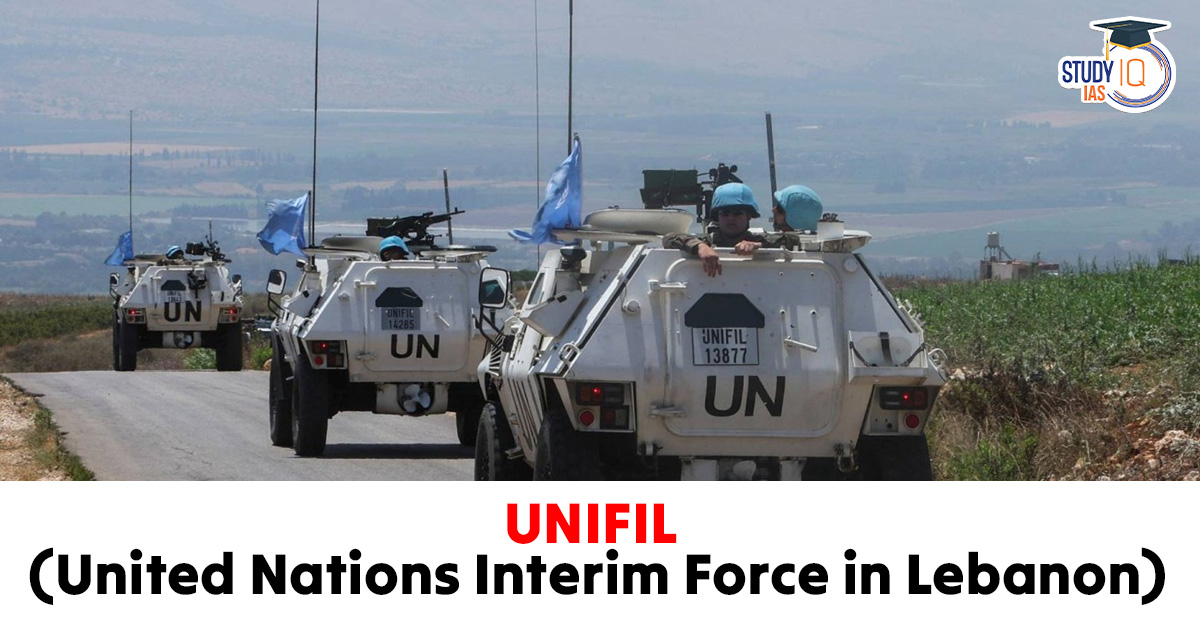
Context: India condemned the killing of three Indonesian UNIFIL(United Nations Interim Force in Lebanon) peacekeepers in south Lebanon amid Hezbollah–IDF clashes.
About UNIFIL (United Nations Interim Force in Lebanon)
- Establishment: Created by UNSC Resolutions 425 & 426 (1978) after Israel’s Operation Litani invasion of South Lebanon(in response to the ‘coastal road massacre where Palestinian militants killed several Israelis).
- Mandate: Ensure Israeli withdrawal, restore peace, and assist the Lebanese government authority in southern Lebanon.
- Expanded Role: After the Israel–Hezbollah war (2006), UNSC Resolution 1701 expanded the mandate to monitor the ceasefire and support the Lebanese Armed Forces.
- Deployment: Mission includes ~10,000 peacekeepers from 40+ countries (HQ: Naqoura, south Lebanon).
- India is a major troop contributor (~600 personnel, including infantry & medical units).
- Legal Protection: Attacks on peacekeepers violate International Humanitarian Law and UNSC Resolution 1701 (may constitute war crimes).
- Current Challenges: Rising Israel–Hezbollah clashes, attacks on peacekeepers, and wider West Asia conflict escalation threaten mission stability.
| About UN Peacekeeping Missions (PKOs) |
Legal Basis: Not explicitly mentioned in the UN Charter; evolved as UN practice to maintain peace (authorised by UNSC mandates; based broadly on Chapter VI – dispute settlement & Chapter VII – action against threats).
Core Principles of UN Peacekeeping
Procedure for Establishing a Mission
Contribution and Funding
|

 International Day For Disarmament And No...
 United Nations General Assembly (UNGA), ...
 Universal Postal Union (UPU), Objective,...












 WhatsApp





