Table of Contents
Access to safe and hygienic sanitation is not merely a public health requirement but also a fundamental condition for ensuring gender equality and economic participation.
In India, inadequate public toilet infrastructure disproportionately affects women, particularly those belonging to economically weaker sections and working in the informal sector.
The concept of Toilet Poverty has recently gained attention as a way of understanding how the lack of affordable, accessible and safe sanitation facilities creates economic disadvantages for women.
Despite initiatives such as the Swachh Bharat Mission (SBM), launched in 2014, the availability and quality of public toilets remain major challenges in several urban areas.
The issue also raises important questions about inclusive urban development, women’s workforce participation and India’s ambition of becoming a Viksit Bharat by 2047.
What is Toilet Poverty?
Toilet poverty refers to a situation in which individuals face significant financial, social or economic difficulties in accessing safe, clean and adequate sanitation facilities.
The concept draws inspiration from multidimensional poverty measurement frameworks, which examine whether households can afford essential services.
For example, in the United Kingdom, households spending 10% or more of their income on energy have traditionally been considered energy-poor under certain definitions.
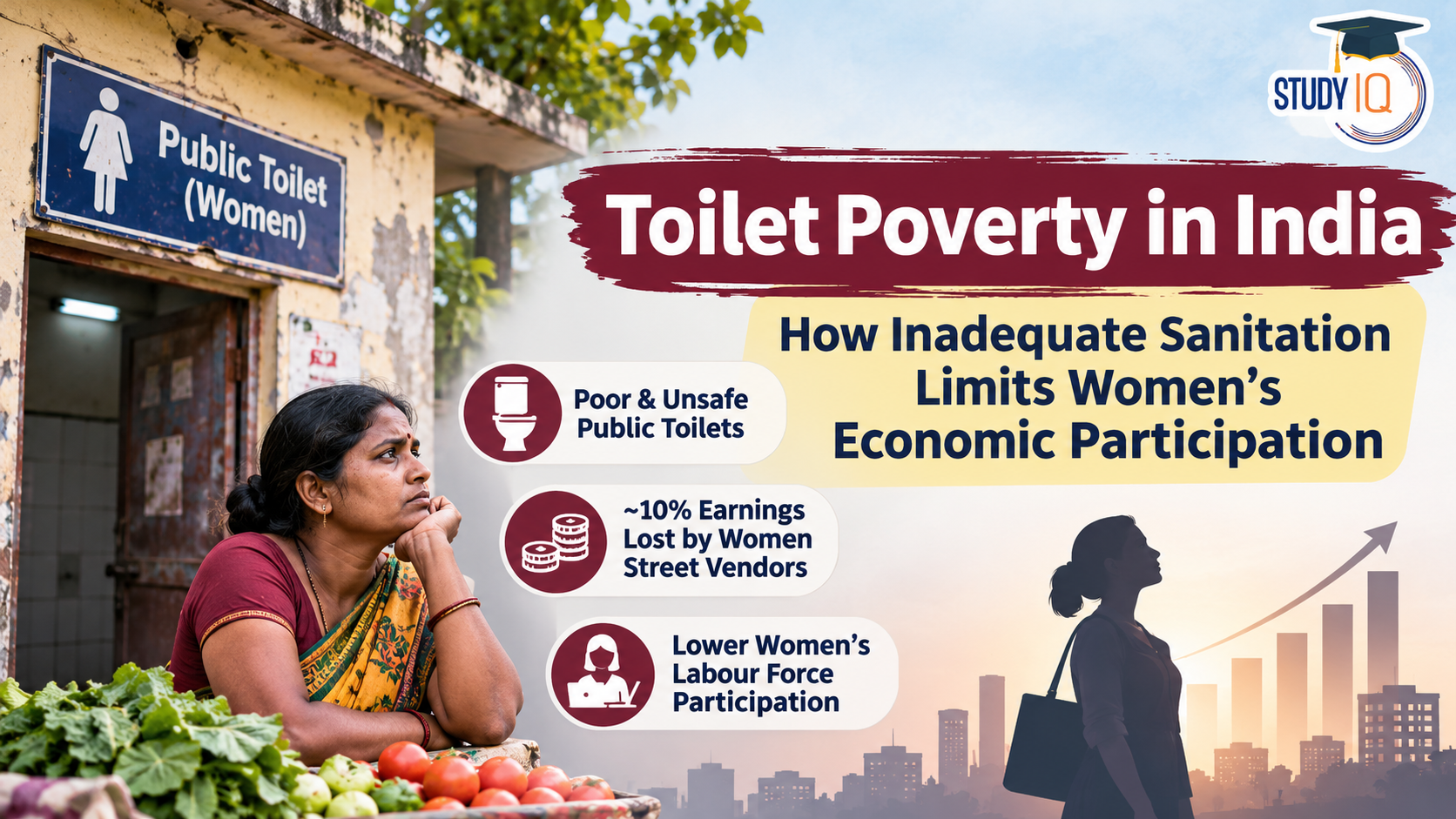
Similarly, people who lose a substantial proportion of their income or earnings to access basic sanitation can be described as experiencing toilet poverty.
In the Indian context, this problem particularly affects women street vendors, daily-wage workers and other informal-sector employees.
Toilet Poverty in India: Key Findings
A survey-based study examining public toilets used by women and queer people in Kolkata highlighted several challenges associated with inadequate sanitation infrastructure.
Major findings include:
-
Income Loss: Women street vendors lose nearly 10% of their earnings due to inadequate access to toilets.
-
Poor Hygiene: Many public toilets lack proper cleanliness and maintenance.
-
Safety Concerns: Inadequate lighting and broken door bolts compromise women’s privacy and security.
-
Sexual Harassment: Some respondents reported incidents of harassment involving male guards or local people.
-
Spatial Inequality: Poorer neighbourhoods generally have inadequate public toilet infrastructure compared to affluent areas.
These findings demonstrate that sanitation inequality is closely connected with economic inequality and gender-based discrimination.
How Does Toilet Poverty Affect Women’s Economic Participation?
Women’s economic participation is essential for achieving inclusive growth and making effective use of India’s demographic dividend.
However, several structural barriers prevent women from entering and remaining in the workforce.
1. Loss of Income
Women working as street vendors, domestic workers and daily-wage labourers often depend on public sanitation facilities.
When these facilities are unavailable, women may have to:
-
Spend money accessing private toilets.
-
Travel long distances to find suitable facilities.
-
Reduce working hours.
-
Temporarily close their shops or workplaces.
Such disruptions directly reduce their daily earnings and economic independence.
2. Safety and Security Concerns
Inadequate lighting, broken locks, poor maintenance and the absence of secure facilities create safety concerns.
Women may avoid using public toilets, particularly after dark, or restrict their working hours because of security risks.
This reduces their freedom of movement and limits their economic opportunities.
3. Impact on Health and Dignity
Poor sanitation facilities can expose women to unhygienic conditions and increase the risk of sanitation-related health problems.
The absence of menstrual hygiene facilities further complicates the situation for women workers.
Access to safe sanitation is therefore closely linked with women’s health, dignity and constitutional rights.
Women’s Labour Force Participation in India
Female Labour Force Participation Rate (FLFPR) is an important indicator of women’s economic empowerment.
India continues to face challenges in ensuring adequate participation of women in paid employment.
Some important observations include:
-
Female labour force participation in urban India has historically remained relatively low.
-
The Periodic Labour Force Survey (PLFS) 2023–24 recorded an increase in female labour force participation, particularly in rural areas.
-
However, higher participation does not automatically indicate better employment opportunities or economic empowerment.
-
Distress-driven employment and unpaid family work can also contribute to increased participation.
According to the International Labour Organization (ILO), gender-based inequalities in employment remain a major challenge across developing economies.
Major Barriers to Women’s Workforce Participation
Toilet poverty is only one among several interconnected barriers affecting women’s economic participation.
1. Unpaid Care Work
Women disproportionately perform household responsibilities, including:
-
Cooking and cleaning.
-
Childcare.
-
Elderly care.
-
Household management.
This reduces the time available for paid employment, education and skill development.
2. Unsafe Public Infrastructure
Inadequate public toilets, unsafe transportation and poorly designed urban spaces discourage women from participating in economic activities.
3. Gender Wage Gap
Women frequently receive lower wages than men for comparable work.
Occupational segregation and limited access to leadership positions further restrict their economic opportunities.
4. Workplace Challenges
The absence of childcare facilities, maternity support, clean toilets and safe working environments makes it difficult for women to remain employed.
5. Social and Cultural Norms
Traditional gender roles often place the responsibility of household and caregiving activities primarily on women.
These social expectations restrict women’s mobility and economic independence.
Spatial Inequality and Sanitation Infrastructure
Spatial inequality refers to the unequal distribution of infrastructure, services and economic opportunities across different geographical areas.
The quality of public sanitation infrastructure often varies significantly between affluent and economically weaker neighbourhoods.
Women belonging to poorer communities face a double disadvantage:
-
They have limited access to quality sanitation facilities.
-
They have fewer financial resources to access private alternatives.
This creates an additional economic burden for women working in the informal sector.
Therefore, sanitation planning must consider not only the number of public toilets but also their location, accessibility, safety and maintenance.
Government Initiatives to Improve Sanitation in India
The Government of India has introduced several initiatives to improve sanitation and public health.
1. Swachh Bharat Mission
Launched on 2 October 2014, the Swachh Bharat Mission aims to eliminate open defecation and improve sanitation infrastructure.
Its major components include:
-
Construction of household toilets.
-
Community and public toilet facilities.
-
Solid and liquid waste management.
-
Behavioural change towards sanitation and hygiene.
2. Swachh Bharat Mission Urban 2.0
Launched in October 2021, SBM-U 2.0 focuses on making cities garbage-free and improving urban sanitation.
It emphasises sustainable sanitation, wastewater management and scientific waste processing.
3. AMRUT 2.0
The Atal Mission for Rejuvenation and Urban Transformation 2.0 aims to improve urban water supply and sewerage infrastructure.
It also supports better access to essential urban services.
4. National Urban Livelihoods Mission
The National Urban Livelihoods Mission focuses on reducing urban poverty through skill development, livelihood opportunities and support for urban self-employment.
Its objectives are relevant to improving the economic conditions of vulnerable urban workers.
Way Forward: Making Sanitation an Economic Priority
Addressing toilet poverty requires moving beyond the traditional understanding of sanitation as a basic civic service.
It must be recognised as an essential component of women’s economic empowerment.
1. Gender-Sensitive Public Infrastructure
Public toilets should be designed keeping women’s specific requirements in mind.
Essential facilities include:
-
Proper lighting and ventilation.
-
Functional locks and secure doors.
-
Clean and accessible toilets.
-
Menstrual hygiene facilities.
-
Safe locations near markets, transport hubs and workplaces.
2. Increase Public Investment in Social Infrastructure
Government spending should prioritise essential social services, including sanitation, healthcare, childcare and elderly care.
Such investments can improve women’s ability to participate in paid employment.
3. Affordable Childcare and Elderly Care
Affordable childcare facilities and elderly care services can reduce women’s unpaid care responsibilities.
This would allow more women to pursue education, employment and entrepreneurship.
4. Improve Urban Planning
Municipal authorities should identify sanitation-deficient areas and ensure equitable distribution of public toilets.
Urban infrastructure planning must incorporate gender audits and consultations with women workers.
5. Strengthen Accountability
Regular inspections, transparent maintenance systems and grievance redressal mechanisms are necessary to ensure that public toilets remain functional and safe.
6. Recognise Social Policy as an Economic Investment
Social policies should not be considered merely welfare expenditure.
Investments in sanitation, healthcare, childcare and public infrastructure can increase labour productivity, employment and economic growth.
Conclusion
Toilet poverty in India is not simply a sanitation challenge; it is a broader issue of gender equality, economic justice and inclusive development.
The inability to access safe and affordable toilets can reduce women’s earnings, restrict mobility and discourage workforce participation.
For India to achieve its Viksit Bharat 2047 vision, public infrastructure must be designed around the needs of all sections of society.
Ensuring safe sanitation for women is not just a matter of dignity; it is an investment in India’s economic growth and human development.

 Chariot-1 Foundation Model: MeitY Launch...
 Delimitation in India 2026: Meaning, Con...
 Red Planet Day 2026: History, Significan...














 WhatsApp