Table of Contents
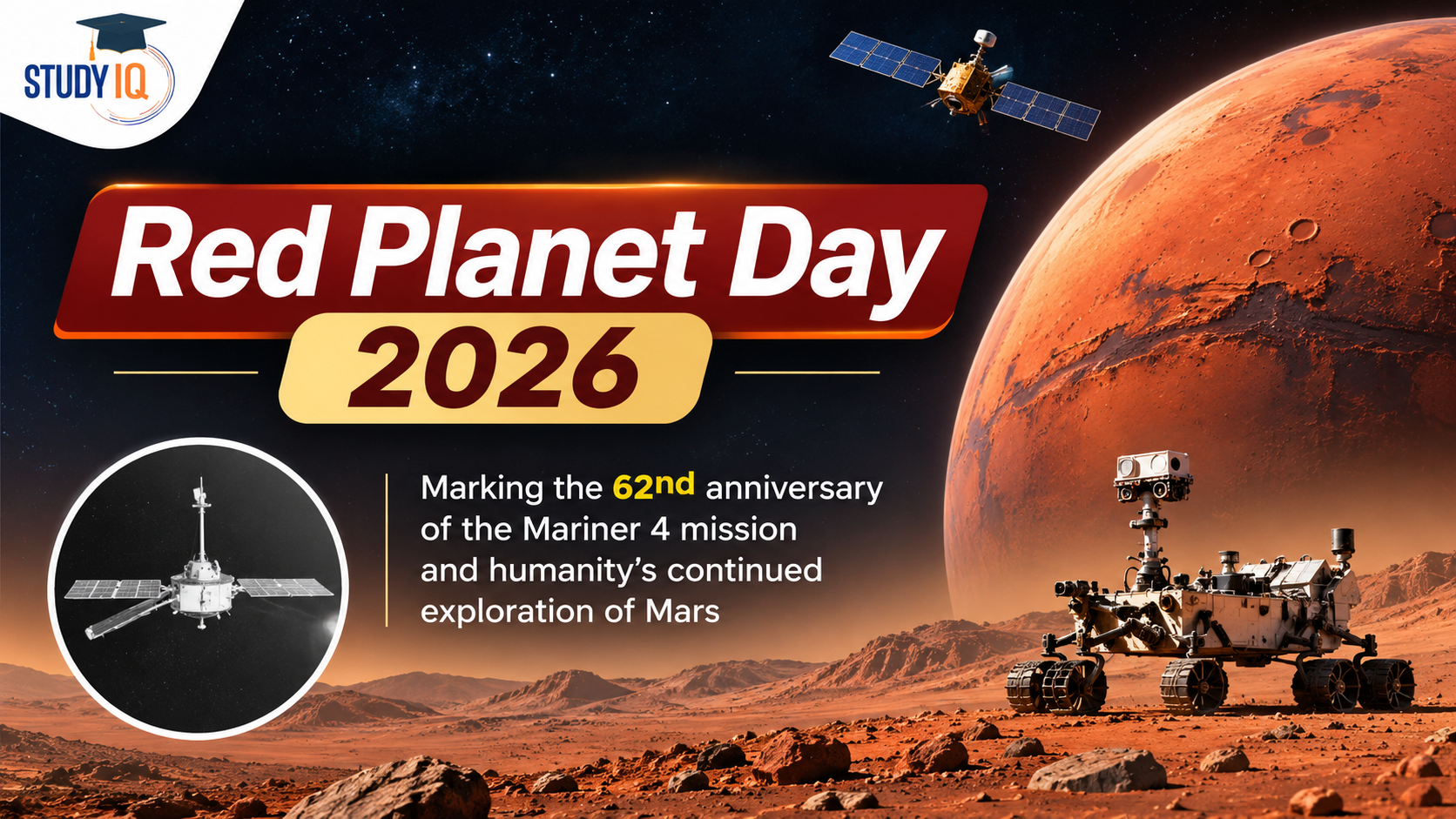
Red Planet Day is observed annually on November 28 to commemorate the launch of NASA’s Mariner 4 spacecraft on November 28, 1964. The mission marked a historic milestone in planetary exploration by becoming the first successful spacecraft to conduct a close flyby of Mars and transmit close-up images of the planet to Earth.
In 2026, the occasion marks the 62nd anniversary of the Mariner 4 launch. The day highlights humanity’s efforts to understand Mars, its geological evolution, evidence of ancient water and the possibility of past microbial life.
History and Significance of Red Planet Day
Red Planet Day is associated with the launch of NASA’s Mariner 4 spacecraft from Cape Canaveral, Florida, on November 28, 1964.
After travelling for approximately eight months, Mariner 4 made its closest approach to Mars on July 14, 1965. It transmitted 22 close-up images, providing humanity with its first detailed photographs of the Martian surface.
The images revealed a heavily cratered landscape, challenging earlier assumptions about Mars and transforming scientific understanding of the planet.
The day recognises the importance of planetary exploration, space science and international efforts to study the possibility of life beyond Earth.
Mariner 4 Mission: Key Facts
| Particulars | Details |
|---|---|
| Space Agency | NASA, USA |
| Mission | Mariner 4 |
| Launch Date | November 28, 1964 |
| Launch Vehicle | Atlas-Agena D |
| Launch Site | Cape Canaveral, Florida |
| Target | Mars |
| Closest Approach | July 14, 1965 |
| Mission Type | Planetary Flyby |
| Images Transmitted | 22 close-up images |
| End of Mission | December 1967 |
Why Is Mars Called the Red Planet?
Mars is known as the Red Planet because of its reddish appearance, which is caused by iron oxide (rust) present in its surface materials and dust.
When iron-bearing minerals react with oxygen, oxidation produces reddish compounds. Dust containing these materials covers much of the Martian surface, giving the planet its characteristic colour.
Important Characteristics of Mars
Mars is the fourth planet from the Sun and belongs to the terrestrial or rocky planet category.
| Characteristics | Details |
|---|---|
| Position | Fourth planet from the Sun |
| Planet Type | Terrestrial (Rocky) |
| Natural Satellites | Phobos and Deimos |
| Atmosphere | Primarily carbon dioxide |
| Length of a Day | Approximately 24 hours 39 minutes |
| Length of a Year | Approximately 687 Earth days |
| Largest Volcano | Olympus Mons |
| Surface Features | Craters, valleys, volcanoes and polar ice caps |
Major Discoveries of the Mariner 4 Mission
Mariner 4 significantly transformed scientific understanding of Mars through its photographs and atmospheric measurements.
1. First Close-Up Images: It transmitted the first close-up photographs of Mars, revealing a heavily cratered surface.
2. Thin Atmosphere: Radio occultation experiments helped scientists determine that Mars has a much thinner atmosphere than Earth.
3. Geological Characteristics: The images revealed impact craters and provided important information about the planet’s geological history.
4. Foundation for Future Exploration: The mission demonstrated the feasibility of interplanetary spacecraft operations and paved the way for subsequent Mars missions.
Important Mars Exploration Missions
Several space agencies have launched missions to study the Martian surface, atmosphere, climate and potential habitability.
| Mission | Agency/Country | Major Achievement |
|---|---|---|
| Mariner 4 (1964) | NASA, USA | First successful Mars flyby |
| Mariner 9 (1971) | NASA, USA | First spacecraft to orbit Mars |
| Viking 1 (1976) | NASA, USA | First successful US Mars lander |
| Mars Pathfinder (1997) | NASA, USA | Deployed Sojourner rover |
| Mars Express (2003) | ESA | Studied Martian surface and atmosphere |
| MAVEN (2013) | NASA, USA | Studies atmospheric loss |
| Hope Probe (2020) | UAE | Studies Mars’ atmosphere and climate |
| Tianwen-1 (2020) | China | Deployed Zhurong rover |
| Perseverance (2020) | NASA, USA | Searches for signs of ancient microbial life and collects samples |
| Curiosity (2011 launch) | NASA, USA | Investigates Martian geology and past habitability |
India’s Mars Exploration Programme: Mangalyaan
India entered the field of interplanetary exploration with its Mars Orbiter Mission (MOM), popularly known as Mangalyaan.
Developed by the Indian Space Research Organisation (ISRO), it was India’s first interplanetary mission. The spacecraft was launched on November 5, 2013, using the PSLV-C25 launch vehicle from the Satish Dhawan Space Centre, Sriharikota.
Mangalyaan successfully entered Mars orbit on September 24, 2014. India became the first country to successfully reach Mars orbit in its maiden attempt.
Key Facts About Mangalyaan
| Particulars | Details |
|---|---|
| Mission Name | Mars Orbiter Mission (MOM) |
| Popular Name | Mangalyaan |
| Space Agency | ISRO |
| Launch Date | November 5, 2013 |
| Launch Vehicle | PSLV-C25 |
| Launch Site | Sriharikota, India |
| Mars Orbit Insertion | September 24, 2014 |
| Scientific Payloads | Five |
| Mission Type | Orbiter |
Major Achievements of Mangalyaan
-
India became the first country to reach Mars orbit successfully in its maiden attempt.
-
ISRO became the fourth space agency to successfully send a spacecraft into Mars orbit.
-
The mission studied Martian surface features, morphology, mineralogy and atmosphere.
-
Its scientific instruments included the Mars Colour Camera (MCC) and Methane Sensor for Mars (MSM).
-
Although designed for a six-month mission life, Mangalyaan operated in Martian orbit for more than eight years.
-
The mission was declared non-recoverable after communication with the spacecraft was lost in September 2022.

 Delimitation in India 2026: Meaning, Con...
 Karnataka Judiciary Notification 2026 Ou...
 BepiColombo Mission 2026: European-Japan...














 WhatsApp