Table of Contents
The Supreme Court has clarified an important question concerning the limits of criminal liability during a medical examination: Can a person be prosecuted for obstructing a public servant merely because they initially resist their own medical examination?
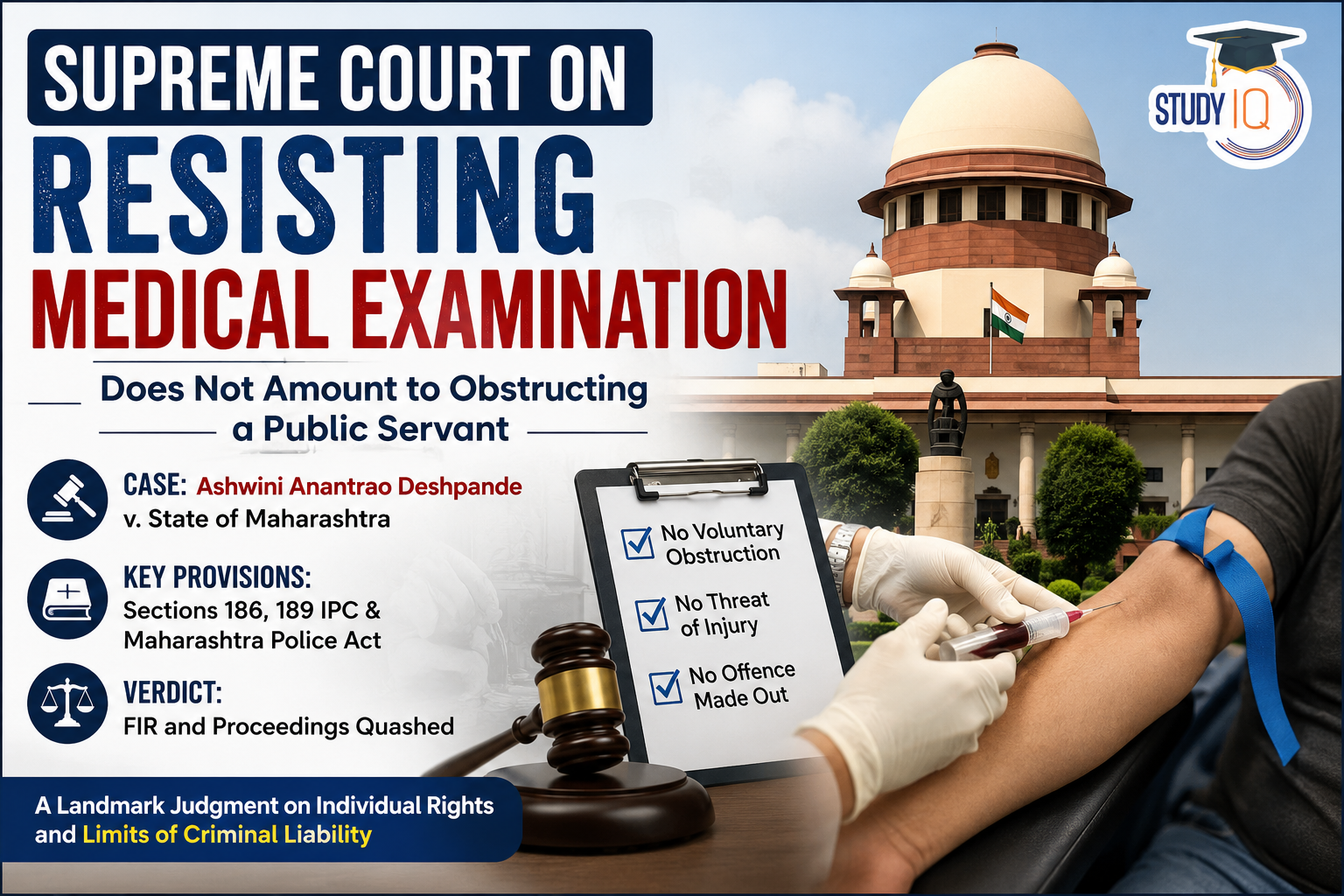
In Ashwini Anantrao Deshpande v. State of Maharashtra, the Supreme Court examined whether the allegations against the appellant attracted offences under Sections 186 and 189 of the Indian Penal Code (IPC) and provisions of the Maharashtra Police Act, 1951.
The judgment is significant for UPSC, State PCS, Judiciary and law aspirants because it highlights the importance of examining the essential ingredients of an offence before criminal proceedings are allowed to continue.
Ashwini Anantrao Deshpande Case: Background
The case arose from an incident dated May 4, 2021, involving the appellant, who was working as a Lekhapal (Accountant) at the Forest Range Office, Paratwada.
She was allegedly found in an intoxicated condition and was creating a disturbance. Following communication from the Forest Range Officer, police personnel accompanied her to the Sub-District Hospital, Achalpur, for a medical examination.
During the visit, the appellant initially resisted the medical examination and created a scene. However, she was subsequently persuaded to undergo the examination, and her blood sample was ultimately collected.
Despite this, an FIR was registered against her, invoking, among other provisions:
- Section 186 IPC – Obstructing a public servant in discharge of public functions
- Section 189 IPC – Threat of injury to a public servant
- Relevant provisions of the Maharashtra Police Act, 1951
The Bombay High Court declined to quash the proceedings. The matter consequently reached the Supreme Court.
What Was the Supreme Court Asked to Decide?
The central issue before the Supreme Court was essentially whether resisting one’s own medical examination could amount to voluntarily obstructing a public servant in the discharge of their public functions under Section 186 IPC.
The Court examined the allegations on their face and considered whether the basic ingredients necessary to constitute the alleged offences were present.
Section 186 IPC: What Does It Mean?
Section 186 IPC dealt with voluntarily obstructing a public servant in the discharge of public functions.
For such an offence to be established, the prosecution must demonstrate more than the mere existence of a public servant and some disagreement or resistance.
There must be voluntary obstruction of the public servant in the performance of a public function.
The Supreme Court found that the allegation that the appellant initially resisted her own medical examination did not, in the circumstances of the case, satisfy this requirement.
Importantly, the prosecution witnesses themselves indicated that she was eventually persuaded and the medical examination was completed and her blood sample was collected.
Thus, the Court found it difficult to treat her conduct as the kind of obstruction contemplated by Section 186 IPC.
Section 189 IPC: Why Was the Charge Unsustainable?
The appellant was also charged under Section 189 IPC, which concerns threatening a public servant with injury with the intention of inducing the public servant to do, omit or delay an act connected with their public functions.
The Supreme Court observed that the essential ingredient of a threat of injury to a public servant was not apparent from the facts.
In other words, merely resisting a medical examination could not automatically be transformed into an offence under Section 189 IPC without the prosecution establishing the specific statutory ingredients.
Maharashtra Police Act Provisions
The Supreme Court also considered the provisions of the Maharashtra Police Act, 1951 invoked against the appellant.
The Court questioned how the relevant provisions could be attracted on the facts presented in the case.
This reinforces a fundamental criminal-law principle:
A criminal charge cannot survive merely because an incident appears undesirable or disorderly; the facts must satisfy the precise ingredients of the statutory offence.
Supreme Court’s Final Decision
A bench comprising Justice K.V. Viswanathan and Justice Arun Palli allowed the appeal.
The Court set aside the Bombay High Court’s order and concluded that, even if the prosecution’s allegations were taken at their highest, the essential ingredients of the offences invoked against the appellant were not established.
Consequently, the Supreme Court quashed the FIR and all consequential proceedings, including the chargesheet.
Section 528 BNSS and Inherent Powers of High Courts
Another important aspect of the judgment is the role of the High Court’s inherent powers.
Section 528 of the Bharatiya Nagarik Suraksha Sanhita, 2023 (BNSS) preserves the inherent powers of the High Court. It enables the High Court to pass appropriate orders to:
- give effect to an order under the BNSS;
- prevent abuse of the process of any court; or
- otherwise secure the ends of justice.
It broadly corresponds to Section 482 of the erstwhile Code of Criminal Procedure, 1973 (CrPC).
The case therefore provides an important example of circumstances in which higher judicial intervention may be justified where the allegations, even if accepted at face value, do not disclose the commission of the alleged offences.
Key Legal Principles
1. Ingredients of the offence are crucial
Criminal liability cannot be established merely because a person’s conduct appears improper or inconvenient.
The prosecution must establish the essential ingredients prescribed by the relevant penal provision.
2. Resistance is not automatically obstruction
The judgment illustrates that resisting one’s own medical examination, particularly where the person ultimately submits to the examination, does not by itself establish an offence under Section 186 IPC.
3. Specific allegations are necessary
For an offence involving a threat to a public servant, such as Section 189 IPC, the prosecution must establish the statutory requirement of a threat of injury and the requisite connection with the public servant’s official act.
4. Inherent powers prevent abuse of criminal process
Section 528 BNSS provides an important judicial safeguard against proceedings that lack the basic ingredients of an offence.
5. Individual rights and criminal investigation must be balanced
The judgment is relevant to the broader constitutional principle that state authority and criminal procedure must operate within the boundaries prescribed by law.
Mains Perspective
The judgment can be used in answers dealing with rule of law, individual liberty, criminal justice, police powers, judicial review and prevention of abuse of process.
A useful way to incorporate it into a Mains answer is:
“The Supreme Court’s decision in Ashwini Anantrao Deshpande v. State of Maharashtra underscores that criminal prosecution must satisfy the essential ingredients of the penal provision. Mere resistance to one’s own medical examination, without the requisite elements of voluntary obstruction or threat, cannot automatically attract penal liability.”
This can be linked to Article 21, which protects life and personal liberty, as well as the broader principle that state action must have a clear legal basis and cannot become arbitrary merely because an individual does not immediately cooperate with an official procedure.
Conclusion
The Ashwini Anantrao Deshpande v. State of Maharashtra judgment is an important reminder that criminal law must be applied according to the precise language and ingredients of the offence.
For aspirants, the case demonstrates three important principles: mere resistance does not automatically constitute obstruction, criminal charges require the statutory ingredients to be satisfied, and inherent judicial powers can be exercised to prevent abuse of the criminal process.
For UPSC and Judiciary preparation, it is a useful case study on the balance between public authority, individual liberty and the rule of law.
Sharing is caring!
 Special Summary Revision (SSR) 2026–27...
 Global Hunger Index 2026: India Ranks 10...
 France Protests 2026: Cost of Living, Sc...













 WhatsApp