
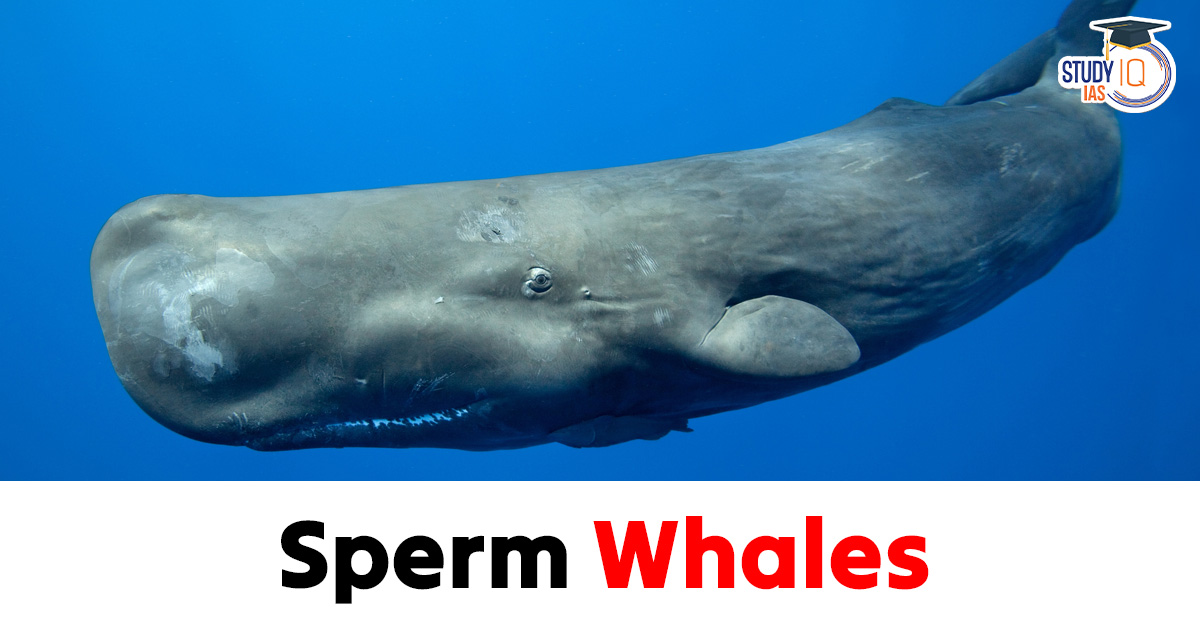
Context: Researchers have captured high-definition footage of a sperm whale birth off the coast of Mauritius, providing a firsthand look at the sophisticated “midwifery” and protective social behaviours of the pod.
About Sperm Whales
- Physical Features: Distinguishable by their massive, square-shaped heads (which house the spermaceti organ) and a single S-shaped blowhole located on the front left.
- They have a dark, wrinkled skin texture and the largest brain of any animal on Earth.
- Habitat Preference: They are a pelagic species (open ocean) that prefers deep waters, typically near edge-of-shelf breaks and underwater canyons, where they can dive over 2,000 meters to hunt.
- Global Presence: They are found across all ice-free marine waters.
- Major populations exist in the Indian Ocean, the South Pacific, and the North Atlantic.
- Hotspots in India: Sightings and strandings have been recorded primarily along the Lakshadweep archipelago, the Andaman and Nicobar Islands, and deep-water zones off the Kerala and Tamil Nadu coasts.
- Ecological Role: As apex predators, they regulate deep-sea ecosystems by consuming large quantities of squid (including Giant Squid).
- Their nutrient-rich faecal plumes also stimulate phytoplankton growth, which traps carbon from the atmosphere.
- IUCN Red List Status: Vulnerable
- WPA Status: Schedule I
- CITES: Appendix I

 Jungle Cats: Habitat, Characteristics an...
 EV Charging Infrastructure: Background, ...
 New Butterfly Species Euthalia Zubeengar...













 WhatsApp





