Table of Contents
Species in News: Cheetah-Why in News?
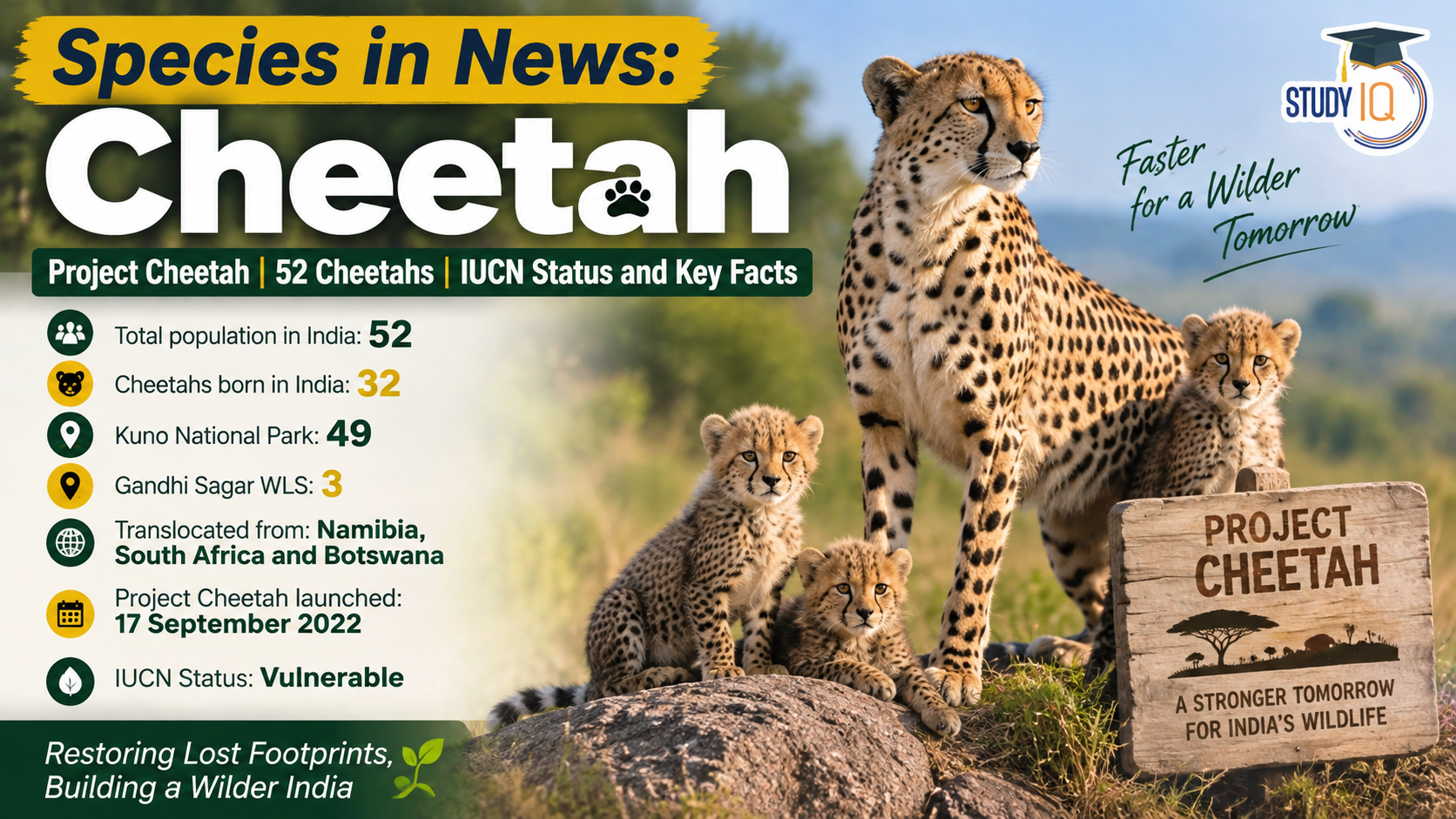
The cheetah is in the news as Project Cheetah completes four years on 17 September 2026. According to the four-year status review, India’s cheetah population has reached 52, including 32 cheetahs born in India.
At present, 49 cheetahs are in Kuno National Park and three are in Gandhi Sagar Wildlife Sanctuary, both in Madhya Pradesh. The next phase of the programme is expected to focus increasingly on habitat expansion and establishing a long-term cheetah metapopulation in India.
Read Also: UPSC Daily Current Affairs 2026
Project Cheetah: Key Details
| Parameter | Details |
|---|---|
| Current cheetah population | 52 |
| India-born cheetahs | 32 |
| Kuno National Park | 49 |
| Gandhi Sagar Wildlife Sanctuary | 3 |
| Project Cheetah launched | 17 September 2022 |
| First batch | 8 cheetahs from Namibia |
| South Africa | 12 cheetahs introduced in February 2023 |
| Botswana | 9 cheetahs introduced in February 2026 |
| Current states with cheetahs | Madhya Pradesh |
| Scientific name | Acinonyx jubatus |
| Family | Felidae |
| IUCN status | Vulnerable |
The four-year review covers the period from 17 September 2022 to 17 September 2026.
What is Project Cheetah?
Project Cheetah is India’s programme for the reintroduction of cheetahs into the country after the species became extinct in India.
The programme was launched on 17 September 2022, when the first eight cheetahs from Namibia were brought to Kuno National Park in Madhya Pradesh.
The programme focuses on:
- Reintroducing cheetahs into suitable habitats
- Establishing a viable breeding population
- Monitoring animal health and behaviour
- Improving habitat and prey availability
- Developing multiple suitable sites
- Creating a long-term cheetah metapopulation
Cheetah Reintroduction in India
1. Namibia — 2022
The first eight cheetahs arrived from Namibia on 17 September 2022 and were released into special enclosures at Kuno National Park.
2. South Africa — 2023
A second batch of 12 cheetahs from South Africa arrived in February 2023.
3. Botswana — 2026
In February 2026, nine cheetahs from Botswana were brought to India to strengthen the population and broaden its genetic base.
Thus, the programme represents an intercontinental wildlife translocation programme involving multiple African range countries.
Latest Status of Cheetahs in India
As of 17 September 2026:
- India’s total cheetah population: 52
- Cheetahs born in India: 32
- Kuno National Park: 49
- Gandhi Sagar Wildlife Sanctuary: 3
The programme has progressed through several stages, including reintroduction, breeding, cub survival and expansion into open forest landscapes.
An important milestone in 2026 was the birth of four cubs to an Indian-born female cheetah in the wild at Kuno, demonstrating reproduction by a second-generation Indian-born cheetah under natural conditions.
Why is Project Cheetah Important?
1. Restoration of a Species
The cheetah became extinct in India, with the last confirmed records dating to 1947 and the species officially considered extinct in India in 1952.
The reintroduction programme seeks to restore this lost component of India’s wildlife heritage.
2. Grassland and Open-Natural-Ecosystem Conservation
Cheetahs require large landscapes with adequate prey. Therefore, their conservation can contribute to the protection and restoration of grasslands and other open natural ecosystems.
3. Establishment of a Breeding Population
The objective is not simply to maintain imported animals but to establish a self-sustaining population through natural breeding.
4. Landscape-Level Conservation
The programme is increasingly moving beyond individual protected areas towards habitat connectivity, prey availability and landscape-level management.
Kuno National Park
Kuno National Park in Madhya Pradesh is the principal site of Project Cheetah.
It was selected because of factors including:
- Suitable habitat
- Adequate prey base
- Relatively low human disturbance
- Availability of a large landscape for cheetah management
The park has been the centre of India’s cheetah reintroduction, breeding and monitoring programme since 2022.
Gandhi Sagar Wildlife Sanctuary
Gandhi Sagar Wildlife Sanctuary in Madhya Pradesh has become the second important location under Project Cheetah.
As of September 2026, three cheetahs are located there. The expansion from Kuno to Gandhi Sagar is significant because establishing populations at more than one site can support the programme’s longer-term objective of developing a metapopulation.
Future Sites for Cheetah Conservation
The government has identified additional landscapes for potential future cheetah conservation and release.
These include:
- Banni Grasslands, Gujarat
- Nauradehi Wildlife Sanctuary, Madhya Pradesh
The broader approach is to ensure adequate habitat, prey base and ecological connectivity for the long-term recovery of the species.
Cheetah: Prelims Facts
Scientific Classification
- Scientific name: Acinonyx jubatus
- Family: Felidae
- Order: Carnivora
- Class: Mammalia
- IUCN Red List: Vulnerable
Important Features
- Cheetahs are specialised predators adapted to open habitats.
- They are known for exceptional acceleration and speed over short distances.
- Unlike most big cats, cheetahs have relatively non-retractable claws that provide traction while running.
- Their conservation requires large, connected landscapes with sufficient prey.
Major Challenges
The long-term success of Project Cheetah depends on:
- Adequate prey availability
- Large and connected habitats
- Successful breeding
- Cub survival
- Genetic diversity
- Disease and veterinary management
- Human-wildlife coexistence
- Expansion beyond a single major population
- Effective landscape-level management
The current phase therefore involves a shift from simply reintroducing animals towards ensuring their long-term ecological establishment.

 Quantum Computing: RRI Scientists Demons...
 Artificial Intelligence in Warfare: How ...
 Daily Current Affairs PDF 2026: Download...














 WhatsApp