Table of Contents
What are Self Help Groups (SHGs)?
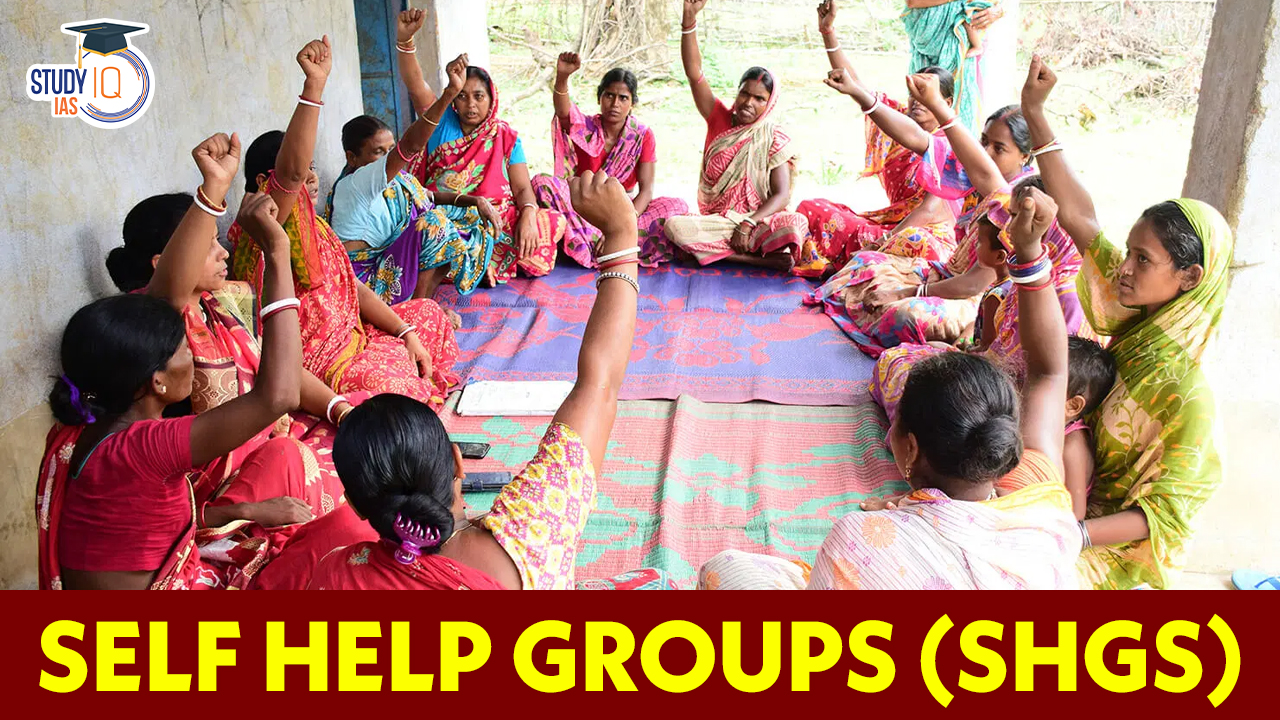
- A Self-Help Group is defined as a “self-governed, peer-controlled information group of people with similar socio-economic background and having a desire to collectively perform a common purpose.”
- It is a method of organising the poor people and the marginalised to come together to solve their individual problems.
- The poor collect their savings and save them in banks. In return, they receive easy access to loans with a low rate of interest to start their micro unit enterprise.
- The SHG method is used by the government, NGOs and others worldwide.
Historical background
- The first-ever SHG started from the Gramin Bank of Bangladesh. This group was created by Chittagong University economist Professor Mohammed Yunus in 1975 to provide small loans to impoverished individuals, primarily women, to help them start or expand businesses.
- SHGs became the path for rural loans in many regions of the world in a short period of time. In 1947, at the World Microcredit Summit in Washington, many developed and rich countries offered to use micro credit facilities in rural areas to avoid rural poverty.
| About the ‘Lakhpati Didi’ Scheme |
The government is planning skill development training for two crore women under the ‘Lakhpati Didi’ scheme.
|
How Does SHGs Function?
- An SHG normally consists of not less than five persons (with a maximum of twenty) of similar economic outlook and social status.
- The members of the group help each other to solve their problems. A reasonably educated but helpful local person takes the lead in mobilising these people to form a group.
- The person, called an animator or facilitator, helps the group members develop the habit of thrift and promote small savings among them. The group savings are kept in a common bank account from which small loans are given to members.
- After six months, the SHG can approach any bank to avail a loan facility to undertake a suitable entrepreneurial activity.
- The group loan is distributed among the members to run a small business. The loan is repaid out of the profits earned.
Self Help Groups Types
In India, a variety of self-help groups are active. The three stages of evolution that all of these SHGs typically go through are –
- Group Formation
- Funding collection
- Increasing the group’s ability to generate income by acquiring the necessary abilities.
To promote the agencies, many self-help groups are formed with the help of self-help only. There are many types of self-help promoting agencies-
- SHG federations
- Self-help group entrepreneurs
- Poverty management programs
- Non-government agencies
- Government
- State and commercial banks
- Microfinance institutions
Evolution of SHGs in India
- The origin of SHGs in India can be traced back to the establishment of the Self-Employed Women’s Association (SEWA) in 1972.
- SHG, as an organised way for poverty eradication, emerged during the 7thFive-Year Plan (1985-90).
- The SHG Bank Linkage Project initiated by NABARD in 1992 has grown into the largest microfinance endeavour globally.
- In 1993, NABARD, in collaboration with RBI, authorised SHGs to establish savings accounts in banks. This decision significantly propelled the SHG movement.
- In 1999, the Government of India introduced the Swarn Jayanti Gram Swarozgar Yojana (SGSY) to promote self-employment in rural areas through the formation and skilling of SHGs.
- The programme evolved as a national movement in 2011 and became the National Rural Livelihoods Mission (NRLM) – the world’s largest poverty alleviation programme.
Benefits of SHGs
- Empowerment of Women: SHGs have played a crucial role in empowering women in rural areas by providing them with a platform to voice their opinions, make decisions, and take control of their lives.
- India boasts of some 12 million SHGs, of which 88 per cent are all-women-member ones.
- Financial Inclusion: SHGs promote financial inclusion by encouraging members to save regularly and access credit from formal financial institutions.
- Poverty Alleviation: SHGs contribute to poverty alleviation by promoting income-generating activities, providing access to credit for small businesses, and enhancing livelihood opportunities for members.
- Skill Development and Entrepreneurship: SHGs encourage skill development and entrepreneurship by providing a platform for members to learn new skills and engage in income-generating activities.
- Social Capital: SHGs build social capital among members, enabling them to collectively negotiate for better services, resources, and rights from local authorities and institutions.
Several Concerns associated with SHGs
- Credit Mobilisation: A study has shown that about 48% of the members had to borrow from local money lenders, relatives and neighbours because they were getting inadequate loans from groups. Also, issues like hoarding of money were witnessed.
- Lack of training and capacity building: Most of the SHGs work on their own without outreach from the state for skill development and capacity building.
- Lack of Technology: Most of the SHGs work with rudimentary or no technology.
- Politicisation: Political affiliation and interference have become a serious problem with SHGs. Political affiliation is also a major reason for group conflicts.
- Too much dependence on government and NGOs: Many SHGs are dependent on the promoter agencies for their survival. In case these agencies withdraw their support, the SHGs are vulnerable to downfall.
- Lacks security: SHGs are mostly not registered. They are run based on the trust between the members. The savings made by the SHG members may not be safe, which brings in mistrust between the members.
Initiatives to Promote SHGs
| Initiatives | Details |
| Self Help Group-Bank Linkage Programme |
|
| Priority Sector Lending |
|
| Grain banks |
|
| Priyadarshini scheme |
|
| Deendayal Antodaya Yojana – National Rural Livelihoods Mission (DAY-NRLM) |
|
Case Studies on SHGs
Kudumbashree in Kerala
It was launched in Kerala in 1998 to wipe out absolute poverty through community action. It is the largest women’s empowerment project in the country. It has three components, i.e., microcredit, entrepreneurship and empowerment. It has a three-tier structure – neighbourhood groups (SHG), area development society (15-20 SHGs) and Community development society (federation of all groups). Kudumbashree is a government agency that has a budget and staff paid by the government. The three tiers are also managed by unpaid volunteers.
Mahila Arthik Vikas Mahamandal (MAVIM) in Maharashtra
SHGs in Maharashtra were unable to cope with the growing volume and financial transactions and needed professional help. Community Managed Resource Centre (CMRC) under MAVIM was launched to provide financial and livelihood services to SHGs. CMRC is self-sustaining and provides need-based services.
Way Forward
- Integrated Approach for Credit and Linkages: This involves connecting SHGs with technology, processing, and marketing organisations to ensure a comprehensive support system that addresses various aspects of their livelihoods.
- Diversified Credit Activities: This suggestion highlights the need to offer credit for a diverse range of activities that contribute to income generation, livelihood enhancement, housing, consumption needs, and even emergencies.
- Responsive Delivery System: To improve the functioning of SHGs, the delivery system should be proactive and responsive to the financial needs of the members, particularly farmers.
- Training Programs: These programs could cover topics such as financial management, record-keeping, production techniques, marketing strategies, and other skills that contribute to successful entrepreneurship.
- Gender Sensitisation: Recognising the important role of women in SHGs, it is suggested to provide gender sensitisation training to bank staff who interact with SHG members.
- Insurance Coverage: Protect SHG-promoted businesses with adequate insurance against unforeseen losses.

 NAMASTE Scheme: Objectives, Features and...
 River Basin Management (RBM) Scheme: Obj...
 Skills Outcomes Fund: Purpose, Benefits ...









 WhatsApp