
Table of Contents
Context
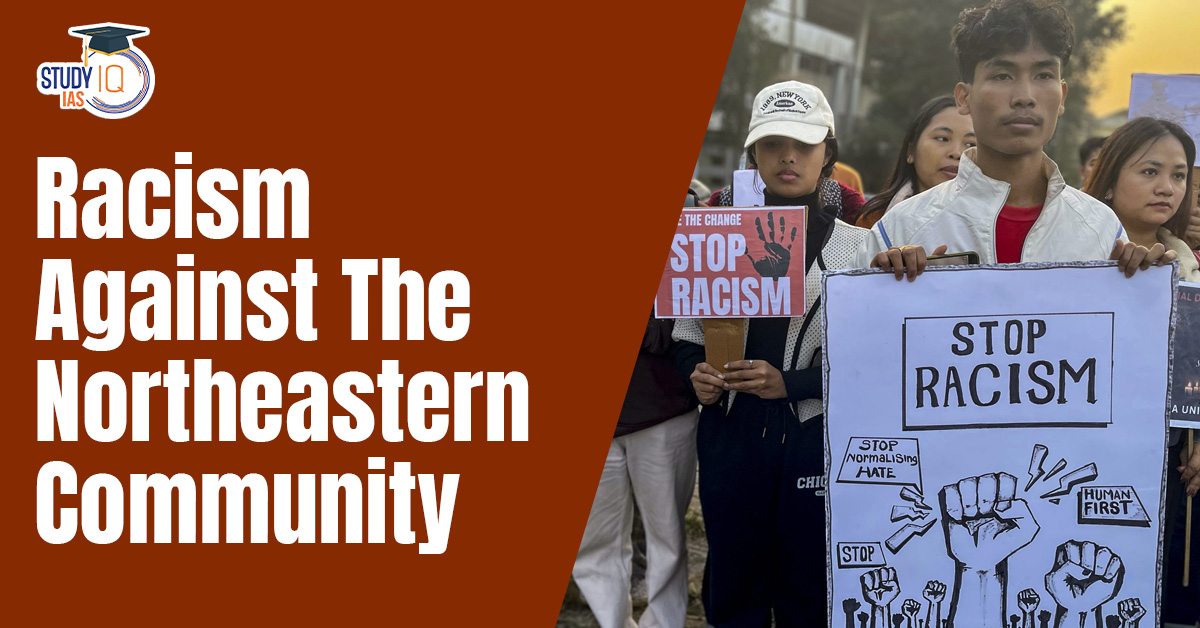
The Union Ministry of Home Affairs (MHA) has recently directed cities in the National Capital Region (NCR), including Noida and Ghaziabad, to appoint nodal officers to address discrimination and racial issues faced by people from the Northeastern states. Delhi and Gurgaon already have such officers in place.
About Casual Racism
| Casual Racism |
|
Socio-cultural Roots of Discrimination against the Northeastern Community
- Historical invisibility: School curricula have traditionally focused on the Gangetic plains, leaving histories of the Northeast, such as the Ahom dynasty or regional freedom movements, largely unacknowledged.
- Impact: Lack of awareness fosters ignorance and reinforces stereotypes rather than promoting familiarity.
- Phenotypic stereotyping: Mongoloid features are often wrongly associated with being “foreign,” giving rise to slurs like “chinky” or “Chinese.”
- Impact: Such perceptions create a racial hierarchy, contradicting India’s pluralistic ethos.
- Stereotype formation: Distinct food, attire, and gender norms of the Northeast are often exoticised or moralised.
- Impact: This leads to hyper-sexualisation of women and dehumanisation of men, reinforcing social prejudice.
- Casual racism and micro-aggression: Everyday jokes, chants, and slurs normalise disrespect, lowering social and moral thresholds for discriminatory behaviour.
- Escalation to physical violence: Verbal abuse can evolve into physical assault, as in Nido Tania’s murder, consistent with sociological frameworks like Allport’s scale of prejudice.
- Power asymmetry and urban vulnerability: Many migrants from the Northeast work in hospitality and retail, making them susceptible to landlord harassment, workplace exploitation, and policing apathy.
- Impact: Structural impunity enables perpetrators to act without fear of consequences.
- Policing deficit: Instances where racial slurs are dismissed as “jokes,” such as in Anjel Chakma’s case, indicate a lack of recognition for hate crimes, weakening deterrence.
- Partial legal response: Measures like SPUNER, nodal officers, and IPC amendments suggested by the Bezbaruah Committee (2014) exist, but implementation is uneven and politically under-prioritised.
Impact on National Unity and Integration
- Psychological alienation and citizenship anxiety: Repeated questioning of one’s nationality violates Articles 14 and 21, leading to emotional alienation from the constitutional mainstream.
- Social fragmentation and ghettoisation: Fear-driven clustering of Northeastern communities reduces multicultural interactions, undermining composite nationalism as envisioned by B.R. Ambedkar.
- Threat to national cohesion: Persistent racism fosters distrust in state institutions, weakening social capital and indirectly affecting national security, as highlighted in the 2nd ARC Reports.
M.P. Bezbaruah Committee
| M.P. Bezbaruah Committee |
About: The M.P. Bezbaruah Committee, constituted by the Ministry of Home Affairs, examined issues faced by citizens from the North Eastern states living elsewhere in India. It proposed a range of remedial measures, including legal, administrative, and social interventions, to protect their rights and ensure safety.
Key Recommendations
|

 LPG Gas Shortage in India 2026: Is There...
 India Lockdown 2026: Is Another Lockdown...
 Strait of Hormuz Crisis: Causes, Impact ...












 WhatsApp





