
Table of Contents
Context: The high-profile Delhi excise policy case recently fell apart after a trial court refused to even frame charges, observing that there was no prima facie evidence of bribery or criminal conspiracy.
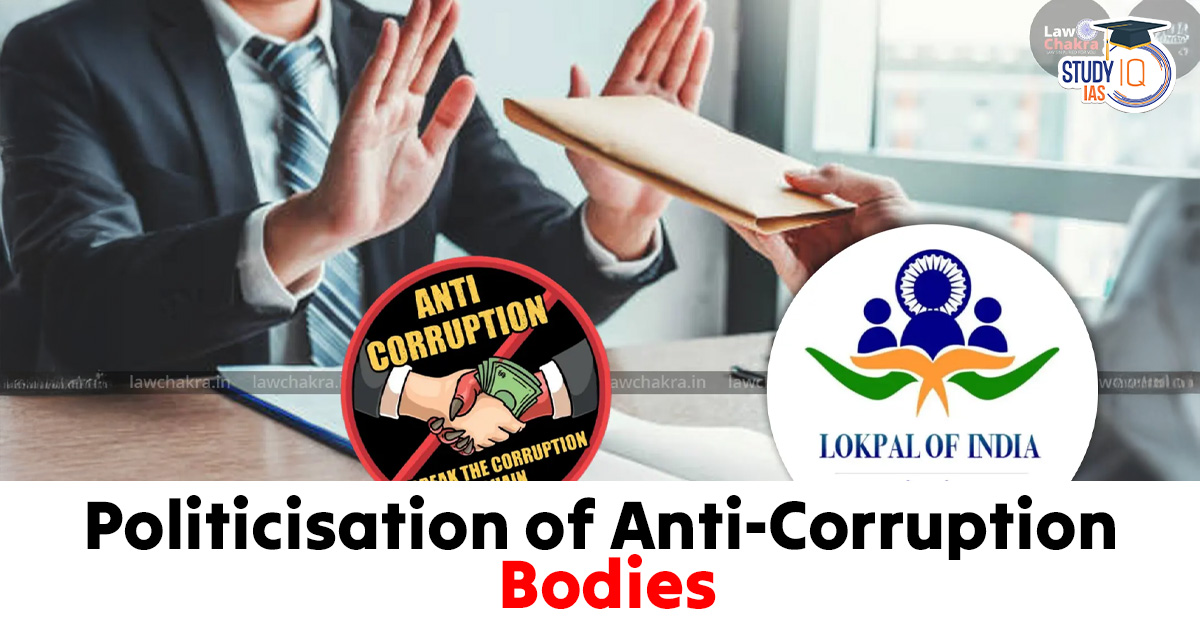
Politicisation of Anti-Corruption Bodies
- About anti-corruption bodies: These are specialised institutions tasked with preventing, detecting, and investigating corruption in both public and private sectors. In India, key agencies include:
- Central Bureau of Investigation (CBI): The main investigative body handling corruption and major economic offences.
- Enforcement Directorate (ED): Deals with financial crimes such as money laundering and violations of economic laws.
- Central Vigilance Commission (CVC): A top advisory body supervising vigilance mechanisms in the central government.
- Lokpal/Lokayuktas: Statutory institutions at the central and state levels that examine corruption allegations against public officials.
Factors Contributing to Politicisation
- External influence on FIR Registration: Investigations may be initiated due to political pressure rather than strong evidence.
- Eg: The Delhi excise case raised concerns when it collapsed despite months of intense media coverage.
- Executive control over agencies: Dependence on the political executive can undermine institutional autonomy and credibility.
- Eg: Arrests of leaders in Delhi influenced political discourse before charges were established.
- Use of criminal law for political ends: Legal action is increasingly viewed as a political tool rather than a purely judicial process.
- Eg: High-profile arrests linked to public contracts often dominate media narratives during elections.
- Weak evidentiary basis: Cases are sometimes built on suspicion rather than robust forensic or financial evidence.
- Eg: The excise policy case failed due to the inability to establish a prima facie case of conspiracy.
Implications of Politicisation of Anti-Corruption Bodies
- Loss of institutional credibility: Failure of cases at early stages weakens public trust in anti-corruption agencies.
- Rising public distrust: Frequent allegations without convictions foster cynicism about the justice system.
- Damage to Reputation and Liberty: Individuals may face prolonged detention and reputational harm without proven guilt.
- Eg: Former Delhi ministers spent months in custody before courts found insufficient evidence.
- Inefficient use of resources: Focusing on politically sensitive but weak cases diverts attention from pressing developmental priorities.
Challenges in Addressing Politicisation
- Complex nature of corruption: Illicit activities are often concealed through indirect channels like shell companies and regulatory manipulation.
- Judicial caution in policy matters: Courts avoid criminalising policy decisions unless clear evidence of mala fide intent exists.
- Eg: The Supreme Court has emphasised that policy changes alone do not constitute a crime without proof of dishonest intent.
- Limited investigative capacity: Agencies often rely on testimonies instead of advanced financial and data analysis techniques.
- Lack of coordination: Fragmentation among agencies like the CBI and ED hampers a unified and specialised approach.
Way Ahead
- Enhance forensic capabilities: Adopt tools such as forensic accounting and data analytics to track financial transactions and ownership structures.
- Ensure institutional autonomy: Decisions on FIRs and prosecutions should be evidence-based and free from political interference.
- Meet judicial standards: Cases should only be pursued when supported by strong and legally sustainable evidence.
- Promote political restraint: Political actors must avoid misusing investigative agencies for partisan purposes.
- Improve inter-agency coordination: Develop a streamlined and expert-driven investigative framework, similar to models in countries like Singapore and Hong Kong.

 Form 6 in Electoral Rolls: Online Regist...
 US-Israel-Iran Conflict 2026: Causes, Ir...
 List of Chief Ministers of Bihar (1947 t...









 WhatsApp





