
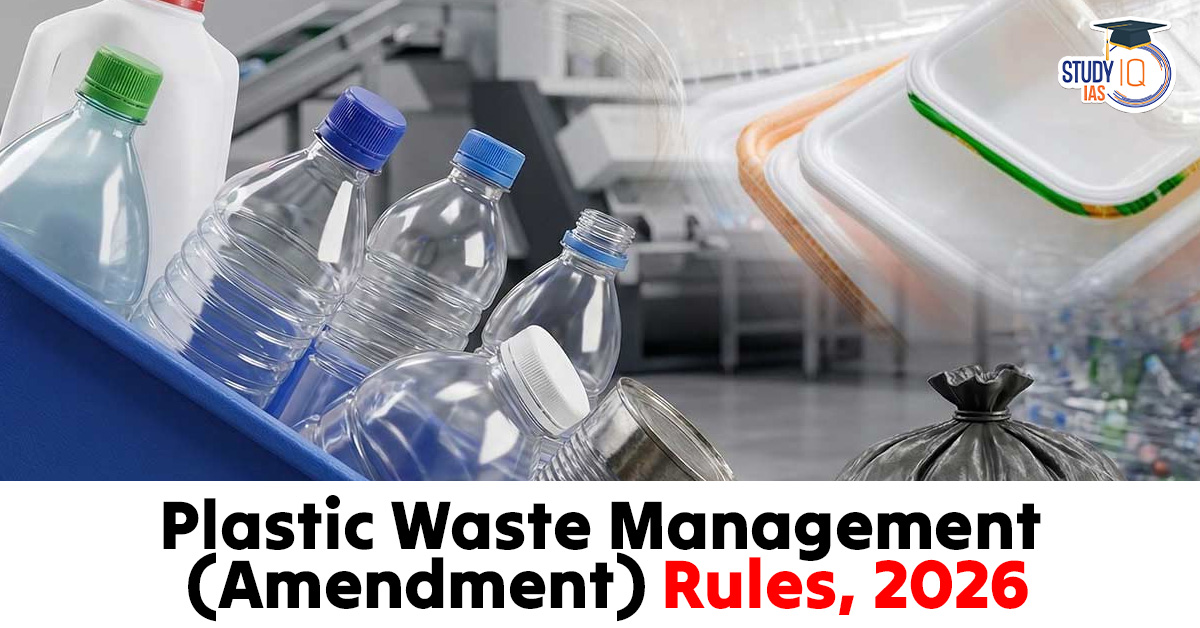
Context: The Ministry of Environment, Forest and Climate Change has reinforced the Plastic Waste Management Rules to transition from a “take-make-dispose” model to a Circular Economy.
Key Features of the Plastic Waste Management (Amendment) Rules, 2026
- Mandatory Recycled Content: For the first time, the rules mandate a specific percentage of recycled plastic in new packaging. For 2025-26, targets are set at 30% for Category I (Rigid), 10% for Category II (Flexible), and 5% for Category III (Multi-layered).
- Compliance Flexibility (Carry-Forward): Companies that fail to meet their 2025-26 recycling targets are permitted to carry forward the shortfall for up to three subsequent years, provided they fulfil at least one-third of the deficit annually.
- Tradable EPR Certificates: The rules formalise a market-based mechanism where companies exceeding their targets can sell Extended Producer Responsibility (EPR) certificates to those facing a shortfall, facilitating a flexible national compliance grid.
- Phased Targets for Reuse: Beyond recycling, the rules introduce mandatory reuse obligations for rigid plastic packaging, such as a 70% reuse target for large water carboys and 10% for smaller containers (0.9–4.9 litres) by 2025-26.
- Centralized Digital Tracking: All Producers, Importers, and Brand Owners (PIBOs) must register and file annual returns on a centralized online portal managed by the Central Pollution Control Board (CPCB) to ensure transparency in waste processing claims.
- Environmental Compensation (EC): A “Polluter Pays” regime is established where financial penalties are levied for non-compliance. These funds are earmarked for collection, shared out for recycling infrastructure, and end-of-life disposal projects.
- Exemptions for Safety Standards: The rules provide a critical exclusion where recycled content targets do not apply if they conflict with food safety regulations (FSSAI) or other specific healthcare quality standards.
- Defined Plastic Categorization: To streamline processing, plastic is strictly divided into four categories: Category I (Rigid), Category II (Flexible/Single Layer), Category III (Multi-layered), and Category IV (Compostable plastics), each with distinct trajectory benchmarks.

 Right to Promotion Consideration as a Fu...
 INS Aridhaman: India’s Nuclear Submari...
 Classification of Left-Wing Extremism (L...













 WhatsApp





