
Table of Contents
Context: Beyond its role as a global oil corridor, the Persian Gulf is a fragile “natural laboratory” where resilient ecosystems face a “point of no return” due to rapid coastal urbanisation, industrial brine discharge, and the toxic legacy of regional warfare.
About Persian Gulf
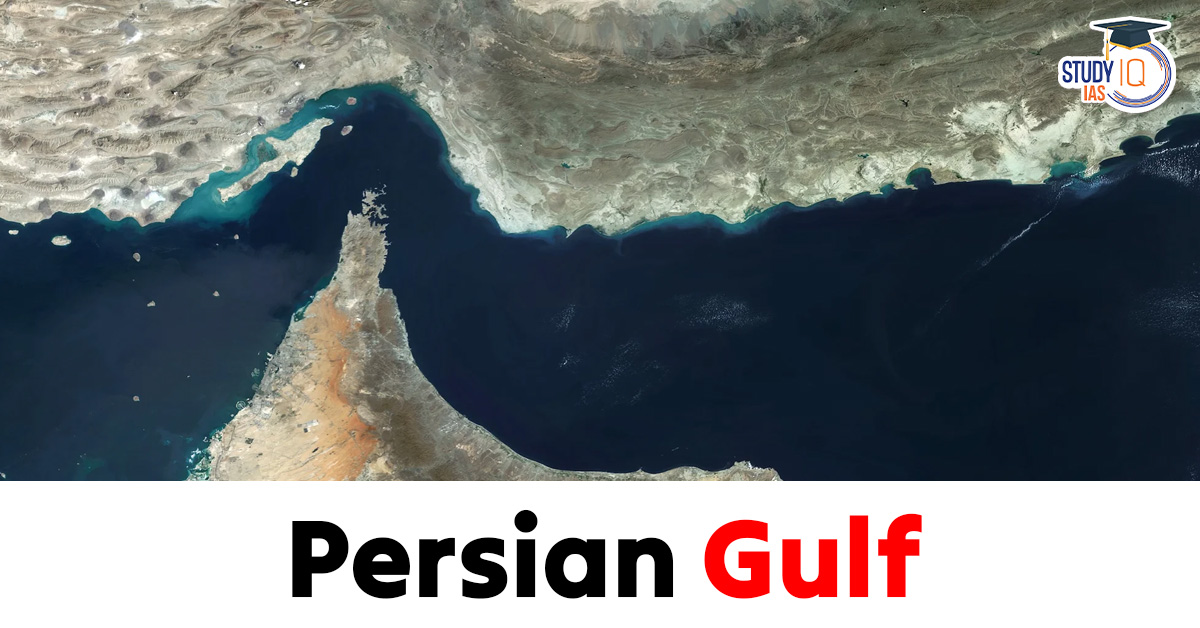
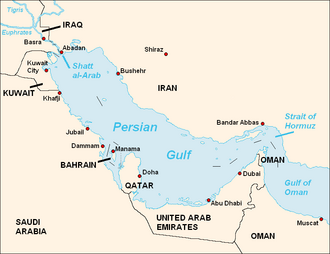
- Persian Gulf is an extension of the Indian Ocean, located between the Arabian Peninsula and southwestern Iran.
- Connectivity: It is connected to the Gulf of Oman in the east by the Strait of Hormuz.
- Dimensions: It is a shallow, semi-enclosed sea covering about 226,000 sq. km.
- Depth: It is remarkably shallow, with an average depth of only 30 meters and a maximum depth of about 90 meters.
- Primary Inflow: Shatt al-Arab (formed by the confluence of the Euphrates and Tigris).
- Major island: Qeshm Island (Iran) — the largest island in the Gulf
- Extreme Conditions: Due to its shallowness and high evaporation, it is one of the saltiest (44-70 ppt) and warmest (exceeding 35°C in summer) marine bodies in the world.
- Littoral States: Eight countries border the Gulf: Iran, Oman, United Arab Emirates, Saudi Arabia, Qatar, Bahrain, Kuwait, and Iraq.
Strategic & Economic importance
- Pearl Era: Before the oil boom, the Gulf was the world’s primary source of Basra Pearls, providing 80% of the global supply until the 1920s.
- The “Oil Chokepoint”: The Strait of Hormuz is the world’s most important oil transit chokepoint. Approximately one-fifth (20%) of global oil consumption passes through this narrow strait.
- Energy Reserves: The region contains the world’s largest single source of crude oil and massive natural gas reserves (e.g., the South Pars/North Dome field shared by Iran and Qatar).
- Desalination Hub: The Gulf hosts nearly 50% of the world’s desalination capacity, providing essential freshwater for the booming megacities of the Middle East.
Ecology
- Dugongs: The region hosts the world’s second-largest population (5,000–6,000 individuals) outside Australia. They depend entirely on the Gulf’s vast seagrass meadows.
- Sea Turtles: Five of the world’s seven species thrive here, including the critically endangered Hawksbill turtle, which nests along the coast.
- Coral Reefs: Covering an area roughly the size of Goa, these “heat-resistant” corals are vital for scientists studying how reefs might survive global climate change.
- Mangroves & Mudflats: These serve as carbon sinks, fish nurseries, and vital refuges for migratory birds.
Environmental Stressors
- Land Reclamation: In cities like Dubai, 60% of the natural coastline has been modified. Mega-projects like Palm Jumeirah have disrupted natural sediment flows and buried seagrass beds.
- The Desalination Dilemma: The Gulf hosts half the world’s desalination plants. These facilities discharge hot, toxic brine back into the sea, further increasing salinity and temperature.
- Urban Concentration: Over 85% of the region’s population now lives within 100 km of the coast, leading to chronic nutrient loading and frequent algal blooms (Red Tides).
- 1991 Gulf War Spill: One of the worst environmental disasters in history; clean-up efforts in Kuwait are still ongoing 35 years later.
- Ongoing Conflict: Drones and missiles targeting oil infrastructure remain a constant threat, posing the risk of fresh catastrophic spills.

 Regional Connectivity Scheme – Modifie...
 Pakistan as Mediator in Iran–US Confli...
 CALM-Brain: Advancing Brain Research and...













 WhatsApp





