
Table of Contents
Context
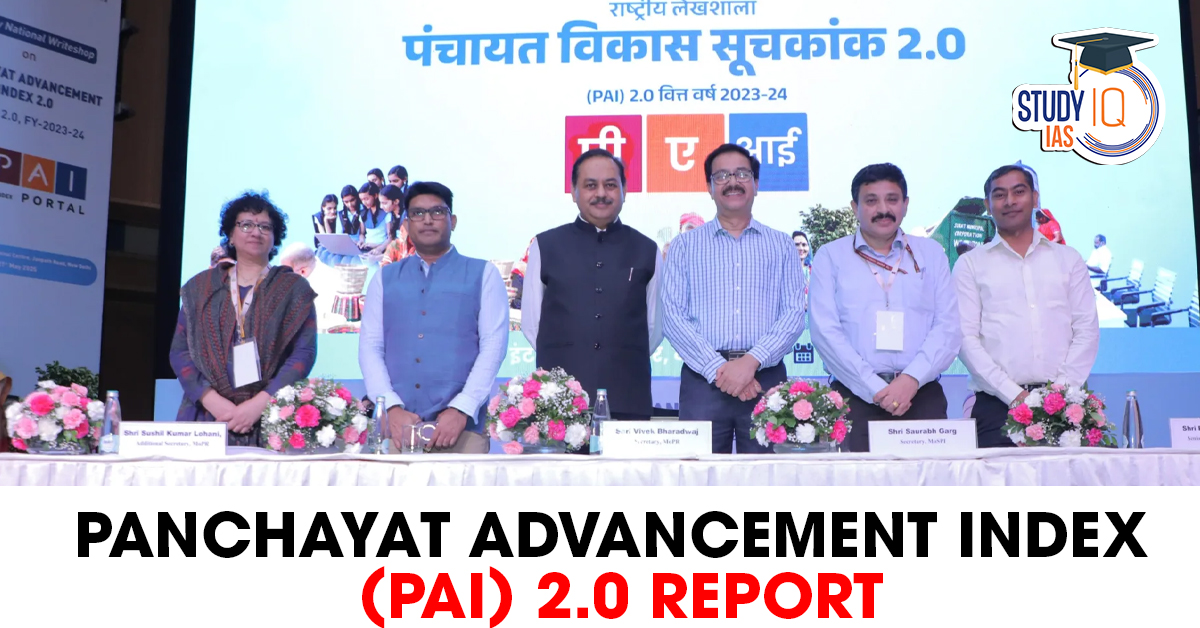
The Ministry of Panchayati Raj unveiled the Panchayat Advancement Index (PAI) 2.0 Report for the year 2023–24 on the occasion of National Panchayati Raj Day.
UPSC Daily Current Affairs 2026
About Panchayat Advancement Index (PAI) 2.0
- PAI 2.0 is a nationwide, data-centric assessment framework developed to evaluate and improve the functioning of more than 2.5 lakh Gram Panchayats (GPs) and Traditional Local Bodies (TLBs).
- It acts as a localized performance evaluation tool for Panchayats.
- The framework measures progress using 150 indicators and 230 data points grouped under nine thematic areas, aligned with the Localization of Sustainable Development Goals (LSDGs).
Key findings and highlights
- Participation: The index recorded 97.30% participation, covering 2,59,867 Panchayats across 33 States and Union Territories. This marks a substantial increase from 80.79% participation in PAI 1.0.
- Performance classification: Panchayats are categorized into five grades based on their overall scores:
- Achiever (A+)
- Front Runner (A)
- Performer (B)
- Aspirant (C)
- Beginner (D)
- Category distribution:
- Front Runners (A): 3,635 Gram Panchayats
- Performers (B): Largest group with 1,18,824 GPs (around 45.7%)
- Thematic achievements: Poverty Reduction (Theme 1): 3,313 GPs secured A+ grades
- Health & Well-being (Theme 2): 1,015 GPs attained A+ status
- Framework improvements: Indicators reduced from 516 (PAI 1.0) to 150 (PAI 2.0) for sharper focus and usability.
- State participation: 33 States/UTs participated.
- Eg: West Bengal did not participate, while Delhi and Chandigarh were excluded due to the absence of Gram Panchayats.
- State-level highlights:
- Top Performer: Tripura, with nearly 80% of its Panchayats achieving Front Runner status.
- No A+ Panchayats: No Gram Panchayat reached the Achiever (A+) category nationally.
- Highest Participation: Uttar Pradesh, with 57,678 Panchayats contributing data.
Success trends in high-performing panchayats
- Evidence-based governance: Panchayats are increasingly using PAI scores to design targeted development plans (GPDPs).
- Knowledge sharing: High-performing Panchayats are being developed as learning hubs for peer exchange.
- Transparency measures: Validation through Gram Sabhas has improved accountability and citizen participation.
- Digital integration: Real-time dashboards and automatic data integration from Union Ministries have enhanced data reliability.
Key challenges
- Regional disparities: Significant variation exists across states.
- Eg: Bihar has a large number of Panchayats in the Aspirant category, while northeastern states like Manipur and Meghalaya have many in the Beginner category.
- Digital constraints: Limited digital literacy hampers effective participation, especially in remote regions like Arunachal Pradesh and Nagaland.
- Infrastructure gaps: Many Panchayats struggle with funding for essential infrastructure.
- Eg: In Uttar Pradesh, thousands remain in the Beginner category due to basic facility shortages.
- Social justice concerns: Performance in social equity indicators lags behind livelihood improvements, indicating gaps in inclusion and welfare delivery.
- Financial dependence: Heavy reliance on state funds limits autonomy and growth, particularly in states like Jharkhand and Chhattisgarh.
Way forward
- Targeted funding: Direct additional financial support to Panchayats in the Aspirant category.
- Capacity building: Provide structured training for representatives, especially in lower-performing Panchayats.
- Incentive linkages: Align Panchayat awards and incentives with PAI performance to encourage competition.
- Language accessibility: Expand vernacular support for better usability of the portal.
- Policy integration: Use PAI as a key tool for evaluating government schemes and shaping rural development policies.
 Species in News: Cheetah | Project Cheet...
 Quantum Computing: RRI Scientists Demons...
 Artificial Intelligence in Warfare: How ...














 WhatsApp





