
Table of Contents
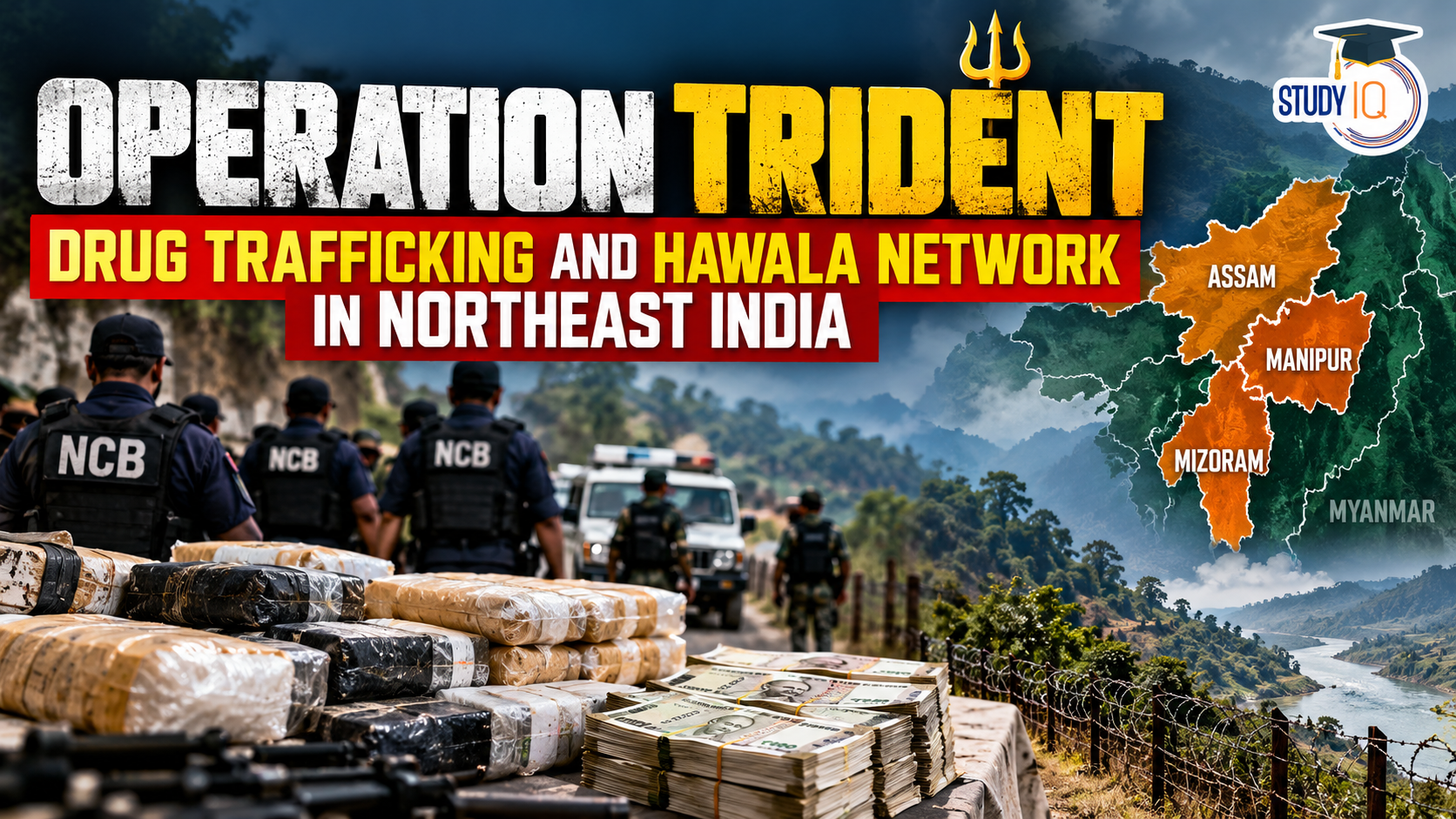
Drug trafficking and illicit financial flows pose interconnected challenges to India’s internal security, particularly in the northeastern region. The reported Operation Trident, launched by the Narcotics Control Bureau (NCB) on October 23, 2026, involved coordinated searches across Assam, Manipur and Mizoram.
According to the newspaper report dated October 27, 2026, the operation resulted in 18 arrests and the tracing of approximately ₹100 crore in suspected hawala transactions associated with an alleged international narcotics network.
The operation highlights the need to address drug trafficking not merely as a law-and-order problem but as a broader challenge involving border management, organised crime, money laundering, public health and regional cooperation.
Read Also: UPSC Daily Current Affairs 2026
Operation Trident 2026: Key Highlights
- Operation: Operation Trident.
- Date: Launched on October 23, 2026, according to the report.
- Geographical coverage: Assam, Manipur and Mizoram.
- Arrests: 18 people reportedly arrested.
- Financial investigation: Approximately ₹100 crore in suspected hawala transactions traced.
- Agencies involved: NCB, Enforcement Directorate (ED), state police and other central agencies.
- Primary objective: Disrupt the alleged cross-border narcotics supply chain and its financial infrastructure.
The operation illustrates the importance of combining physical enforcement with financial investigations to identify both the suppliers of narcotics and the networks that handle their proceeds.
Understanding the Drug Trafficking–Hawala Nexus
Drug trafficking generates substantial illicit proceeds, which criminal organisations must transfer, conceal or reinvest. Hawala is an informal value-transfer arrangement that uses intermediaries to facilitate transfers of value, often without conventional cross-border bank transfers.
Hawala is not inherently illegal in every circumstance. However, when used to conceal criminal proceeds, facilitate illicit transactions or evade applicable laws, it can become an instrument of financial crime.
The relationship between narcotics trafficking and illicit financial flows generally involves three stages:
- Generation of proceeds: Illegal drugs are transported and distributed through trafficking networks.
- Transfer and concealment: Intermediaries move payments through informal financial channels, cash transactions or complex business arrangements.
- Integration: Criminal proceeds may be used to acquire assets or enter apparently legitimate economic activities.
Investigating this financial chain is essential because arresting individual carriers may disrupt a shipment without dismantling the wider organisation that finances and coordinates the trade.
Why Is Northeast India Vulnerable to Drug Trafficking?
1. Proximity to the Golden Triangle
The Golden Triangle refers to the region around Myanmar, Laos and Thailand, historically associated with illicit drug production and trafficking. Myanmar’s proximity to India’s northeastern states creates opportunities for cross-border smuggling.
Synthetic drugs, including methamphetamine, and other narcotics moving through regional trafficking networks pose significant enforcement and public health challenges.
2. Porous International Borders
Northeast India shares international borders with Myanmar and Bangladesh, while the wider region also borders Bhutan and China.
Difficult terrain, forested areas, remote settlements and multiple transportation routes complicate border surveillance. Criminal networks may exploit gaps in monitoring and shift routes in response to enforcement measures.
3. Organised Transnational Crime
Drug trafficking networks may operate through multiple layers of suppliers, transporters, local intermediaries and financial facilitators. Their cross-border character makes investigations more complex because evidence and suspects may be located in different jurisdictions.
4. Illicit Financial Networks
Concealed financial transfers make it difficult to identify the ultimate beneficiaries of trafficking proceeds. Financial investigations must therefore examine suspicious transactions, beneficial ownership, asset transfers and links between individuals and commercial entities.
5. Internal Security and Social Consequences
Drug trafficking can contribute to organised crime, corruption, addiction and violence. In cases where criminal proceeds finance armed groups, it may also aggravate wider security threats. However, such links must be established through case-specific evidence rather than presumed.
Major Challenges in Tackling Drug Trafficking
- Geographical challenges: Difficult terrain and remote border settlements make continuous surveillance resource-intensive.
- Intelligence gaps: Information may remain fragmented across central agencies, state police and border enforcement bodies.
- Financial opacity: Multiple intermediaries and concealed ownership structures complicate the identification of illicit proceeds.
- International jurisdiction: Investigating cross-border networks requires timely information-sharing and cooperation with neighbouring countries.
- Demand-side challenges: Enforcement alone cannot eliminate drug abuse without prevention, treatment, rehabilitation and community participation.
- Due process: Investigations must distinguish between verified evidence and allegations while respecting applicable legal safeguards.
India’s Institutional and Legal Response
Narcotic Drugs and Psychotropic Substances Act, 1985
The NDPS Act provides India’s principal legal framework for controlling narcotic drugs and psychotropic substances. It establishes offences and penalties relating to prohibited activities, subject to the applicable statutory provisions.
Narcotics Control Bureau
The NCB coordinates and supports efforts against drug trafficking, undertakes investigations within its legal mandate and facilitates cooperation among central and state enforcement agencies.
Prevention of Money Laundering Act, 2002
The PMLA provides the framework for investigating money laundering and taking authorised action against proceeds of crime where the statutory conditions are satisfied. The ED plays a central role in such investigations.
Border and Financial Intelligence
Customs and border agencies help detect smuggling, while financial intelligence and banking-sector reporting mechanisms can assist in identifying suspicious transactions. Coordinated investigations can connect evidence from drug seizures with financial trails and asset ownership.
Way Forward: A Comprehensive Strategy
1. Strengthen Intelligence-Led Border Management
Surveillance technology, risk-based inspections, improved communication systems and better coordination among border agencies can help identify trafficking routes while facilitating legitimate movement across borders.
2. Follow the Money
Investigations should target the financial infrastructure of criminal networks through lawful analysis of bank records, suspicious transactions, asset ownership and links between suspected facilitators.
3. Improve Inter-Agency Coordination
Joint investigation teams, timely intelligence-sharing and clearly defined responsibilities can reduce duplication and close gaps between narcotics enforcement and financial investigations.
4. Enhance International Cooperation
India should strengthen intelligence-sharing and operational coordination with neighbouring countries through appropriate bilateral and regional mechanisms. Cross-border investigations are more effective when information can be exchanged promptly and lawfully.
5. Address Demand and Social Vulnerability
Prevention programmes, accessible de-addiction services, rehabilitation and community-based awareness are essential to reduce the demand that sustains illicit markets. Young people and vulnerable border communities should be treated as partners in prevention, not merely as subjects of enforcement.
6. Build Professional Investigative Capacity
Specialised training in digital forensics, financial investigation, evidence management and transnational organised crime can improve the quality and effectiveness of prosecutions.
Conclusion
Operation Trident highlights the interconnected nature of narcotics trafficking, illicit financial flows and internal security in Northeast India. The reported tracing of approximately ₹100 crore in suspected hawala transactions underlines the importance of investigating the financial foundations of organised crime alongside the physical movement of drugs.
A sustainable response requires coordinated enforcement, intelligence-led border management, financial transparency, international cooperation and a public health approach to substance abuse. Integrating these measures can help protect border communities, weaken criminal networks and strengthen India’s internal security.

 Ladakh Governance Crisis 2026: Statehood...
 UN Reform 2026: Challenges, Proposals an...
 China Zorrilla: World’s Largest Batter...













 WhatsApp






