
Table of Contents
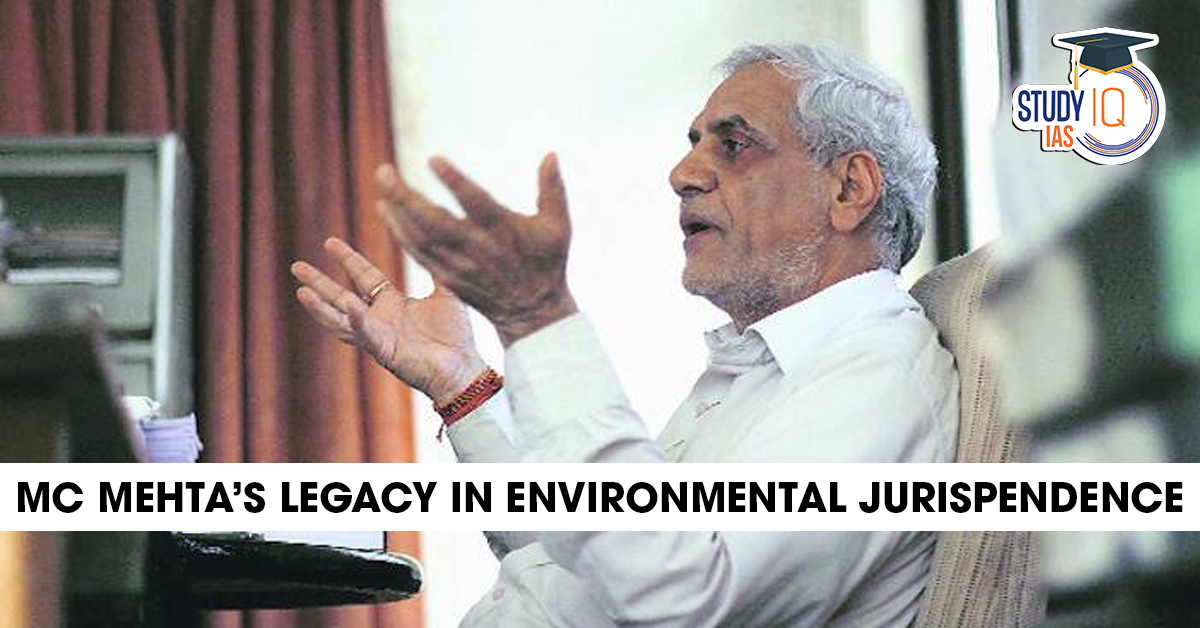
Context: Nearly four decades after veteran lawyer M.C. Mehta filed a Public Interest Litigation (PIL) on vehicular pollution, the Supreme Court has officially closed the case.
Timeline of Landmark Interventions
The Foundation: Absolute Liability (1984–1986)
- 1984: Spurred by the Bhopal Gas Tragedy, Mehta began filing PILs against hazardous industries.
- 1985: The Oleum Gas Leak case occurred at the Shriram Food and Fertiliser plant in Delhi.
- 1986: In a landmark judgment, the Supreme Court established the principle of “Absolute Liability.” It ruled that hazardous industries are strictly liable for any harm caused by their activities, regardless of negligence, ensuring they must compensate victims.
Cleaning the Delhi’s Air (1994–2002)
- 1994–95: The Court ordered the establishment of low-lead petrol outlets in major metros like Delhi, Mumbai, Kolkata, and Chennai.
- 1996: Mehta’s petition led to the closure or relocation of 1,168 polluting industrial units out of residential areas in Delhi.
- 1998: In one of the most visible changes to daily life, the Court ordered Delhi’s entire public bus fleet to be converted to Compressed Natural Gas (CNG).
- 2002: The Court imposed heavy fines on the Delhi government for every diesel bus still operating, solidifying the transition to cleaner fuel.
Institutionalising Oversight (2015–2018)
- 2015: The Court directed the implementation of a cess on heavy diesel trucks entering Delhi to discourage through-traffic.
- 2016: The Graded Response Action Plan (GRAP) was institutionalised, creating a system that automatically triggers pollution control measures during severe smog episodes.
- 2018: The Court banned diesel vehicles older than 10 years and petrol vehicles older than 15 years from the National Capital Region (NCR).
Modern Directives (2024–2025)
- 2024: A total ban on firecrackers in Delhi-NCR was issued to mitigate winter pollution spikes.
- 2025: Regulations were refined to allow for “green crackers” only on specific festive days, balancing tradition with public health.
The “Continuing Mandamus”: A Legal Revolution
- Perhaps M.C. Mehta’s greatest contribution isn’t a single verdict, but a legal innovation called “Continuing Mandamus.”
- Unlike standard court orders that resolve a dispute and close a file, a continuing mandamus allows the Supreme Court to keep a case open indefinitely.
- This enabled the Court to issue over 1,000 interim orders over 40 years, monitoring executive compliance and providing “periodic directions” to ensure that environmental laws weren’t just written, but enforced.
“When a poor man comes to me saying his fields are ruined because of toxic water, what can I ask him to pay? You have to choose where you stand.” — MC Mehta
|
Read More Notes |
|
| Environment Notes | Art and Culture Notes |
| Science and Tech | History Notes |
| Geography Notes | Indian Polity Notes |
| General Knowledge | International Relation |
|
Explore StudyIQ Courses |
|

 Electric Cooking Solutions in India: Wor...
 CAPF Bill 2026: Formalising IPS Deputati...
 Chhattisgarh Freedom of Religion Bill 20...




 WhatsApp





