
Table of Contents
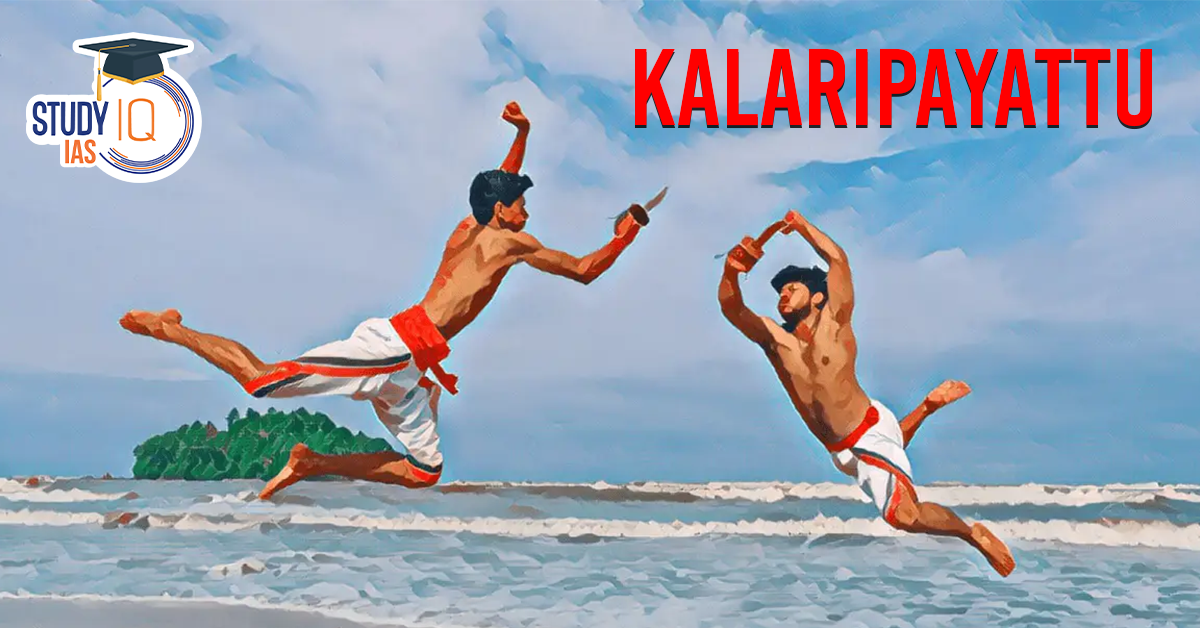
Kalaripayattu, often referred to as the “mother of all martial arts,” is one of the oldest combat systems in the world, originating in Kerala, India. It has a rich cultural, historical, and spiritual heritage, making it an important topic for UPSC preparation.
Key Features of Kalaripayattu
- Meaning of ‘Kalari’
- The term “Kalari” means “battlefield” or “threshing floor.”
- The training space for Kalaripayattu is also called “Kalari.”
- Physical Training
- Emphasizes strength, flexibility, and agility through rigorous physical conditioning.
- Incorporates exercises such as kicks, leaps, stretches, and stances.
- Combat Techniques
- Includes unarmed combat, strikes, and grappling.
- Practitioners are trained in various movements that mimic animals like lions, snakes, and elephants.
- Weapon Training
- Uses an array of traditional weapons, such as:
- Urumi: A flexible sword.
- Kuntham: Spears.
- Vettukathi: Machetes.
- Dhanurveda: Bow and arrow.
- Uses an array of traditional weapons, such as:
- Healing Techniques
- Integrated with Ayurveda to promote healing and wellness.
- Practitioners are trained in Marma Vidya, knowledge of vital points in the human body.
- Spiritual Aspect
- Rooted in ancient Indian philosophies and rituals.
- Training involves meditative practices to enhance focus and mental discipline.
Historical Significance of Kalaripayattu
- Origins and Legacy
- Believed to have originated around 3rd century BCE, during the Sangam period.
- Inspired the development of other martial arts in Asia, such as Kung Fu.
- Role in Warfare
- Used extensively by the warriors of Kerala, particularly in the feudal era.
- Played a crucial role in defending Kerala against external invasions.
- Colonial Suppression
- Declined during British rule due to the suppression of traditional practices.
- Revived post-independence as a symbol of cultural pride.
Cultural and Contemporary Relevance
- Performing Art
- Kalaripayattu is often showcased in cultural events and festivals.
- Combines martial techniques with rhythmic movements and dance-like sequences.
- Tourism and Global Recognition
- Promoted as a tourist attraction in Kerala.
- Recognized globally for its unique combination of physical and spiritual training.
- Integration in Cinema and Theatre
- Techniques are used in action choreography for movies.
- Inspires contemporary art forms and storytelling.
- Fitness and Self-Defense
- Practiced worldwide as a fitness discipline.
- Gaining popularity as a self-defense technique.
| State | Martial Art |
| Thagta ta | Manipur |
| Silambam | Tamil Nadu |
| Gatka | Punjab |
| Pari Khanda | Bihar |
| Thoda | Himachal Pradesh |
| Malkhamb | Madhya Pradesh |
| Squay | Jammu & Kashmir |
| UPSC PYQ |
| Q. With reference to India’s culture and tradition, what is ‘Kalaripayattu’? (2014)
(a) It is an ancient Bhakti cult of Shaivism still prevalent in some parts of South India (b) It is an ancient style of bronze and brasswork still found in the southern part of the Coromandel area (c) It is an ancient form of dance-drama and a living tradition in the northern part of Malabar (d) It is an ancient martial art and a living tradition in some parts of South India Answer: D |

 Small Modular Reactors (SMRs): India’s...
 Nag Panchami 2026: Significance, History...
 Tribunals Reforms Bill 2026: Key Provisi...







 WhatsApp





