
Table of Contents
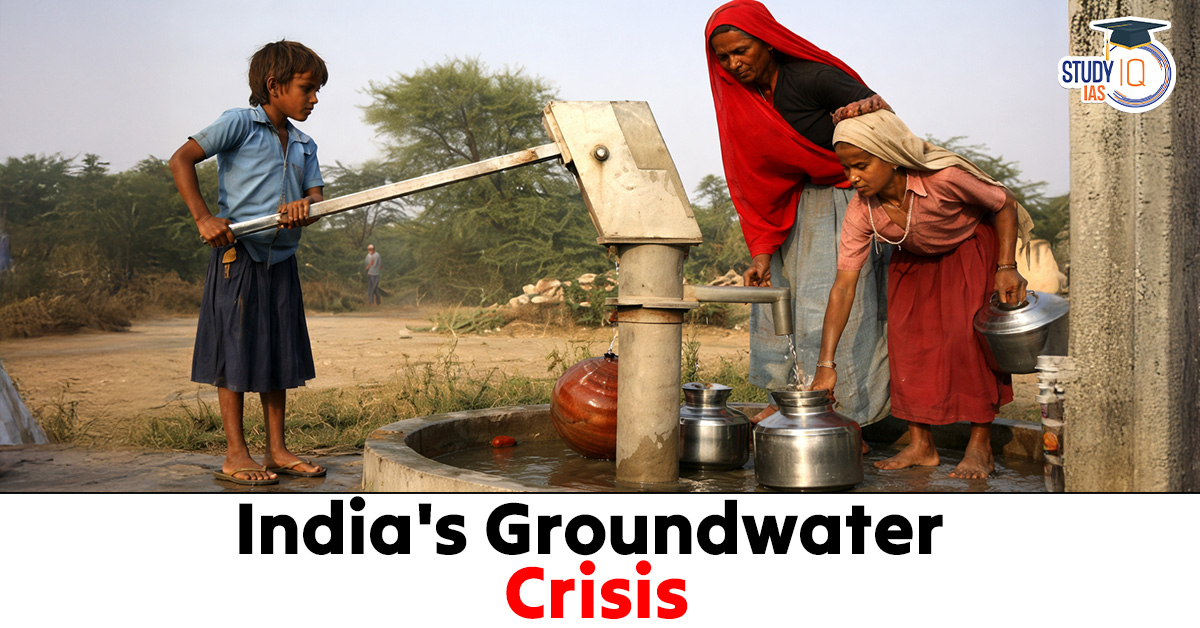
Context: A recent parliamentary committee report has flagged a grave environmental challenge, revealing that India is the world’s largest consumer of groundwater, accounting for 25% of the global total, exceeding the combined usage of the United States and China.
India Facing Groundwater Crisis
India is facing a looming groundwater crisis as rapid urbanization, population growth, and unsustainable agricultural practices continue to deplete its underground water reserves. Groundwater, which supports a large share of irrigation, drinking water supply, and industrial use, is being extracted at a rate far exceeding natural recharge.
Erratic monsoons, climate change, and inefficient water management have further aggravated the situation, pushing several regions toward severe water stress. This emerging crisis not only threatens food security and livelihoods but also poses significant challenges to sustainable development and environmental stability in the country.
Key Findings of the Parliamentary Committee Report
- Global Lead in Extraction: India extracts approximately 230–250 cubic kilometres of groundwater annually.
- Agricultural Dominance: Nearly 90% of extracted groundwater is used for agriculture.
- Critical Water Table Depletion: The committee noted that in several states, the rate of extraction far exceeds the rate of natural recharge.
- Over 14% of assessment units in India are classified as “over-exploited,” while others are rapidly reaching “critical” stages.
- Quality Deterioration: As water tables sink, the concentration of geogenic contaminants like Arsenic and Fluoride increases, posing severe public health risks to rural communities dependent on hand pumps.
Also Check: Groundwater Contamination in India
Key Challenges in Management
- Fragmented Governance: Water is a State subject under the Indian Constitution, leading to a lack of a unified national regulatory framework.
- Coordination between the Central Ground Water Board (CGWB) and state agencies remains weak.
- The Energy-Water Nexus: The provision of free or highly subsidised power for irrigation removes any financial incentive for farmers to conserve water, leading to “tragedy of the commons” scenarios.
- The Indian Easements Act, 1882: The colonial-era law creates a significant legal hurdle by linking groundwater rights to land ownership.
- This prevents the government from effectively regulating private extraction and treats a shared, fluid resource as private property.
- Climate Change Impact: Erratic monsoon patterns and shorter, more intense rainy seasons reduce the “soak time” required for natural aquifers to recharge, even when total rainfall remains normal.
- Lack of Real-Time Data: While monitoring has improved, the committee highlighted the need for more digital water-level recorders to provide granular, real-time data for local planning.
Also Check: Dynamic Ground Water Resource Assessment Report 2024
Way Forward
- Crop Diversification: Shifting away from water-intensive crops in semi-arid zones toward millets, pulses, and oilseeds is essential to reducing the agricultural water footprint.
- Incentivizing Micro-Irrigation: Scaling up the Pradhan Mantri Krishi Sinchayee Yojana (PMKSY) to promote drip and sprinkler irrigation can reduce water usage by up to 50%.
- Community-Led Recharge: Expanding models like the Atal Bhujal Yojana, which involves village-level “Water Security Plans” and traditional structures like Johads and Baolis for rainwater harvesting.
- Conjunctival Use of Water: Integrating the use of surface water (canals/rivers) with groundwater to ensure that aquifers are only tapped when surface sources are insufficient.
- Legislative Reform: Moving toward a “Public Trust” doctrine where groundwater is viewed as a common resource rather than an extension of land ownership rights.

 What is Manche Shlok? Meaning, Origin an...
 Hectocotylus: Structure, Function and Ro...
 Anganwadi Workers in India: Roles, Impor...












 WhatsApp





