
Table of Contents
The vision of Health for All lies at the heart of India’s commitment to inclusive development and social justice. It aims to ensure that every citizen has access to affordable, equitable, and quality healthcare without financial hardship. However, despite policy intent and incremental reforms, India’s journey towards universal health coverage remains constrained by funding gaps, systemic inefficiencies, rising disease burden, antimicrobial resistance, and regulatory challenges. These issues have brought renewed scrutiny to India’s public health system and its preparedness to meet future health shocks.
India’s Evolving Health Landscape
With a population of nearly 146 crore, India faces one of the world’s most complex public health challenges. Over the past decade, the country has witnessed a significant epidemiological transition.
-
Non-communicable diseases (NCDs) such as diabetes, cardiovascular disorders, cancers, and mental health conditions are rising rapidly.
-
At the same time, communicable diseases like tuberculosis, vector-borne illnesses, and emerging viral outbreaks continue to persist.
This dual disease burden places extraordinary pressure on an already stretched healthcare system. Additionally, climate change has emerged as a silent health multiplier, intensifying heat stress, air pollution, floods, and extreme weather events—each contributing to higher morbidity and healthcare demand.
Public Health Financing: The Core Bottleneck
One of the most critical barriers to achieving Health for All in India is chronic under-investment in healthcare.
-
India’s public health expenditure has remained below 2% of GDP for decades.
-
This falls short of the 2.5% of GDP target envisaged under the National Health Policy.
-
In 2025–26, the Union government allocated around ₹99,859 crore to the health sector—an increase from previous years, yet insufficient for population-level needs.
The funding gap has widened further due to the withdrawal or reduction of international assistance in areas such as HIV/AIDS, maternal health, and population services. Consequently, states have been forced to absorb additional fiscal pressure, resulting in uneven health capacity across regions.
Infrastructure Deficits and Access Inequality
While post-pandemic investments improved diagnostic capacity and hospital infrastructure in urban centres, rural and peri-urban India continue to face severe shortages.
Key challenges include:
-
Inadequate primary healthcare facilities
-
Shortage of trained doctors, nurses, and specialists
-
Overcrowded district hospitals
-
Weak referral and emergency care systems
These gaps translate into high out-of-pocket expenditure, pushing millions of households into poverty every year due to health-related costs.
Environmental Health and Air Pollution Crisis
Environmental health risks have become a major obstacle to Health for All. Severe air pollution, particularly in northern India during winter months, has reduced life expectancy and increased respiratory and cardiovascular illnesses.
Children, elderly citizens, and individuals with pre-existing conditions are disproportionately affected. Without sustained air quality management and integration of environmental health into public health planning, these stressors threaten to overwhelm India’s healthcare system.
Tuberculosis Control and Antimicrobial Resistance
India’s ambition to eliminate tuberculosis by 2025 has not yielded the desired outcomes. Although diagnostic tools such as TrueNat have strengthened detection capacity, multidrug-resistant (MDR) and extensively drug-resistant (XDR) TB continue to pose serious challenges.
A related and more systemic threat is antimicrobial resistance (AMR).
-
Resistance levels in India are significantly higher than global averages, especially for hospital-treated infections.
-
Key drivers include over-the-counter antibiotic access, self-medication, incomplete treatment courses, pharmaceutical waste, and weak regulatory enforcement.
Unchecked AMR risks reversing decades of medical progress and undermines the very foundation of universal health coverage.
Pharmaceutical Quality and Regulatory Challenges
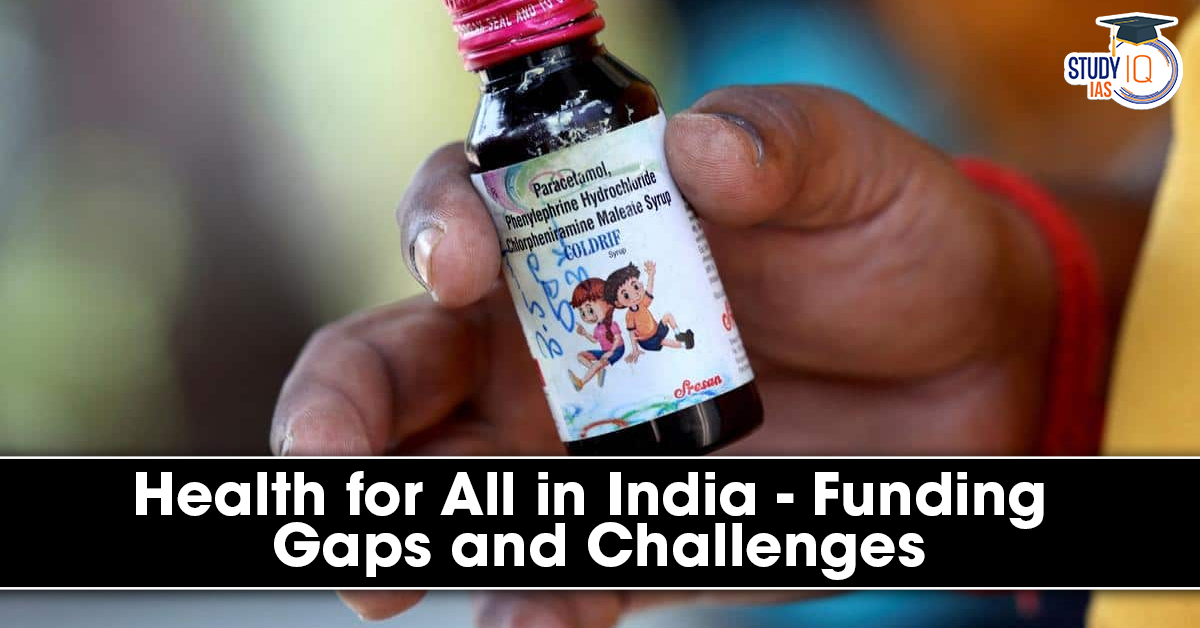
India’s status as a global supplier of affordable medicines has come under strain due to recent pharmaceutical quality failures. Incidents involving contaminated medicines, including toxic cough syrups, exposed serious lapses in manufacturing oversight, quality testing, and enforcement mechanisms.
Such episodes not only endanger domestic public health but also damage India’s credibility as the “pharmacy of the world”. Strengthening drug regulation, ensuring accountability, and upgrading quality control systems are essential to restoring trust.
Way Forward: Bridging the Gaps
To achieve Health for All, India must adopt a holistic and sustained reform approach:
-
Increase public health expenditure to at least 2.5% of GDP in a time-bound manner
-
Strengthen primary healthcare as the backbone of the health system
-
Integrate climate resilience and environmental health into healthcare planning
-
Enforce strict antibiotic regulation and scale up AMR surveillance
-
Modernise pharmaceutical regulation with transparency and accountability
-
Reduce out-of-pocket expenditure through expanded insurance and public provisioning
Conclusion
Health for All in India is not merely a welfare aspiration—it is a developmental imperative linked to human capital, productivity, and social stability. Persistent funding gaps, systemic weaknesses, and emerging health threats have slowed progress, but they also offer a clear roadmap for reform. With adequate investment, strong governance, and an integrated public health vision, India can transform Health for All from a policy promise into a lived reality for its citizens.
 Illegal Sand Mining in National Chambal ...
 16th Finance Commission: Key Facts, Func...
 Species in News for UPSC Prelims 2026: C...













 WhatsApp





