
Table of Contents
Context: In 2025, the Great Atlantic Sargassum Belt reached a record length of 5,500 miles (twice the width of the US), signaling a massive ecological shift.
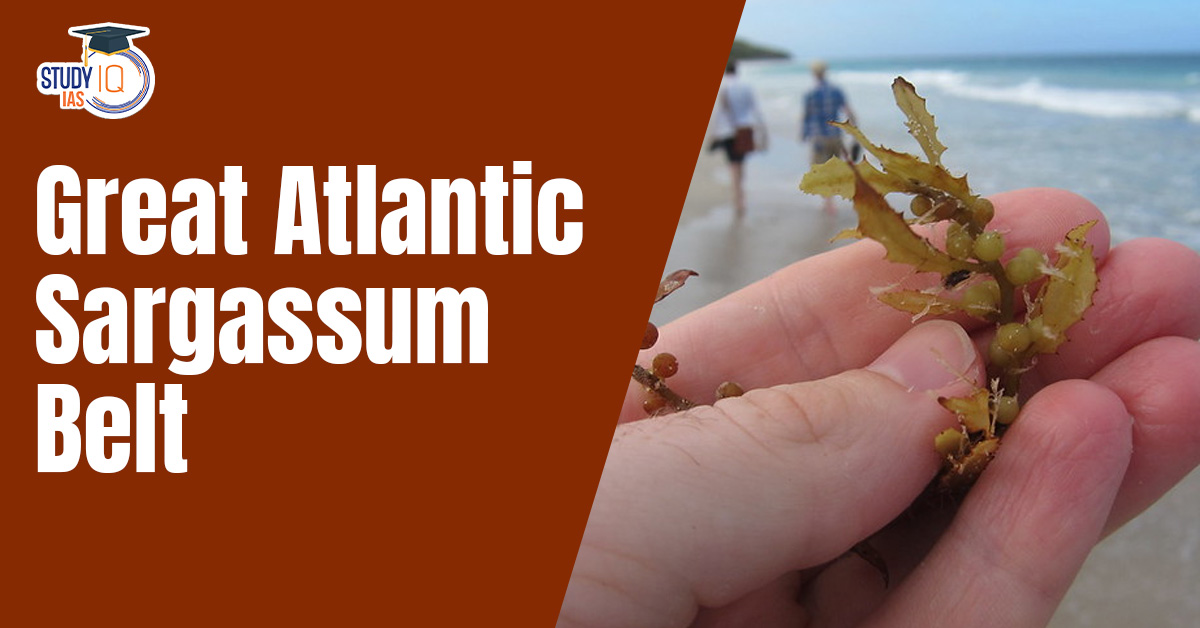
About Sargassum
- Definition: A genus of large brown seaweed (algae) that floats in island-like masses.
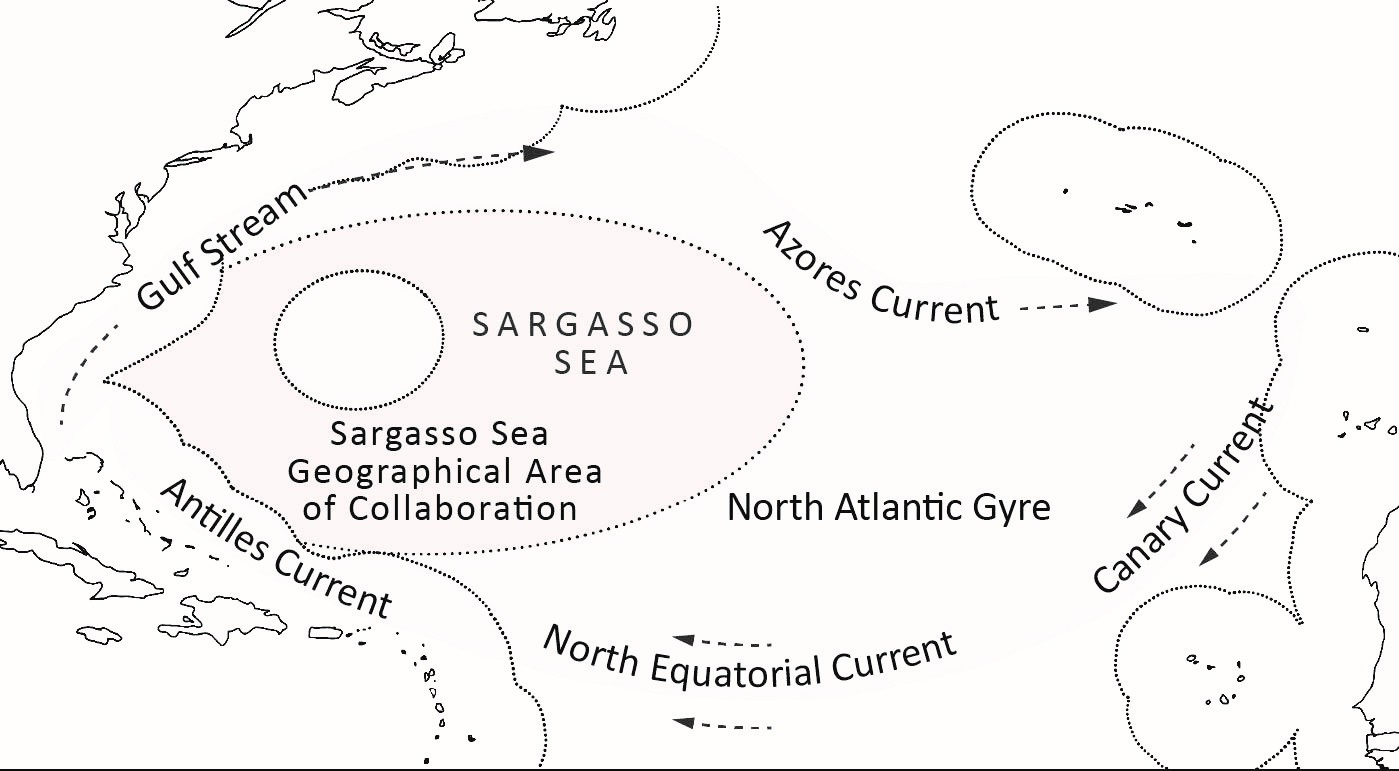
- Habitat: Historically confined to the Sargasso Sea (a region in the North Atlantic surrounded by four currents). Unlike other seaweeds, it is “holopelagi,” meaning it spends its entire life cycle floating on the ocean surface rather than being attached to the seafloor.
- Significance: In open water, it is a “Golden Floating Rainforest.” It serves as a critical habitat for over 100 species, including sea turtles, tuna, and eels.
About The Great Atlantic Sargassum Belt (GASB)
- While the Sargasso Sea has existed for centuries, the GASB is a new phenomenon that first appeared in 2011.
- Scale: By May 2025, it contained 5 million tons of biomass.
- Geographical Span: Forms an unbroken band from West Africa to the Gulf of Mexico.
- Growth Rate: In nutrient-rich waters, its biomass can double in just 11 days.
- Divers of the GASB: Recent studies in the journal Harmful Algae show that the expansion is driven by Eutrophication (excessive nutrient enrichment) from land-based sources:
- Riverine Discharge: The Amazon River (South America) and the Mississippi/Atchafalaya Rivers (USA) discharge massive amounts of nitrogen and phosphorus from agricultural runoff and wastewater.
- Human-induced pollution: Between 1980 and 2020, the nitrogen content in sargassum tissue increased by 55%, proving it is “feeding” on human-induced pollution.
- Ocean Currents: The Loop Current and Gulf Stream act as conveyor belts, transporting these blooms across the Atlantic.
Concerns
- Toxic Decomposition: As it rots on beaches, it releases hydrogen sulfide gas (smells like rotten eggs), which is toxic to humans and wildlife.
- Dead Zones: Thick mats block sunlight and use up oxygen as they decay, creating hypoxic (low oxygen) dead zones that kill coral reefs and seagrass.
- Climate Feedback: Decomposing sargassum emits methane and other greenhouse gases, potentially accelerating global warming.
- Economic Impact: Smothers tourism-dependent beaches and can even clog the cooling water intakes of nuclear power plants.
| The Sargasso Sea |
|
|
Read More Notes |
|
| Environment Notes | Art and Culture Notes |
| Science and Tech | History Notes |
| Geography Notes | Indian Polity Notes |
| General Knowledge | International Relation |
|
Explore StudyIQ Courses |
|

 China’s Global Ocean Mapping Initiativ...
 Ancient Marine Snail Discoveries in Guja...
 Biologics and Non-Animal Methodologies (...













 WhatsApp





