
Table of Contents
Context: Ahead of the West Bengal elections, a surge in Form 6 registrations raised concerns over the inclusion of voters from other states just before the final roll-out, while the Supreme Court of India reviewed voter deletions during the Special Intensive Revision (SIR).
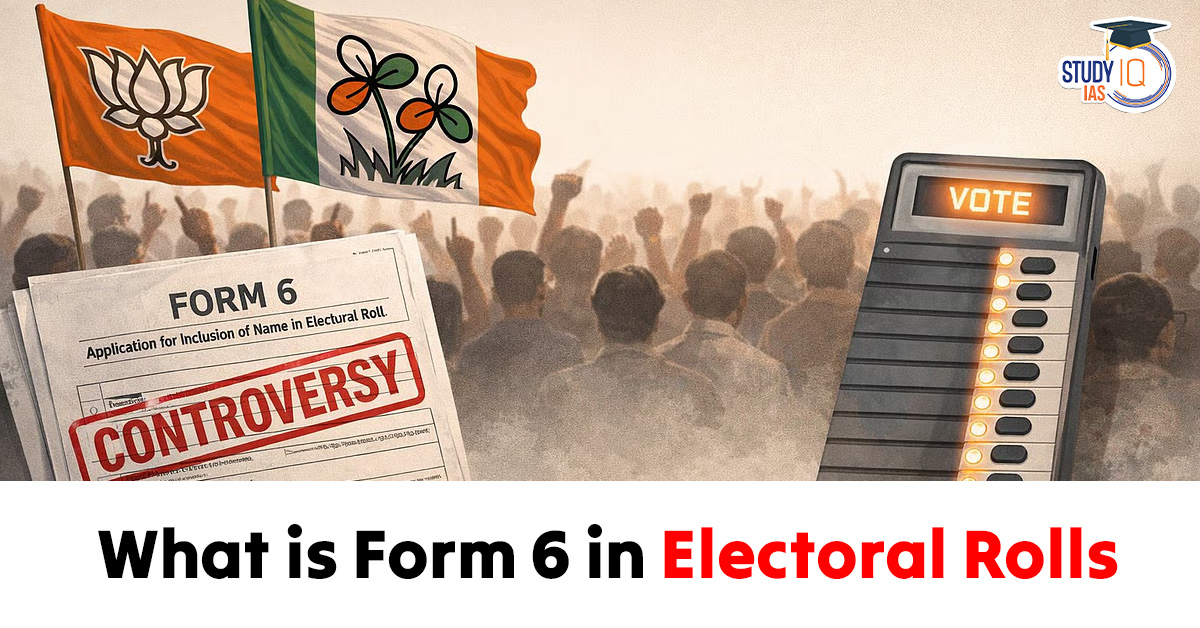
What is Form 6 in Electoral Rolls
- Definition: Form 6 is the official application used to register as a new voter, as per the Registration of Electors Rules, 1960, issued by the Election Commission of India.
- Authority involved: It is submitted to the Electoral Registration Officer (ERO), who is responsible for adding, deleting, and maintaining electoral rolls.
- Eligibility criteria: Applicant must be:
- An Indian citizen
- 18 years or above (as per Article 326 of the Indian Constitution)
- An ordinary resident of the constituency
- Documents required: Proof of age and residence (self-attested). Includes a self-declaration of citizenship (no direct proof required initially)
- Mode of application: Can be submitted online (ECINET portal) or offline to the ERO.
Processing of Form 6
- Step 1: Submission by the applicant
- Step 2: Field Verification by Booth Level Officer (BLO)
- Step 3: Final Decision by ERO after satisfaction
- Types of inclusion
- Special summary revision (SSR): Pre-election/annual revision
- Continuous updation: Allowed throughout the year except during the election period
- Safeguard: A minimum 7-day notice period is given for objections before final inclusion.
Also Check: Right To Vote in India
Significance of Form 6
- Enables democratic participation: Acts as the primary gateway for citizens to exercise voting rights.
- Ensures inclusiveness: Helps in adding new voters, migrants, and first-time voters to the rolls.
- Maintains electoral accuracy: Ensures that only eligible residents are included after verification.
- Legal accountability: False declaration can lead to a penalty or imprisonment, ensuring the seriousness of the process.
SC Judgement on Electoral Roll Exclusions
- Fair adjudicating authority: Only the Electoral Registration Officers (EROs) have the authority to add or delete names after verification to carefully avoid wrongful exclusion.
- Voting rights cannot be permanently denied: Removal of names from electoral rolls is temporary, and eligible citizens can be re-included.
- Strengthening of appellate mechanism: Independent tribunals led by senior judges will hear appeals of excluded voters.
- Transparency in decision-making: Authorities must provide clear reasons for deletion to ensure accountability.
- Large-scale adjudication recognised: The Court acknowledged the massive number of claims and objections being processed.
- Supplementary electoral lists allowed: Periodic updates ensure continuous inclusion of eligible voters before elections.
Impact
- Protection of democratic rights: Reinforces voting as a core right under Article 326 of the Indian Constitution.
- Balance between accuracy and inclusion: It ensures electoral rolls are clean (free from duplicates) while remaining inclusive.
- Clarity in enrolment process (Form 6): Form 6 enables new voter registration with verification by BLOs and approval by EROs. It further introduces checks and accountability in adding voters.
- Institutional accountability: Limits arbitrary powers by ensuring decisions remain with designated authorities (EROs)
Challenges
- High rate of exclusion: Large-scale deletions raise concerns about wrongful disenfranchisement.
- Time constraints before elections: Pressure to finalise rolls before nominations affects thorough verification.
- Risk of misuse of Form 6: Allegations of bulk enrolment and demographic manipulation create political controversy.
- Administrative burden: Handling lakhs of claims daily strains institutional capacity.
- Lack of clarity in appeal timelines: Ongoing adjudication creates uncertainty for voters seeking inclusion.
Way Forward
- Strengthen verification with inclusion focus: Ensure that revision exercises do not exclude genuine voters.
- Ensure transparency and accountability: Provide clear reasons and accessible appeal mechanisms for all exclusions.
- Improve administrative capacity: Deploy trained officials and streamline processes to handle large-scale revisions efficiently.
- Regulate Form 6 submissions: Monitor bulk applications to prevent misuse or political manipulation.
- Balance speed with fairness: Allow adequate time for verification and appeals before finalising electoral rolls.

 Politicisation of Anti-Corruption Bodies...
 List of Chief Ministers of Bihar (1947 t...
 Telangana Employees Accountability and M...








 WhatsApp





