
Table of Contents
Context: The International Day of Zero Waste (March 30) highlights the growing concern of food wastage. It reflects a paradox like large-scale food loss coexisting with hunger and malnutrition.
| Key Facts |
|
Recent Trends in Food Wastage
- India ranks among the top contributors to food waste, with 78 million tonnes of food discarded annually — second only to China.
- While India’s per capita food waste is 55 kg annually, lower than some developed nations like the US (73 kg), the sheer population size makes the total wastage volume significant.
- Approximately 61% of global food waste occurs at the household level due to over-purchasing, poor storage, and improper meal planning.
Check here: International Day of Zero Waste
What is meant by Food Wastage?
- Food wastage is a broader term that includes both food loss and food waste — covering the entire food supply chain from production to consumer disposal.
- Example: Spoiled grains due to poor storage (food loss) and uneaten cooked meals (food waste).
| Food Loss and Food Waste |
|
Data on Food Wastage
Global Food Waste
As per the UNEP Food Waste Index Report 2024, approximately 1.05 billion tonnes of food are discarded globally each year. Households account for 60%, followed by food services (28%) and retail (12%)
- This widespread wastage reflects inefficiencies in supply chains, policy shortcomings, and consumption habits.
- At the same time, nearly 783 million people suffer from hunger, and over 3.1 billion individuals cannot afford a nutritious diet, exposing a deep moral and systemic imbalance.
India’s Contradiction
India is the second-largest contributor to food waste globally, losing nearly 78–80 million tonnes annually, valued at about ₹1.55 lakh crore, second only to China.
- Although India’s per capita food waste (55 kg/year) is lower than that of countries like the U.S. and Germany, the country ranks 111th on the Global Hunger Index, with nearly 194 million undernourished people.
- This stark contrast highlights the disconnect between availability and access to food.
Punjab case study
Punjab, a major agricultural hub, produces surplus food but faces significant post-harvest losses due to climatic stress and weak infrastructure.
- Nearly 20% of fruits and vegetables are lost after harvest
- Over 8,200 tonnes of foodgrains were damaged in FCI storage between 2019–2024, the highest in the country
- Key challenges include inadequate storage facilities, poor cold-chain systems, limited mechanisation, and inefficient packaging and grading, as pointed out by NITI Aayog.
Causes of food waste in India
- Over-purchasing: About 67% of urban households waste food due to lack of proper meal planning.
- Inadequate storage: Around 40% of food production is lost due to insufficient storage and weak supply chains.
- Socio-cultural practices: Events like weddings often lead to 10–20% food wastage due to over-preparation.
- Weak Supply Chain Infrastructure: Inefficiencies result in losses worth ₹92,651 crore annually.
- Perishability of Food Items: Nearly 16% of fruits and vegetables are wasted due to short shelf life and poor handling.
- Retail and Hospitality Sector: The food service industry generates nearly 22 million tonnes of waste each year.
Issues and Challenges
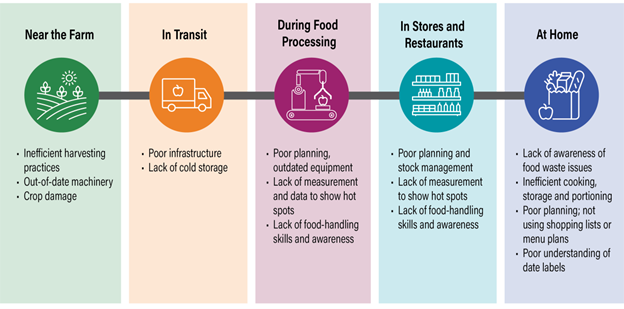
- Supply Chain Inefficiencies: Poor storage facilities, lack of cold chains, and inadequate transport infrastructure lead to high food loss at the production and distribution stages.
- Consumer Behaviour: Over-purchasing, lack of meal planning, and excessive food preparation at household levels result in avoidable wastage.
- Policy and Infrastructure Gaps: Limited investment in cold storage, poor market linkages, and lack of effective redistribution networks exacerbate the problem.
Implications of Food Wastage
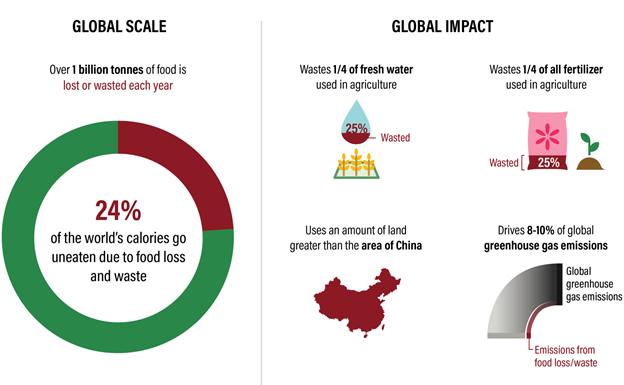
- Environmental Impact: Food wastage increases greenhouse gas emissions (8%–10% of annual global emissions), primarily from methane released in landfills.
- Wasted food also leads to overuse of resources like water, land, and energy during production and distribution.
- Economic Loss: Globally, food wastage costs around $1 trillion annually in terms of lost production, transportation, and storage costs.
- Businesses and households face higher expenses due to inefficient food management.
- Food Insecurity: Despite surplus production, millions face hunger due to inefficient food distribution and wastage.
- In India, over 20 crore people face hunger, while 78 million tonnes of food are discarded annually.
- Social Injustice: Wastage reflects unequal access to food — surplus food in some areas contrasts with hunger and malnutrition in others.
- It widens the gap between food availability and accessibility.
- Pressure on Natural Resources: Food production requires significant amounts of water, land, and energy; wastage puts additional strain on these limited resources.
- Increased demand for food production leads to deforestation and biodiversity loss.
- Challenge to Sustainable Development: Food wastage hinders progress toward SDG 2 (Zero Hunger) and SDG 12.3 (Reducing food waste at retail and consumer levels).
- Higher food wastage increases the environmental footprint, slowing down global sustainability efforts.
| International Models Addressing Food Waste |
|
Main Drivers of Food Loss and Waste Throughout the Supply Chain
Impact of Food Loss And Waste
- Hunger and Malnutrition: Food wastage can also negatively impact food security and food availability, and contribute to increasing the cost of food.
- This excludes many people from accessing quality food owing to poor socio-economic conditions.
- Example: In the Global Hunger Index, 2023, India ranks 111th out of 125 countries with 14% of Indians undernourished.
| Other Facts |
|
- Greenhouse Gas Emission: The disposal of food loss and waste in landfills leads to greenhouse gas emissions, contributing to climate change.
- Example: It accounts for approximately 8%-10% of global greenhouse gas emissions.
- Economic Impact: According to the United Nations Environment Programme, estimates that India wastes 74 million tonnes of food each year, representing a loss of 92,000 crore rupees, and securing India’s second rank (after China).
- Wastage of Resources: When food is lost or wasted, all the resources that were used to produce this food – including water, land, energy, labour and capital – go to waste.
Indian Government Initiatives to Reduce Food Loss and Waste
- Save Food, Share Food: Launched by the Food Safety and Standards Authority of India (FSSAI) to encourage donation of surplus food to the needy through food banks and NGOs.
- Indian Food Sharing Alliance (IFSA): A network of food recovery agencies under FSSAI that facilitates food redistribution from businesses and households to reduce waste.
- Operation Greens: Launched in 2018 to stabilize the supply of perishable crops (like tomatoes, onions, and potatoes) by improving storage, transportation, and market linkages.
- Mega Food Parks Scheme: Establishes food processing infrastructure with cold storage, packaging, and logistics to reduce food loss during production and distribution.
- Food Processing Incentives: The Production-Linked Incentive (PLI) Scheme for the food sector encourages investment in food processing and better storage infrastructure.
- Mid-Day Meal Scheme: Reduces food wastage in schools by ensuring planned meal preparation and effective distribution to students, minimizing excess food disposal.
- Taskforce Against Food Loss and Waste: A proposal is underway to establish a national Taskforce aimed at reducing food loss and waste (FLW) in India, aligning with the UN’s Sustainable Development Goal 12.3, which seeks to halve global food waste by 2030.
- SAMPADA (Scheme for Agro-Marine Processing and Development of Agro-Processing Clusters) Yojana: This scheme involves developing an integrated cold chain and value addition infrastructure.
- National Food Security Act, 2013: It places an obligation on the government to deliver quality food at affordable prices to the poor.
What are the Solutions?
- Enhance Storage and Distribution: Improve cold chain infrastructure and modernise transportation to reduce food loss at the production stage.
- Consumer Education: Promote awareness about meal planning, proper food storage, and creative reuse of leftovers to reduce household waste.
- Redistribution Networks: Scale up initiatives like “Save Food Share Food” to connect surplus food with those in need.
- Policy Reforms: Introduce incentives and subsidies for businesses and farmers to adopt sustainable practices and improve food storage.
- Promote Composting and Recycling: Encourage household and community-level composting to reduce landfill waste and generate organic manure.
- Support Sustainable Consumption: Encourage plant-based diets, reduce overproduction, and optimise food supply chains to minimise resource use and emissions.
- Promoting Mechanization in Agriculture: Use of combine harvesters to reduce post-harvest losses, especially for crops like paddy.
- Mechanization significantly cuts losses compared to manual harvesting.
- Encouraging Farmer Producer Organizations (FPOs) and Custom Hiring Centres (CHCs) to facilitate group leasing of machinery, making it more accessible to small and marginal farmers.
- Improving Drying and Storage Infrastructure: Adoption of solar dryers and dehydrators to replace traditional sun drying, which is prone to contamination and uneven drying.
- These green technologies are cost-effective and extend the shelf life of perishables.
- Expansion of proper storage facilities to reduce grain loss.
- The government’s plan to add 70 million metric tons (MMT) of storage capacity over five years can help minimise post-harvest losses.
- Revisiting Packaging Methods: Revising the Jute Packaging Material Act (JPMA, 1987) to promote the use of airtight bags instead of jute bags, which are prone to rodent attacks and pilferage in tropical climates.
- Airtight bags can significantly reduce storage and transit losses.
- Enhancing Farming Practices: Food producers, including farmers, ranchers, and fishers, can minimise losses by adopting better farming practices, such as harvesting crops at the right maturity and using suitable equipment.
- Example: Utilising weather apps like Mausam can help them optimise harvesting schedules and engage with wholesale retailers to manage order changes effectively.
- FIFO Method: The “First In, First Out” method encourages using older products before newer ones to ensure nothing expires unused.
- Promoting Food Donation Drives: Organizing food donation drives in communities can be a powerful way to channel excess food to those who require it most.
- Example: Zero food wastage initiative by Dawoodi Bohras in Pune.
- Policy Support: Providing policy incentives to ensure small and marginal farmers can access advanced machinery, storage solutions, and infrastructure improvements.
Food waste in India reflects systemic inefficiencies and behavioural issues. Addressing it requires better infrastructure, policy support, and responsible consumption practices to ensure food security and sustainability.

 Index of Service Production (ISP): Need,...
 Rise of Orange Economy in India: Key Sec...
 Payments Bank Regulation – Paytm Payme...













 WhatsApp





