
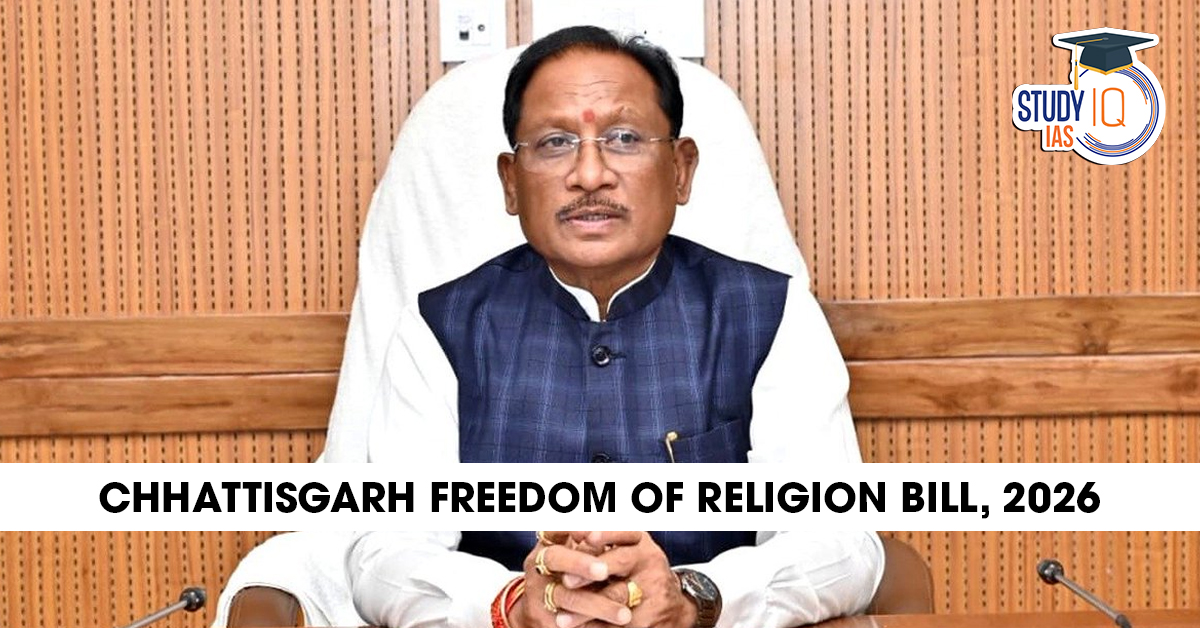
Context: The Chhattisgarh Legislative Assembly on Thursday passed the Dharm Swatantraya Vidheyak (Freedom of Religion Bill), 2026, to replace the earlier 1968 Act.
Key Features of the Chhattisgarh Freedom of Religion Bill 2026
- Mandatory intimation: Individuals intending to convert must inform the District Magistrate or authorised officer in advance.
- Public disclosure of details: Authorities must publish details such as name, current religion and proposed religion within seven days.
- Transparency and scrutiny: This allows society and authorities to examine the genuineness of the conversion.
- Window for objections: Any person can raise objections within 30 days of public notice.
- Official inquiry: Authorities are required to verify the authenticity of the conversion before approving.
- Marriage not automatic conversion: Marriage alone does not imply a change in religion.
- Check on conversion for marriage: Conversion done solely for marriage or without following due process will be treated as illegal.
- Advance declaration for interfaith marriage: A declaration must be submitted 60 days before marriage for scrutiny.
- Return to ancestral faith: Re-conversion to one’s original or ancestral religion is not treated as conversion under the law.
- Mandatory reporting by priests/clergy: Persons conducting conversions must inform authorities about the intent and details.
- Annual disclosure requirement: Organisations involved in conversions must submit yearly data, including the number of conversions and financial details.
- Control over financial flows: Funds, whether domestic or foreign, linked to illegal conversions can be restricted.
- Withdrawal of state support: Government benefits or assistance may be cancelled if violations are found.
| Provisions for Penalties |
|
|
Read More Notes |
|
| Environment Notes | Art and Culture Notes |
| Science and Tech | History Notes |
| Geography Notes | Indian Polity Notes |
| General Knowledge | International Relation |
|
Explore StudyIQ Courses |
|

 Electric Cooking Solutions in India: Wor...
 CAPF Bill 2026: Formalising IPS Deputati...
 Maternity Leave For Adoptive Mothers, Ma...







 WhatsApp





