
Table of Contents
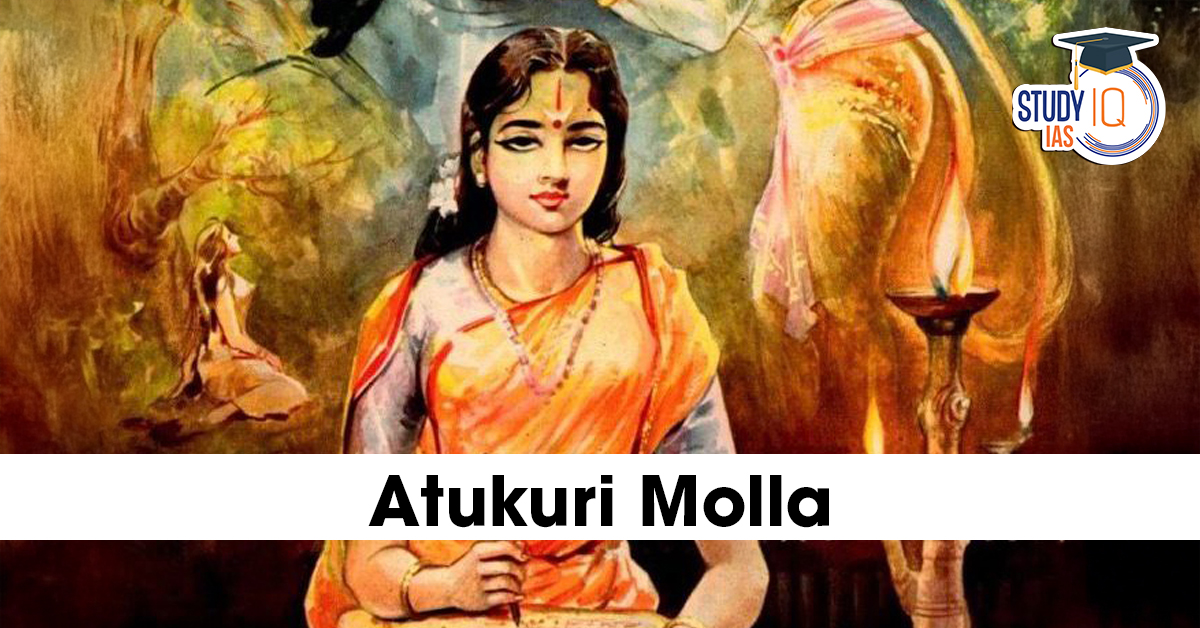
Context: Atukuri Molla remains a revolutionary figure in Telugu literature, celebrated as one of the first female poets to challenge the Brahmanical monopoly over the Sanskrit epics by composing the Molla Ramayanam in simple, accessible Telugu.
Atukuri Molla: Background
- Period: Late 15th to early 16th century (contemporary to the Vijayanagara Emperor Krishnadevaraya).
- Location: Born in Gopavaram, Kadapa district (modern-day Andhra Pradesh).
- Social Identity: She belonged to the Kummari (Potter). In an era where Sanskrit scholarship and epic poetry were reserved for high-caste men, her emergence as a literary giant was a major social breakthrough.
- The “Molla” Name: “Molla” translates to “Jasmine” in Telugu, a name she used as her signature (Mudara).
- Molla is the second notable female Telugu poet, after Tallapaka Timmakka, the wife of Tallapaka Annamayya (“Annamacharya”).
Literary Contributions of Atukuri Molla
Molla’s primary contribution is her version of the Ramayana, known for its distinct stylistic choices:
- Language (Janu-Telugu): Unlike the complex, Sanskrit-heavy Champu style (prose mixed with verse) used by her predecessors, she wrote in simple Telugu. She famously stated that poetry should be like “honey,” easily enjoyed without intense labour.
- Structure: It is a relatively short version (approximately 870 verses) compared with the Valmiki or Ranganatha Ramayanam, emphasising emotional depth rather than exhaustive detail.
- Innovation: She was the first to introduce the “Dandaka” (a specific poetic meter) in the context of the Ramayana in Telugu literature.
|
Read More Notes |
|
| Environment Notes | Art and Culture Notes |
| Science and Tech | History Notes |
| Geography Notes | Indian Polity Notes |
| General Knowledge | International Relation |
|
Explore StudyIQ Courses |
|

 Bhagat Singh Death Anniversary 2026: Bio...
 Veer Baburao Pullesur Shedmake: The Forg...
 Who Was Ayatollah Ali Khamenei? Biograph...









 WhatsApp





