Table of Contents
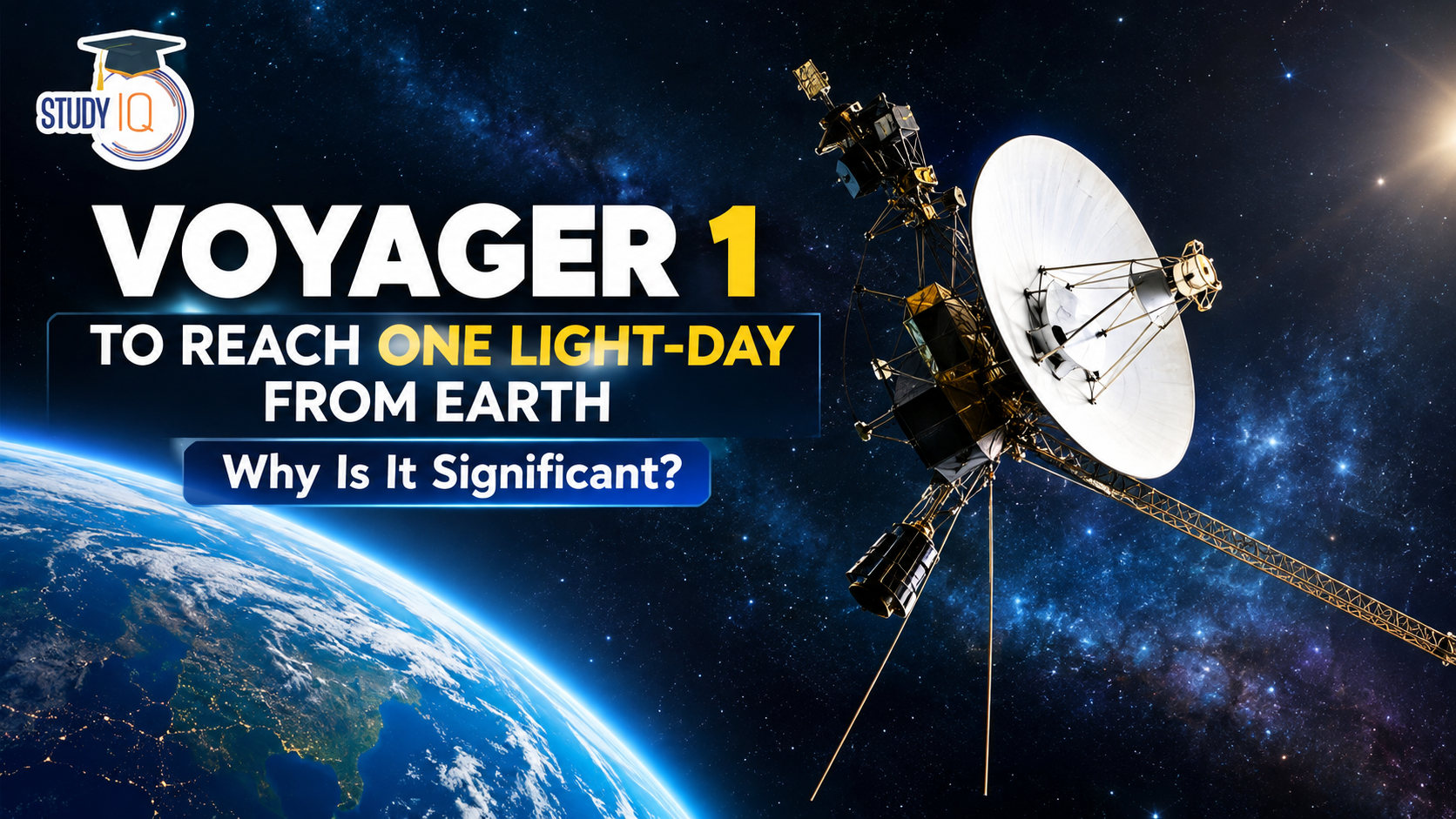
NASA’s Voyager 1 achieved a historic milestone on November 18, 2026, becoming the first human-made object to reach a distance of one light-day from Earth.
Located approximately 25.9 billion kilometres (16.1 billion miles) away, the spacecraft has taken nearly five decades to reach this extraordinary distance. The milestone highlights the remarkable longevity of NASA’s Voyager mission and humanity’s growing understanding of interstellar space.
However, NASA reported on November 18 that Voyager 1 had stopped transmitting science and engineering data following a communications issue detected on November 14. Engineers were investigating the problem while continuing to receive its carrier signal. NASA planned to confirm the milestone using the signal and trajectory calculations on November 19.
About Voyager 1
-
Launch: September 5, 1977.
-
Space Agency: NASA (National Aeronautics and Space Administration).
-
Mission Objective: To explore the outer planets of the Solar System, particularly Jupiter and Saturn.
-
Current Mission: Exploration of interstellar space.
-
Mission Management: NASA’s Jet Propulsion Laboratory (JPL).
-
Significance: It is the most distant human-made object from Earth.
Voyager 1 was launched as part of NASA’s Voyager programme, along with its twin spacecraft, Voyager 2. Although Voyager 2 was launched earlier, Voyager 1 followed a faster trajectory and became the first spacecraft to enter interstellar space.
Despite being designed for a much shorter planetary exploration mission, Voyager 1 has continued operating for nearly 50 years.
Major Discoveries and Achievements of Voyager 1
Voyager 1 transformed scientific understanding of the outer Solar System through several important discoveries.
-
Jupiter Exploration: It discovered a thin ring around Jupiter and two of its moons, Thebe and Metis.
-
Volcanic Activity on Io: It detected active volcanic eruptions on Jupiter’s moon Io, providing the first direct evidence of active volcanism beyond Earth.
-
Saturn Exploration: It discovered new details about Saturn’s rings, moons and atmosphere.
-
Titan’s Atmosphere: It provided important observations of Titan’s thick atmosphere.
-
Interstellar Space: On August 25, 2012, Voyager 1 became the first human-made spacecraft to enter interstellar space.
These discoveries significantly expanded humanity’s understanding of planetary systems and the environment beyond the Sun’s protective influence.
What Does One Light-Day from Earth Mean?
A light-day is a unit of distance, not time. It represents the distance travelled by light in 24 hours through space.
-
Speed of light: Approximately 299,792 kilometres per second.
-
One light-day: Approximately 25.9 billion kilometres.
-
Equivalent distance: Approximately 16.1 billion miles.
At this distance, a radio signal travelling from Earth takes approximately 24 hours to reach Voyager 1. Similarly, a response from the spacecraft takes another 24 hours to return.
Therefore, communication between Earth and Voyager 1 involves a round-trip delay of approximately 48 hours.
This creates significant challenges for NASA engineers, as troubleshooting and operating the spacecraft require considerable time.
What Is Interstellar Space?
Interstellar space refers to the region of space between stars. It exists beyond the heliosphere, which is the enormous protective bubble formed by charged particles and magnetic fields originating from the Sun.
The boundary of the heliosphere is known as the heliopause.
Voyager 1 crossed this boundary on August 25, 2012, becoming the first human-made spacecraft to enter interstellar space. Voyager 2 followed in November 2018.
However, entering interstellar space does not mean that Voyager 1 has completely escaped the Solar System’s gravitational influence.
How Does Voyager 1 Communicate with Earth?
Voyager 1 communicates with NASA through radio signals using the Deep Space Network (DSN).
The network consists of powerful radio antenna facilities located at three major geographical locations:
-
Goldstone, California, USA.
-
Madrid, Spain.
-
Canberra, Australia.
These facilities enable NASA to maintain communication with distant spacecraft and receive scientific information from deep space.
However, on November 14, 2026, Voyager 1 experienced a data transmission problem. NASA received its carrier signal but not its science and engineering data. The mission team began investigating the issue.
The carrier signal indicated that the spacecraft’s antenna and broadcasting equipment were still functioning, although the onboard system responsible for processing and transmitting data appeared to have encountered a problem.
Power Source of Voyager 1
Voyager 1 relies on Radioisotope Thermoelectric Generators (RTGs) to generate electricity.
These generators convert heat produced by the radioactive decay of plutonium-238 into electrical energy.
As plutonium-238 gradually decays, the available electrical power decreases. NASA has therefore been switching off selected instruments and spacecraft systems to conserve energy and extend the mission’s operational life.
Despite these limitations, Voyager 1 has continued to provide valuable information about the interstellar environment.
Significance of the Voyager 1 Mission
The one-light-day milestone is important for several reasons:
-
Space Exploration: It demonstrates humanity’s ability to send spacecraft to extraordinary distances beyond the Solar System.
-
Scientific Research: Voyager 1 provides direct measurements of interstellar space, including cosmic rays, plasma waves and magnetic fields.
-
Technological Achievement: Its nearly five-decade-long operation demonstrates the durability of spacecraft engineering.
-
Communication Challenges: The 24-hour one-way signal delay highlights the difficulties of communicating with distant spacecraft.
-
Future Space Missions: Its discoveries provide valuable scientific knowledge for future missions exploring the outer Solar System and interstellar environments.
Conclusion
NASA’s Voyager 1 represents one of the greatest achievements in the history of space exploration. From its launch in 1977 to entering interstellar space in 2012 and reaching the one-light-day milestone in November 2026, the spacecraft has continuously expanded humanity’s understanding of the universe.
Its journey demonstrates how scientific curiosity, technological innovation and long-term international scientific collaboration can push the boundaries of human exploration.
Voyager 1 FAQs
Q1. What is Voyager 1?
Voyager 1 is an unmanned space probe launched by NASA on September 5, 1977, to explore the outer planets of the Solar System.
Q2. When did Voyager 1 enter interstellar space?
Voyager 1 entered interstellar space on August 25, 2012, after crossing the heliopause.
Q3. What is one light-day?
One light-day is the distance travelled by light in 24 hours, approximately 25.9 billion kilometres.
Q4. Why is Voyager 1’s one-light-day milestone significant?
It became the first human-made object to reach a distance of one light-day from Earth.
Q5. What is the power source of Voyager 1?
Voyager 1 uses Radioisotope Thermoelectric Generators (RTGs), which generate electricity using heat from the radioactive decay of plutonium-238.
Q6. What is the Deep Space Network?
NASA’s Deep Space Network is a global system of large radio antennas used to communicate with distant spacecraft.
Q7. What is the difference between the heliosphere and interstellar space?
The heliosphere is the protective region influenced by the Sun’s solar wind and magnetic field, while interstellar space lies beyond the heliopause, between stars.

 Bridging India’s Rural Digital Divide:...
 AIBE 22 Admit Card 2026 Released: Downlo...
 China's 10-Year Higher Education Reform ...














 WhatsApp