Table of Contents
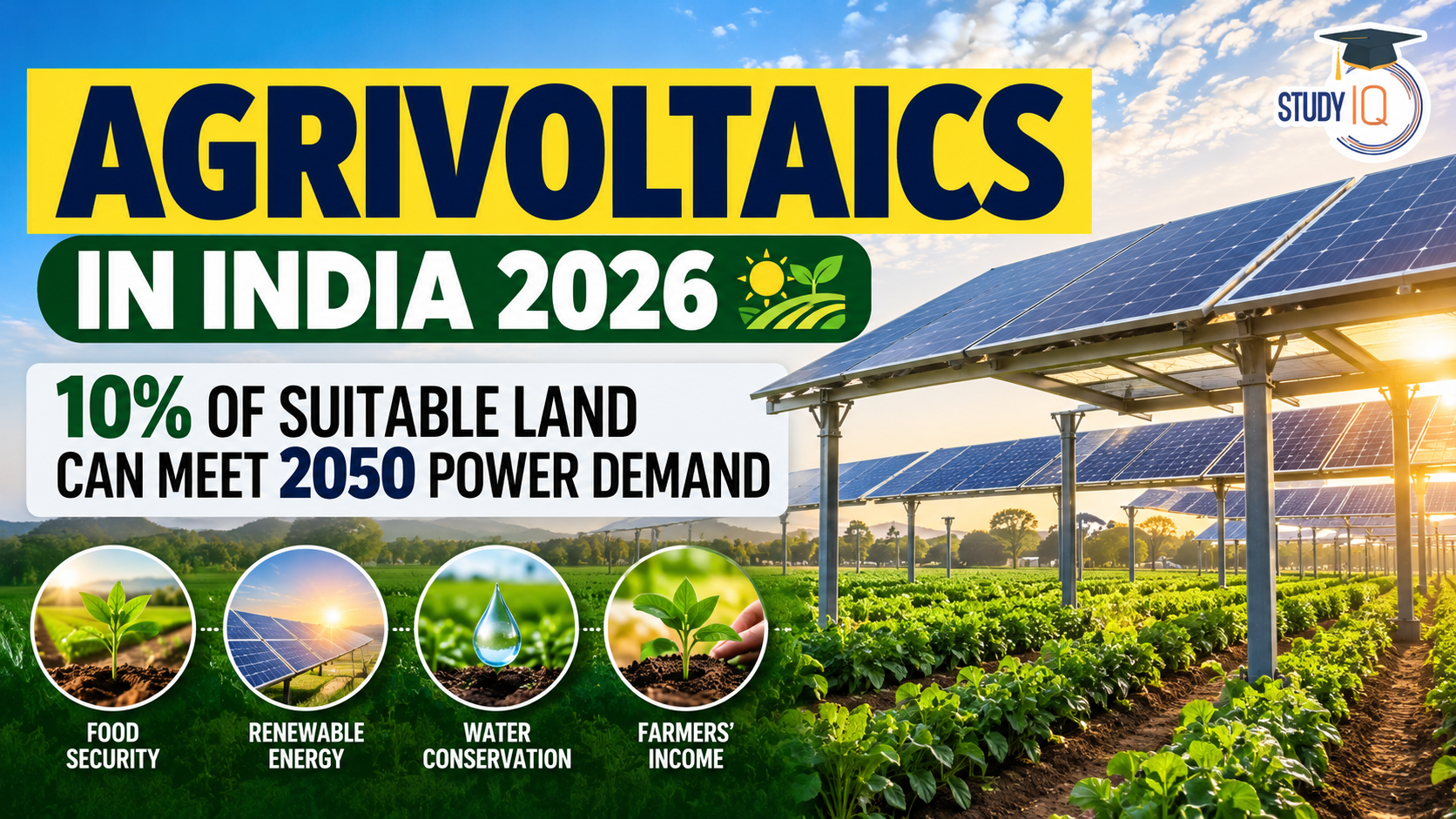
Agrivoltaics has emerged as a promising solution to India’s growing energy needs and agricultural challenges. It involves the simultaneous use of agricultural land for crop cultivation and solar photovoltaic electricity generation. On October 21, 2026, Union Minister for New and Renewable Energy Pralhad Joshi stated that operationalising just 10% of the agricultural land identified as suitable for agrivoltaics could meet India’s projected electricity demand for 2050, citing a study by The Energy and Resources Institute (TERI).
Read Also: UPSC Daily Current Affairs 2026
What Is Agrivoltaics?
Agrivoltaics, also known as AgriPV, agrisolar or dual-use solar, integrates solar panels with agricultural activities on the same land. Unlike conventional solar parks, which may displace farming, agrivoltaic systems are designed to facilitate agricultural production alongside renewable energy generation.
Major types include:
- Elevated systems: Solar panels are mounted above crops, allowing farming underneath.
- Row-based systems: Panels are positioned between crop rows to manage shading.
- Vertical systems: Upright, often bifacial, panels generate electricity while preserving farming space.
- Greenhouse-integrated systems: Photovoltaic panels are incorporated into greenhouse structures.
Agrivoltaics in India: Latest Developments in 2026
A TERI study published in July 2026 identified approximately 47.5 million hectares of agricultural land as suitable for agrivoltaics, equivalent to nearly 30% of India’s more than 160 million hectares of arable land.
The government is considering a dedicated agrivoltaics component under the next phase of the Pradhan Mantri Kisan Urja Suraksha evam Utthaan Mahabhiyan (PM-KUSUM).
At the seventh Agrivoltaics World Conference, Pralhad Joshi highlighted the potential of agrivoltaics to contribute substantially to India’s future electricity requirements. Union Agriculture Minister Shivraj Singh Chouhan also emphasised farmer participation, regional suitability and safeguards for agricultural land.
Benefits of Agrivoltaics for India
1. Enhancing Energy Security
Agrivoltaics can expand solar power capacity without necessarily requiring additional land exclusively for energy production. This supports India’s renewable energy transition and long-term decarbonisation objectives.
2. Improving Farmers’ Income
Farmers may earn additional revenue through electricity sales, land-use agreements or participation in community-owned solar projects. Combining agricultural and energy income can diversify rural livelihoods.
3. Promoting Sustainable Agriculture
Partial shading can reduce soil moisture loss and moderate temperatures during periods of intense heat. Certain shade-tolerant crops may benefit from these conditions, although outcomes depend on crop type, panel design and local climate.
4. Reducing Land-Use Conflicts
India faces increasing competition for land among agriculture, infrastructure and renewable energy projects. Dual-use solar systems can help reduce this conflict by allowing food and electricity production on the same land.
5. Strengthening Climate Resilience
Agrivoltaics may reduce heat stress and water requirements for selected crops. It can also contribute to rural climate adaptation when systems are designed around local agricultural needs.
Challenges in Implementing Agrivoltaics
Despite its potential, agrivoltaics faces several challenges.
- High capital costs: Elevated solar structures can cost 25–30% more than conventional ground-mounted solar installations.
- Economic viability: The minister cited electricity costs of approximately ₹3.20–₹3.30 per unit for agrivoltaics, compared with ₹2.50–₹2.60 for conventional ground-mounted solar.
- Crop suitability: Excessive shading may reduce yields for crops requiring direct sunlight.
- Land ownership issues: Fragmented holdings and unclear leasing arrangements can complicate implementation.
- Limited awareness: Farmers may lack access to technical guidance, affordable credit and insurance.
- Environmental concerns: Solar panel disposal and recycling must be addressed through appropriate waste-management systems.
Way Forward
India needs a farmer-centric strategy to scale up agrivoltaics.
- Dedicated policy framework: Incorporate suitable agrivoltaics provisions into the next phase of PM-KUSUM.
- Crop-specific research: Identify appropriate crop–panel combinations for different agroclimatic zones.
- Financial assistance: Improve access to affordable loans, targeted subsidies and insurance.
- Farmer protection: Establish transparent revenue-sharing arrangements, accessible dispute-resolution mechanisms and clear land-restoration provisions.
- Pilot projects: Evaluate agricultural productivity, electricity output, water savings and farmer income before expanding installations.
- Technology and grid support: Improve solar system design, rural grid connectivity and recycling infrastructure.

 Typhoon Champi Hits East Asia: Impact on...
 India–Poland Relations 2026: Strategic...
 Supreme Court on Children's Right to Int...














 WhatsApp