Table of Contents
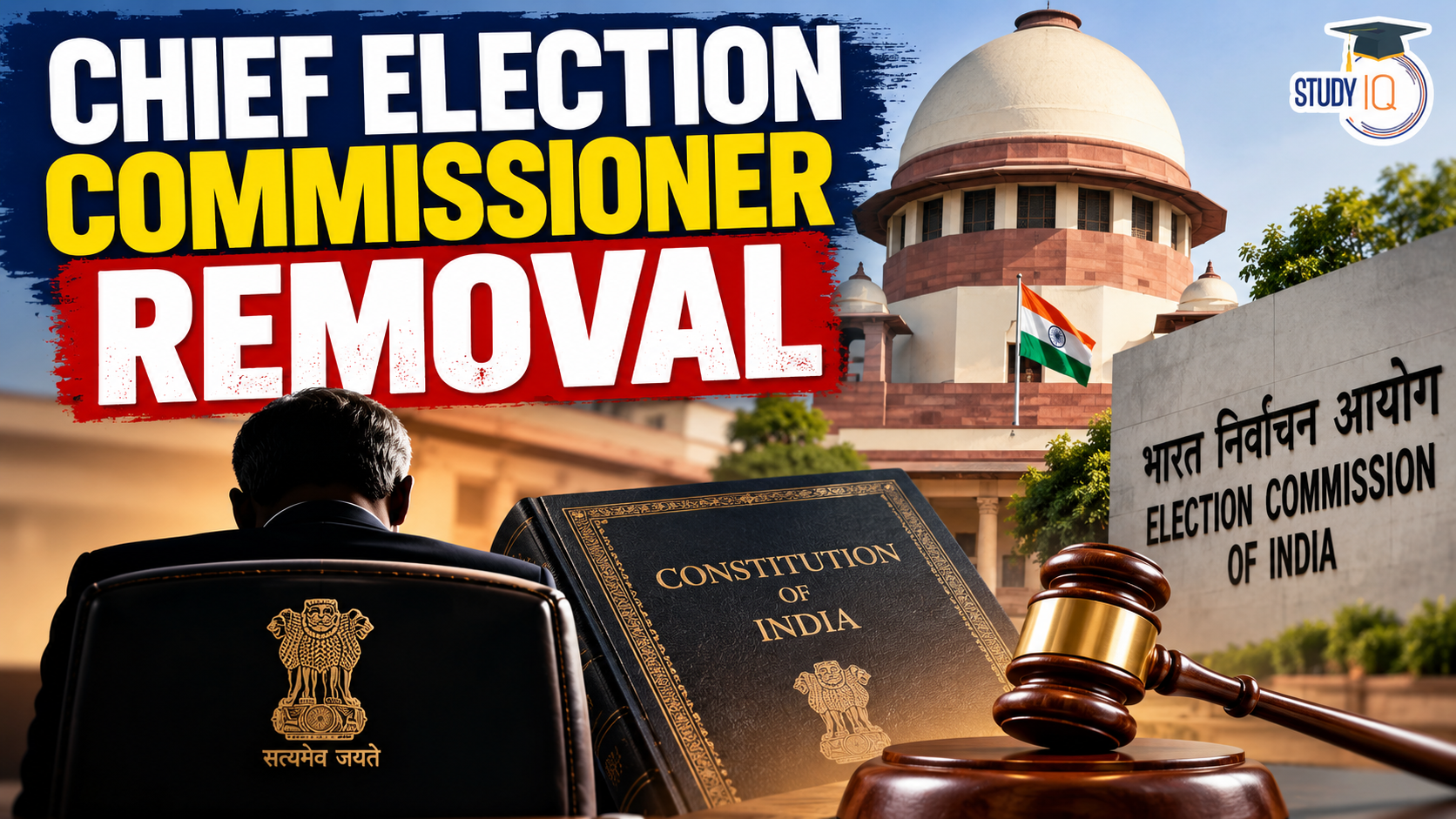
The Chief Election Commissioner (CEC) enjoys special constitutional protection against removal to safeguard the independence of the Election Commission of India (ECI). In 2026, the proposed removal motion concerning CEC Gyanesh Kumar has brought renewed attention to the constitutional and parliamentary procedure governing the removal of the CEC.
Chief Election Commissioner Removal: Constitutional Provision
The Election Commission of India derives its constitutional status from Article 324 of the Constitution.
Under Article 324(5), the Chief Election Commissioner can be removed from office only in the same manner and on the same grounds as a Judge of the Supreme Court.
The relevant grounds are:
- Proved misbehaviour
- Incapacity
This protection is intended to provide institutional independence to the Election Commission.
How Can the CEC Be Removed?
The removal procedure involves Parliament and is substantially more stringent than an ordinary removal process.
1. Notice of Removal Motion
Members of Parliament must initiate the process by submitting a notice containing the grounds for removal.
2. Minimum Signatures Required
The notice must be supported by:
- 100 MPs in the Lok Sabha, or
- 50 MPs in the Rajya Sabha
3. Admission of the Motion
The presiding officer of the concerned House considers whether the motion should be admitted.
4. Inquiry
If the motion is admitted, an inquiry is conducted to examine the allegations and evidence concerning the alleged misbehaviour or incapacity.
5. Special Majority in Parliament
For removal, the motion must be passed by both Houses of Parliament with:
- A majority of the total membership of the House, and
- A majority of at least two-thirds of members present and voting.
This is the same constitutional standard applicable to the removal of a Supreme Court judge.
6. President’s Role
After both Houses pass the required address, the President issues the order for removal of the CEC.
What Are the Grounds for CEC Removal?
The Constitution specifies two grounds:
1. Proved Misbehaviour: Conduct that has been established through the prescribed constitutional process as amounting to misbehaviour.
2. Incapacity: A legally established inability to discharge the functions of the office.
Importantly, mere political disagreement or criticism of an ECI decision does not by itself constitute a constitutional ground for removal.
CEC and Other Election Commissioners: Difference in Removal
The Constitution provides different safeguards for the CEC and other Election Commissioners.
| Chief Election Commissioner | Other Election Commissioners |
|---|---|
| Removal follows the procedure applicable to a Supreme Court Judge | Cannot be removed by the President except on the recommendation of the CEC |
| Grounds: proved misbehaviour or incapacity | Different constitutional protection |
| Requires an address passed by both Houses with special majority | CEC’s recommendation is required for removal |
CEC Appointment and Tenure
The appointment framework is governed by Article 324 and the Chief Election Commissioner and Other Election Commissioners (Appointment, Conditions of Service and Term of Office) Act, 2023.
The Selection Committee consists of:
- Prime Minister — Chairperson
- Union Cabinet Minister nominated by the Prime Minister
- Leader of Opposition in the Lok Sabha
The President formally appoints the CEC and Election Commissioners based on the prescribed process.
The term is six years or until the age of 65 years, whichever is earlier, with no reappointment.
CEC Removal Controversy in 2026
In 2026, a proposed removal motion concerning CEC Gyanesh Kumar has drawn attention to the constitutional safeguards governing the Election Commission.
The controversy has been associated with disagreements surrounding ECI decisions, including the Special Intensive Revision (SIR) of electoral rolls.
Earlier in 2026, notices seeking the CEC’s removal were reportedly submitted in both Houses of Parliament. According to reports cited in the material, the notices were supported by 130 Lok Sabha MPs and 63 Rajya Sabha MPs but were subsequently rejected by the presiding authorities.
A fresh motion would still have to satisfy the constitutional and parliamentary requirements before any removal could take place.
Has Any CEC Ever Been Removed?
No Chief Election Commissioner has so far been removed through this constitutional removal procedure.
Therefore, a proposed removal motion should not be confused with the actual removal of a CEC. Removal requires completion of the constitutionally prescribed parliamentary process.
Why Is CEC Removal Important for UPSC?
The issue is important for UPSC GS Paper II, particularly under:
- Constitutional Bodies
- Election Commission of India
- Electoral Reforms
- Independence of Constitutional Institutions
- Parliamentary Procedures
- Checks and Balances
- Democratic Accountability
 Fundamental Duties of Indian Constitutio...
 Anti-Defection Law: Origin, Provisions o...
 Central Information Commission (CIC): Ap...












 WhatsApp