Table of Contents
India is moving towards its maiden Blue Bond issuance, with Sagarmala Finance Corporation Ltd. (SMFCL) proposing to raise up to ₹1,000 crore through a blue bond. The initiative aims to connect India’s growing blue economy with capital markets and create an additional source of long-term financing for sustainable maritime infrastructure.
What are Blue Bonds?
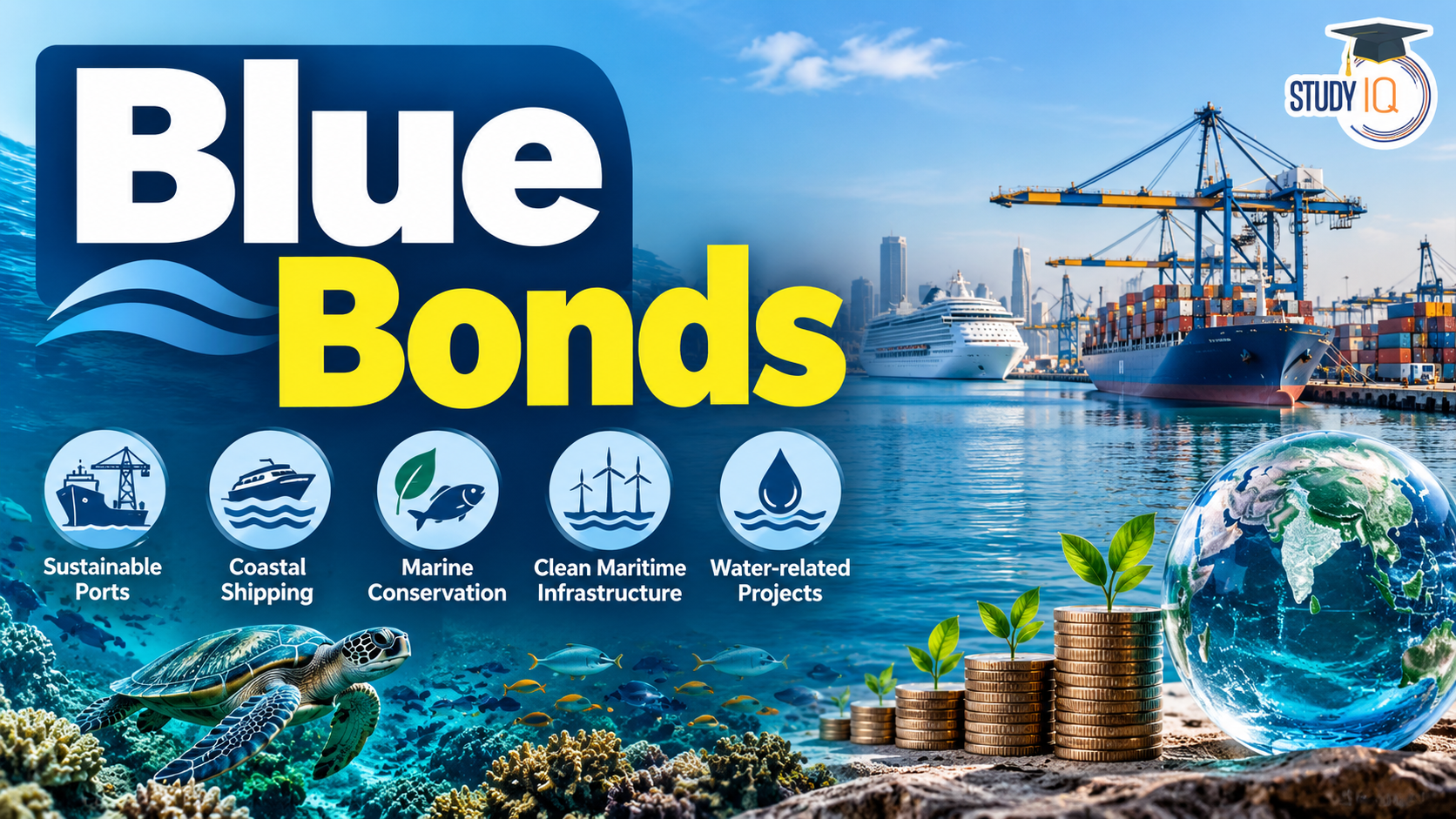
Blue Bonds are debt instruments through which governments, financial institutions or companies raise funds for projects related to the sustainable use and conservation of oceans, seas and water resources.
Like conventional bonds, investors receive returns and the principal is repaid at maturity. However, the proceeds are earmarked for eligible ocean- and water-related projects.
Key Features of Blue Bonds
- Finance sustainable ocean and water-related activities.
- Require clearly defined eligible projects.
- Include mechanisms for measuring environmental impact.
- Require periodic reporting and transparency.
- Help prevent bluewashing, similar to the risk of greenwashing in green finance.
India’s Proposed Blue Bond
The proposed ₹1,000 crore Blue Bond by SMFCL is significant because it could provide a new financing channel for India’s maritime infrastructure.
SMFCL is associated with the Sagarmala programme, which focuses on port-led development and improving India’s maritime connectivity.
The bond can also help address an asset-liability mismatch, as infrastructure projects often have long repayment periods while financial institutions may rely on comparatively shorter-term borrowing.
Why are Blue Bonds Important for India?
India has a large maritime sector and substantial dependence on maritime transport for international trade. Blue finance can support investments in:
- Port modernisation
- Coastal shipping
- Inland waterways
- Sustainable fishing infrastructure
- Cruise terminals
- Ro-Ro and Ro-Pax services
- Cleaner port operations
- Electrification of port equipment
- Shore-power infrastructure
- Marine and coastal ecosystem conservation
Blue Bonds and Sagarmala
The Sagarmala programme seeks to promote port-led development by improving ports, coastal connectivity and maritime logistics.
However, not every Sagarmala project will qualify for blue bond financing. Projects need to demonstrate measurable environmental or water-related sustainability outcomes.
Thus, blue bonds can complement traditional infrastructure financing rather than replace it.
Global Experience with Blue Bonds
Blue bonds have emerged as an important component of sustainable finance globally.
- Seychelles: Issued the world’s first sovereign blue bond in 2018 with World Bank support.
- Nordic Investment Bank: Issued an early institutional blue bond in 2019.
- Belize: Completed an ocean-conservation-linked debt transaction in 2021 involving approximately $553 million of external debt.
The global market remains considerably smaller than the green bond market.
Why Do Blue Bonds Face Challenges?
Despite their potential, blue bonds face several challenges:
1. Lack of Standardisation
There is no universally accepted global blue taxonomy defining all eligible activities.
2. Difficult Impact Measurement
It can be difficult to quantify the financial value of outcomes such as biodiversity conservation, coral restoration and improved fish stocks.
3. Limited Investor Base
Blue bonds continue to attract a relatively specialised group of sustainability and impact-focused investors.
4. Project Readiness
Countries may have ambitious ocean policies but lack sufficiently developed, investment-ready projects.
5. Risk of Bluewashing
Without robust monitoring and reporting, projects may be presented as environmentally beneficial without delivering meaningful outcomes.
Blue Bonds vs Green Bonds
| Feature | Blue Bonds | Green Bonds |
|---|---|---|
| Primary focus | Oceans, marine and water resources | Broader environmental projects |
| Examples | Sustainable fisheries, marine conservation, clean ports | Renewable energy, clean transport |
| Market maturity | Emerging | More developed |
| Major concern | Measuring blue impact | Preventing greenwashing |
Significance for the Blue Economy
Blue bonds can help India mobilise private and institutional capital for sustainable use of marine resources.
For India, the opportunity extends beyond ports and shipping to areas such as fisheries, coastal livelihoods, marine conservation, renewable energy and sustainable tourism.
Read Also: UPSC Daily Current Affairs 2026
 Daily Mains Articles 2026 – Updated Da...
 Make in India Completes 12 Years: Key Ac...
 World Lung Day 2026: Theme, Date, Histor...














 WhatsApp