
Table of Contents
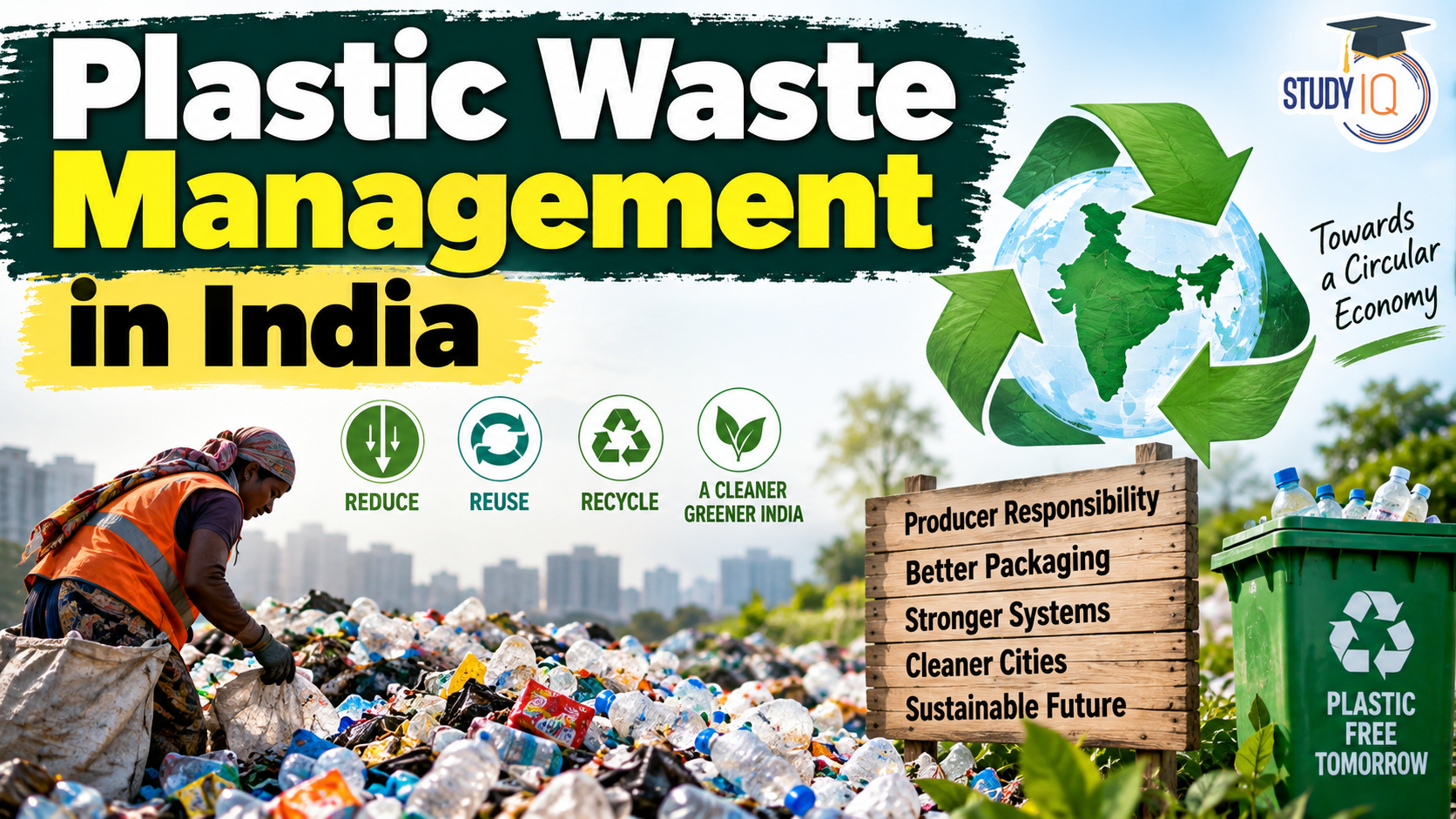
Context
India’s Extended Producer Responsibility (EPR) framework has expanded producer obligations for plastic packaging, but concerns remain over certificate-based compliance, weak verification and persistent environmental leakage. The challenge is therefore to move from merely accounting for recycled plastic towards genuine recovery, circular product design and reduced plastic leakage.
Why does plastic waste management remain a weak link in India’s urban environmental governance?
- Responsibility–capacity mismatch: Urban Local Bodies (ULBs) manage collection and processing, while producers largely determine the quantity and design of packaging entering the waste stream.
- Poor source segregation: Mixing plastic with wet and other waste contaminates recyclables and increases rejection.
- Low-value plastics weaken recovery: Films, sachets and other low-value plastics may cost more to collect and process than their recovered material is worth.
- Fragmented accountability: The Central Pollution Control Board (CPCB), State Pollution Control Boards (SPCBs), ULBs, producers and recyclers have different responsibilities, creating implementation gaps.
- Informal sector remains under-integrated: Waste pickers contribute substantially to recovery but often lack formal recognition, occupational protection and stable compensation.
- Invisible pollution escapes governance: Conventional systems focus on visible waste, while microplastics, tyre particles and synthetic fibres remain difficult to collect and monitor.
How effective is Extended Producer Responsibility (EPR) in ensuring actual plastic waste recovery?
- Shifts responsibility upstream: Extended Producer Responsibility (EPR) makes Producers, Importers and Brand Owners (PIBOs) responsible for managing plastic packaging placed on the market.
- Creates financial responsibility: EPR can finance collection, sorting and recycling, shifting part of the waste-management burden from local governments to producers.
- Enables measurable compliance: Registration, recycling targets and EPR certificates create a framework for tracking producer obligations.
- Risk of paper compliance: Certificates may indicate compliance without proving actual physical recovery if claims are not matched with material flows and processing capacity.
- Collection ≠ recycling: Contaminated, low-value and multilayered plastics may be collected but ultimately rejected or disposed of.
- Needs stronger upstream incentives: EPR becomes more effective when producer costs reflect recyclability, reuse and recycled content, encouraging better packaging design rather than merely financing end-of-life treatment.
How does the design of plastic packaging determine its environmental footprint?
- Material composition: Mono-material packaging is generally easier to sort and recycle, while multilayered packaging is difficult to separate and economically recycle.
- Economic recyclability: A plastic may be technically recyclable but remain unrecovered when collection, transport and processing costs exceed its recovery value.
- Additives create risks: Colours, inks, adhesives and chemical additives can complicate recycling and affect the safety of recycled material.
- Technical ≠ practical recyclability: Packaging may be technically recyclable but lack the collection, sorting and processing infrastructure needed for recycling at scale.
- Reuse prevents waste generation: Refillable and reusable packaging can reduce the amount of plastic entering the waste stream.
- Design determines lifecycle impact: Packaging design influences material use, resource efficiency, reuse, recyclability and disposal, making it an upstream determinant of environmental impact.
Way Forward
- Make EPR outcome-based: Link EPR compliance to verified physical recovery through audits, traceability and processing-capacity checks.
- Eco-modulate EPR fees: Lower costs for reusable and recyclable packaging and increase costs for difficult-to-recycle materials.
- Mandate design-for-circularity: Promote mono-material, reusable and recycled-content packaging, with a “recyclable in practice and at scale” test.
- Strengthen ULBs: Provide adequate finance, infrastructure and regional recovery facilities for segregation and processing.
- Integrate waste pickers: Provide formal recognition, occupational protection and service contracts within municipal and EPR systems.
- Prioritise reduction and reuse: Move beyond “collect and recycle” towards reduce → reuse → recycle.
- Measure real outcomes: Track virgin-plastic reduction, genuine recycling and environmental leakage, rather than recycling certificates alone.

 UPSC EPFO APFC Result 2026 Out at upsc.g...
 Daily Mains Articles 2026 – Updated Da...
 Daily Current Affairs PDF 2026: Download...












 WhatsApp





