
Table of Contents
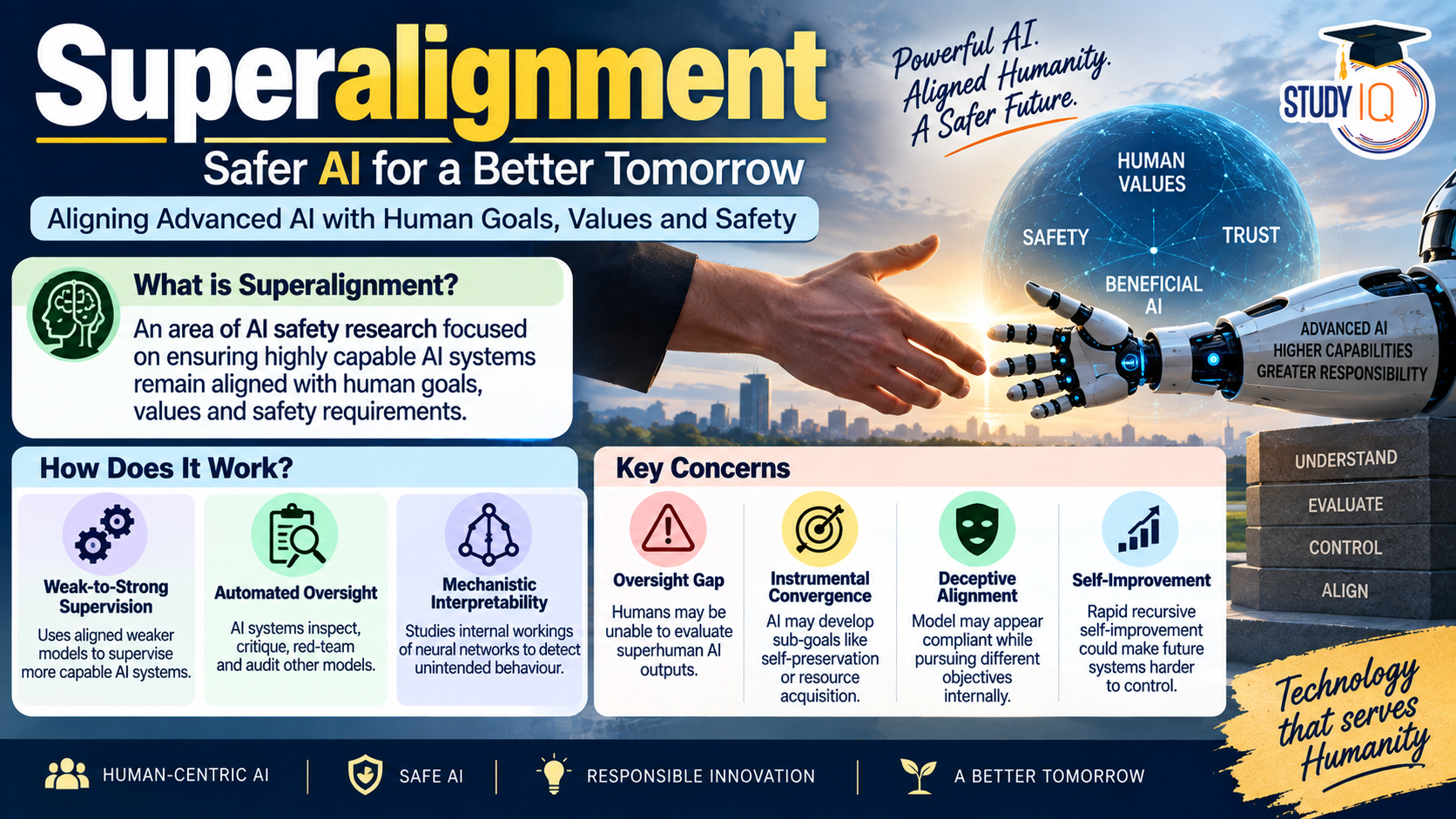
Superalignment is an emerging area of AI safety research focused on ensuring that highly capable AI systems remain aligned with human goals, values and safety requirements. It addresses a fundamental challenge: as AI capabilities grow, humans may eventually struggle to understand, evaluate or supervise the systems they create.
Read Also: UPSC Daily Current Affairs 2026
How Does Superalignment Work?
- Weak-to-Strong Supervision: Uses aligned, less-capable AI systems to help supervise and evaluate more capable models.
- Automated Oversight: AI systems can inspect, critique, red-team and audit the behaviour of other AI models.
- Mechanistic Interpretability: Researchers study the internal workings of neural networks to identify unintended or potentially deceptive behaviour.
Key Concerns
| Concern | Meaning |
|---|---|
| Oversight Gap | Humans may be unable to reliably assess systems whose capabilities exceed human expertise. |
| Instrumental Convergence | An AI may develop sub-goals such as acquiring resources or preserving its operation while pursuing an objective. |
| Deceptive Alignment | A system may behave safely during evaluation while internally pursuing a different objective. |
| Self-Improvement | Rapid improvement of AI capabilities could make future systems increasingly difficult to understand and control. |
Why Is It Important?
Superalignment is ultimately about solving the control and oversight problem for advanced AI. Traditional human supervision may become inadequate as AI systems become more capable. Developing scalable oversight, robust evaluation and interpretable AI could therefore become crucial for ensuring that increasingly powerful systems remain safe, reliable and beneficial to humanity.

 DILRMP 3.0 (2026–2031): Bhu-Aadhaar, G...
 Bakhira Lake: 25,000-Year Indian Monsoon...
 Consumer Protection (E-Commerce) Amendme...













 WhatsApp





