
Table of Contents
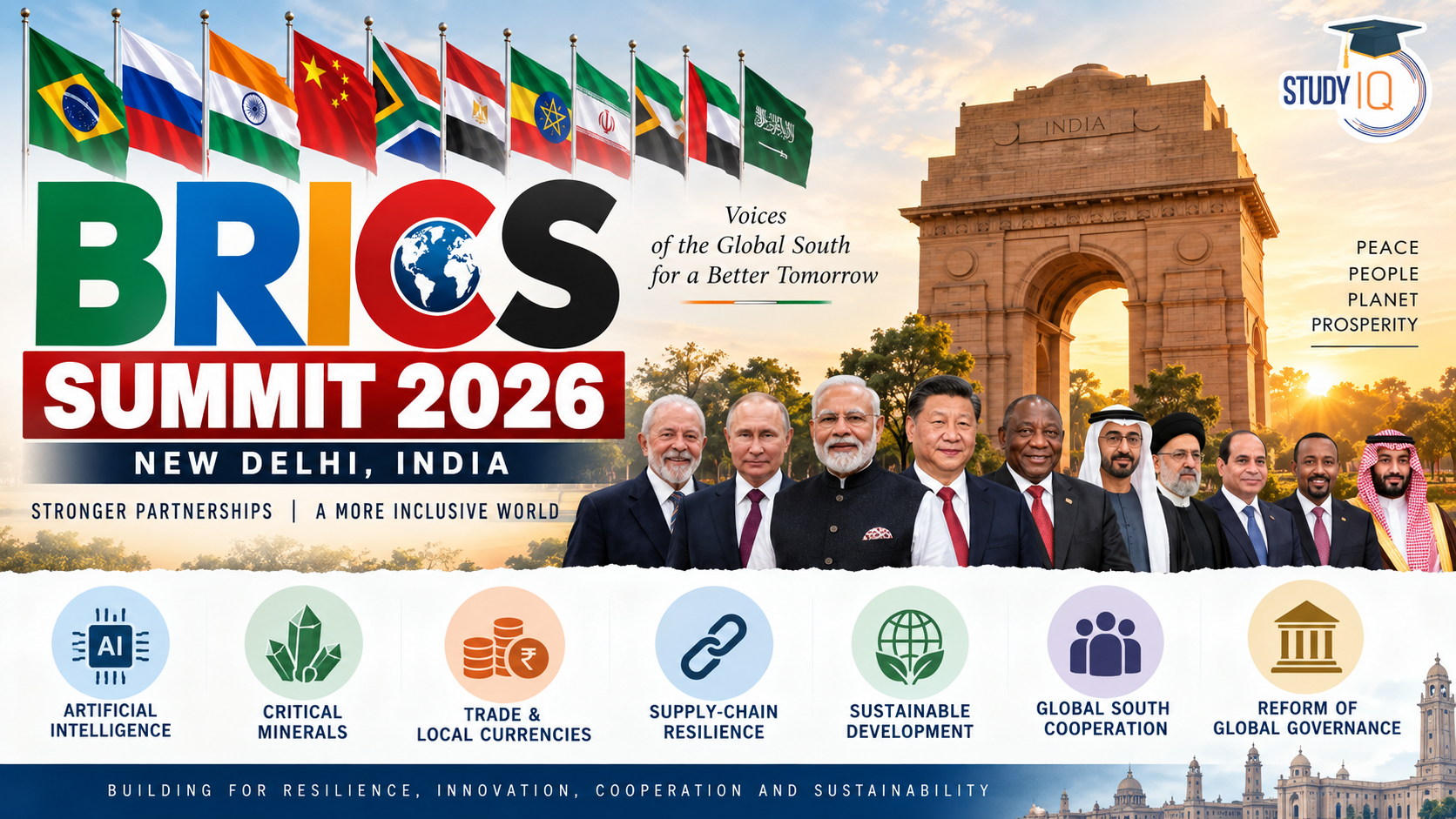
BRICS Summit 2026: The 18th BRICS Summit, hosted by India in New Delhi on 12–13 September 2026, marked an important moment in the evolution of the Global South grouping. Held under the theme “Building for Resilience, Innovation, Cooperation and Sustainability,” the summit sought to move BRICS beyond traditional economic cooperation towards technology, critical minerals, health, supply-chain resilience and global governance reform.
For India, the summit was an opportunity to strengthen strategic autonomy, multipolarity and Global South leadership while managing differences among major powers within BRICS.
Read Also: UPSC Daily Current Affairs 2026
What is BRICS?
BRICS began as BRIC—Brazil, Russia, India and China—and evolved into a wider platform with South Africa joining in 2011. Its subsequent expansion has increased its geographical, demographic and economic significance.
However, BRICS is not a military alliance or a formal economic union. Its significance lies in providing a platform for coordination among emerging economies and developing countries on global economic and political issues.
BRICS Summit 2026: Major Outcomes
1. New Delhi Declaration
The summit adopted the New Delhi Declaration, reflecting consensus on economic cooperation, international peace, development and reform of global institutions. The declaration reaffirmed commitment to a more representative, equitable and effective multilateral order.
The significance lies not merely in the declaration itself but in India’s ability to secure consensus among countries with divergent strategic interests.
2. AI and Emerging Technologies
Artificial Intelligence emerged as a major area of cooperation. BRICS emphasised safe, secure, inclusive and reliable AI, particularly improving access to AI resources for developing countries.
China also proposed initiatives aimed at strengthening BRICS cooperation in open-source AI, digital infrastructure and technological capacity-building.
For India, AI cooperation is strategically important because technological dependence can become a new form of geopolitical dependence.
3. Critical Minerals and Supply-Chain Resilience
Prime Minister Narendra Modi warned against the “weaponisation” of technology and critical minerals, highlighting their growing importance for economic security.
Critical minerals such as lithium, cobalt and rare earth elements are essential for renewable energy, electric vehicles, semiconductors and advanced technologies. BRICS therefore recognised the need for reliable, diversified and resilient critical-mineral supply chains, while respecting the sovereignty of resource-rich countries.
This marks a shift from conventional energy geopolitics towards technology and mineral geopolitics.
4. Local-Currency Trade and Financial Cooperation
BRICS continued discussions on facilitating cross-border payments and trade settlements in local currencies. The objective is to reduce transaction costs, strengthen financial resilience and lessen excessive dependence on existing international financial arrangements.
However, this should not be interpreted as the creation of a common BRICS currency. The focus remains on pragmatic financial cooperation and interoperability among payment systems.
5. Supply Chains and Global Value Chains
The declaration emphasised resilient, transparent and inclusive global value chains. BRICS countries seek greater participation of developing economies in higher-value manufacturing and production, supported by technology transfer, investment and capacity-building.
This is particularly relevant amid geopolitical fragmentation, protectionism and recurring disruptions caused by conflicts, pandemics and climate-related disasters.
BRICS and Global Governance Reform
A central theme of the summit was reform of global institutions, particularly the United Nations and the broader multilateral system.
For India, BRICS provides an important platform to push for greater representation of developing countries in global decision-making. The objective is not simply to replace one dominant power structure with another, but to create a more representative and multipolar international order.
Significance for India
The summit advances India’s interests in several ways:
- Global South leadership: India strengthened its role as a bridge between developed and developing countries.
- Strategic autonomy: BRICS provides diplomatic space beyond traditional power blocs.
- Technology security: Cooperation on AI and emerging technologies can reduce technological vulnerabilities.
- Economic resilience: Local-currency settlements and diversified supply chains can improve resilience.
- Critical minerals: Greater cooperation can support India’s energy-transition and manufacturing ambitions.
- Diplomatic balancing: India demonstrated that cooperation with China and Russia can coexist with independent strategic choices.
Challenges
BRICS nevertheless faces structural limitations. Its members have different political systems, economic priorities and geopolitical interests. India-China strategic competition, divergent approaches to conflicts and differences over the pace of financial de-dollarisation can constrain deeper integration.
Therefore, the real test is whether BRICS can convert declarations into institutions, mechanisms and measurable outcomes.
Way Forward
BRICS should prioritise:
- Practical interoperability of cross-border payment systems.
- Transparent and sustainable critical-mineral supply chains.
- Inclusive AI governance and technology access.
- Stronger cooperation through the New Development Bank.
- Greater integration of developing countries into global value chains.
- Institutional reforms that enhance continuity and implementation.
Conclusion
The BRICS Summit 2026 demonstrates that the grouping is evolving from an economic acronym into a broader platform for multipolarity, strategic autonomy and Global South agency.
For India, the central achievement is not the creation of an alternative world order, but the strengthening of a platform through which emerging economies can become “rule-shapers” rather than merely rule-takers.
The future relevance of BRICS will ultimately depend on its ability to transform geopolitical diversity into functional cooperation and concrete developmental outcomes.

 Superalignment: Meaning, AI Safety, Weak...
 DILRMP 3.0 (2026–2031): Bhu-Aadhaar, G...
 Bakhira Lake: 25,000-Year Indian Monsoon...













 WhatsApp





