Table of Contents
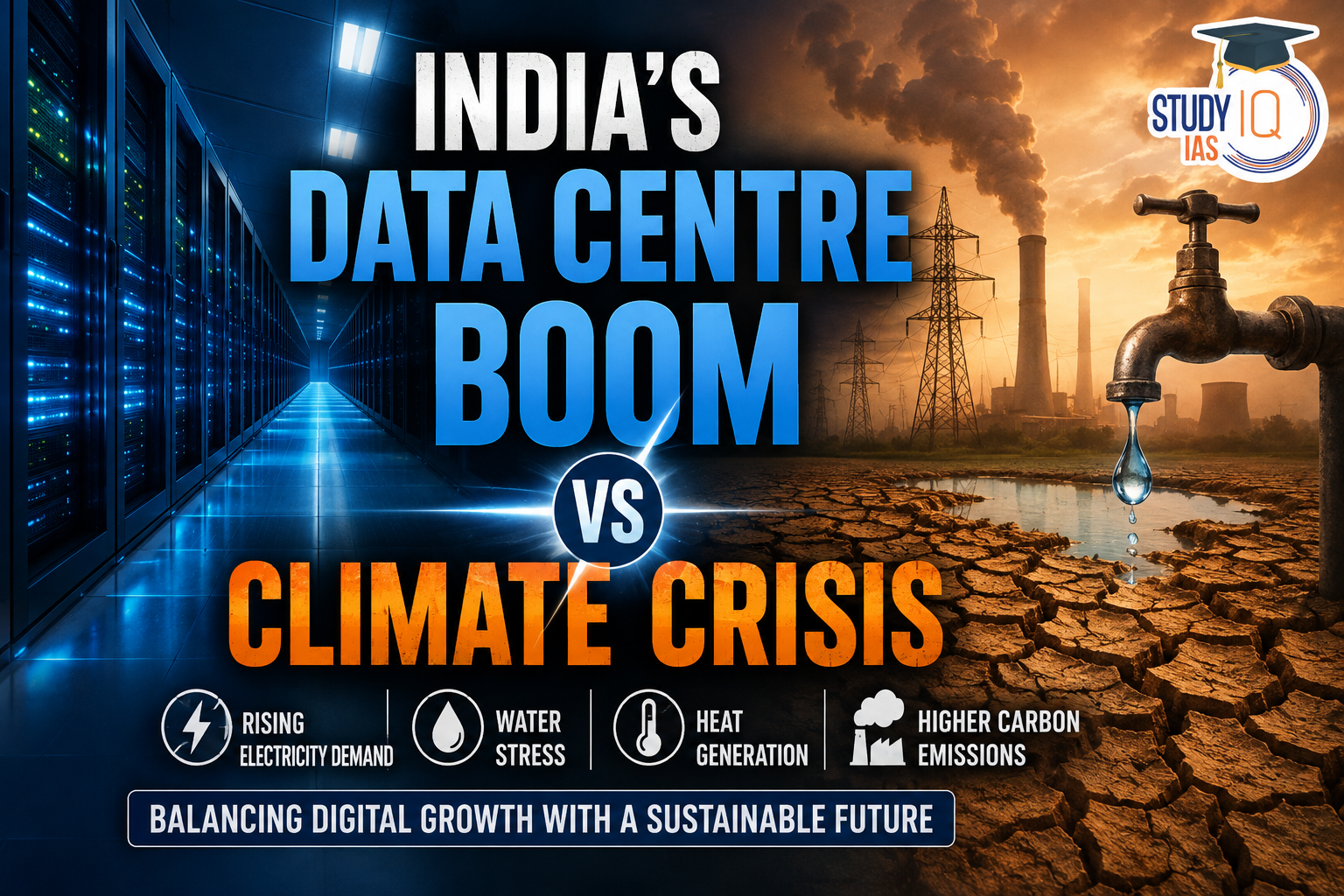
India’s Data Centre Boom vs Climate Crisis: India is rapidly emerging as a major data centre hub, with technology companies investing billions of dollars in digital infrastructure. The growth is being powered by Artificial Intelligence (AI), cloud computing, 5G, digital payments and India’s expanding digital economy.
But there is a catch: data centres need huge amounts of electricity and water, and they generate a lot of heat.
This is creating a new challenge for India—how to expand its digital economy without increasing pressure on already-stressed natural resources.
Read Also: UPSC Daily Current Affairs 2026
Why Are Data Centres Growing So Fast in India?
A data centre is essentially a facility where thousands of computers and servers operate continuously to store, process and transmit data.
India’s data-centre capacity has grown from around 520 MW in 2020 to nearly 1.5 GW. By 2030, it is projected to reach around 6.5 GW.
The growth is being driven by:
- AI and generative AI
- Cloud computing
- 5G and digital services
- Digital payments
- E-commerce
- Digitisation of businesses
The government expects data centres to attract nearly $200 billion in investment over the coming decade.
States including Maharashtra, Telangana, Karnataka and Gujarat are competing to attract these investments.
The Biggest Problem: Electricity
Data centres cannot simply switch off when electricity demand is high.
Their servers operate 24×7, requiring a continuous and highly reliable power supply.
According to the figures highlighted in the source article, electricity demand from data centres could rise from around 13 TWh to nearly 57 TWh by 2030.
That is a huge increase.
And AI could make the situation even more challenging because AI workloads require considerably more computing power than many conventional digital services.
The problem in simple terms:
More AI → More servers → More electricity → More cooling → More power demand
India is also trying to increase renewable energy while reducing dependence on fossil fuels. If additional demand is met by coal-heavy electricity, the environmental benefits of digitalisation could be partly offset by higher emissions.
Water: The Hidden Cost of Data Centres
When we think about data centres, we usually think about computers and electricity.
But there is another major requirement: water.
Servers generate enormous amounts of heat. Many facilities use water-based cooling systems to keep temperatures under control.
A large data centre can therefore consume millions of litres of water.
This becomes particularly concerning when data centres are built in cities already experiencing water stress.
For example, major technology hubs such as Bengaluru and Hyderabad have faced significant water-related challenges.
So the question is important:
Should a water-stressed city use scarce freshwater for rapidly expanding digital infrastructure?
The answer requires careful planning rather than a simple yes or no.
Data Centres Are Also Adding Heat
There is another less-discussed issue: heat.
Thousands of servers operating continuously generate large quantities of waste heat.
That heat has to be removed through cooling systems.
This creates an interesting cycle:
Hotter weather → More cooling → More electricity consumption → More heat and emissions
The problem can become even worse in cities affected by the urban heat-island effect, where built-up areas are significantly warmer than surrounding regions.
This means climate change itself can increase the energy required to operate data centres.
Transmission Infrastructure Is Another Challenge
It is not enough to generate electricity. India also needs the transmission infrastructure to deliver that electricity reliably to data centres.
Large facilities require a stable power supply and can put significant pressure on local electricity networks.
Transmission delays could therefore become a bottleneck for data-centre expansion.
In simple terms:
Data centre investment + electricity generation + transmission capacity = sustainable digital growth
If one link is missing, the entire system can face problems.
What Is the Government Doing?
Several states are offering incentives to attract data-centre investments.
Some policies encourage:
- Renewable-energy use
- Special electricity arrangements
- Faster approvals
- Infrastructure support
- Investment incentives
However, incentives alone may not be enough.
India needs common and enforceable environmental standards so that data-centre growth does not simply shift environmental costs to local communities.
What Should India Do?
1. Set Water-Use Standards
Data centres should have clear limits on freshwater consumption and should maximise water recycling and reuse.
2. Promote Renewable Energy
Data centres should increasingly use renewable electricity, supported by energy storage where necessary.
3. Assess Grid Impact
Before approving large projects, authorities should examine whether the local transmission network can handle the additional demand.
4. Encourage Efficient Cooling
Water-efficient and energy-efficient cooling technologies should become standard, particularly in water-stressed regions.
5. Choose Locations Carefully
Data centres should not be concentrated only in major technology hubs. Locations should be assessed based on:
Water availability + Power availability + Transmission capacity + Climate risk
6. Make Environmental Data Public
Companies should disclose their:
- Electricity consumption
- Water consumption
- Renewable-energy share
- Cooling requirements
- Environmental footprint
This would make it easier to measure the real sustainability of India’s digital economy.
Why Does This Matter for India?
India wants to become a global leader in AI, cloud computing and digital infrastructure.
That requires data centres.
But India’s development challenge is becoming increasingly clear:
Digital growth cannot be separated from resource security.
A data centre may look like a symbol of a modern, digital India, but behind every server are electricity, water, land and cooling requirements.
Therefore, India needs to build a model where economic growth, technological progress and environmental sustainability move together.
Bottom Line
India should not stop its data-centre expansion. Instead, it should make that expansion smarter.
The goal should be:
More digital infrastructure + less water waste + cleaner electricity + efficient cooling + stronger grids.
That is the only way India’s data-centre boom can become a long-term digital opportunity rather than a new environmental burden.

UPSC IAS Live GS P2I Foundation 2027 Pratigya August Evening Batch 2 (Basic)
 Special Summary Revision (SSR) 2026–27...
 Global Hunger Index 2026: India Ranks 10...
 France Protests 2026: Cost of Living, Sc...














 WhatsApp