Table of Contents
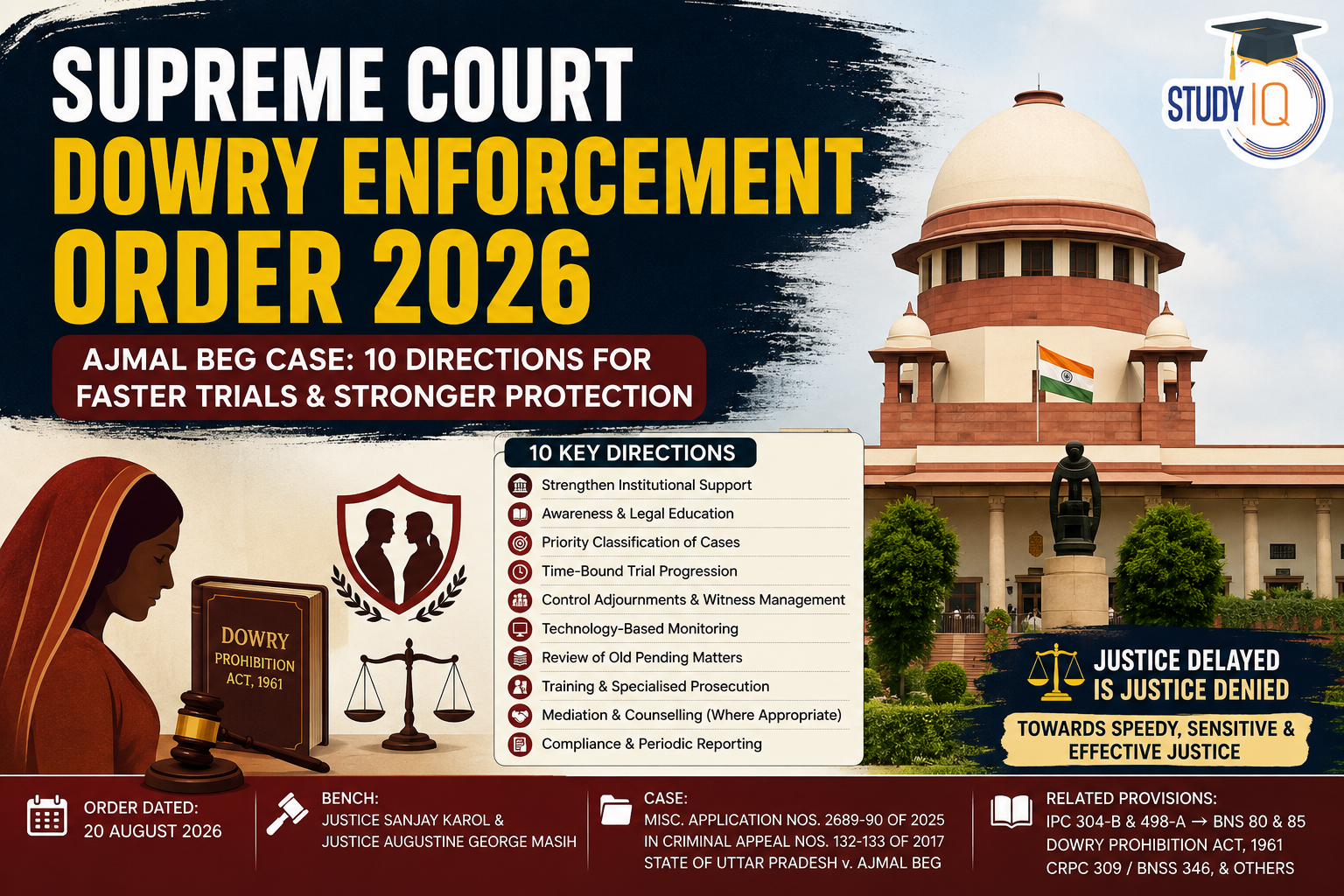
Supreme Court Dowry Enforcement Order 2026: The Supreme Court’s 20 August 2026 order in State of Uttar Pradesh v. Ajmal Beg marks an important development in the enforcement of laws relating to dowry and matrimonial cruelty. The order focuses not merely on deciding an individual criminal case but on improving the institutional and procedural architecture through which such cases are investigated and tried.
The case is particularly significant because the underlying proceedings took 24 years, beginning in 2001 and reaching finality only in 2025. The Supreme Court therefore adopted a continuing supervisory approach and issued directions aimed at reducing delays, strengthening institutional support, improving monitoring and ensuring better implementation of existing legal provisions.
The matter concerns Miscellaneous Application Nos. 2689-90 of 2025 in Criminal Appeal Nos. 132-133 of 2017, before a Bench comprising Justice Sanjay Karol and Justice Augustine George Masih. The order was dated 20 August 2026.
Read Also: Judiciary Current Affairs
What is the Ajmal Beg Case?
The Supreme Court had earlier decided State of U.P. v. Ajmal Beg on 15 December 2025. It allowed the State’s appeals and restored the trial court’s conviction under Sections 304-B and 498-A of the Indian Penal Code (IPC).
Under the new criminal-law framework, these provisions correspond to:
- Section 304-B IPC → Section 80, Bharatiya Nyaya Sanhita (BNS), 2023
- Section 498-A IPC → Section 85, BNS, 2023
Despite the conclusion of the criminal appeal, the Court highlighted the extraordinary 24-year delay in the proceedings. Instead of simply closing the matter, it retained supervisory control and sought compliance reports from States and High Courts.
This transformed the case into an example of continuing mandamus, where the Court continues to supervise implementation rather than issuing a one-time direction. The source links this approach to Vineet Narain v. Union of India (1998).
Why Did the Supreme Court Intervene?
The central concern was not simply the existence of laws against dowry and matrimonial cruelty. India already has a statutory framework addressing these offences.
The concern was effective enforcement.
The Court’s approach addresses several practical problems:
- Long-pending criminal trials.
- Ineffective implementation of Dowry Prohibition Officers.
- Lack of institutional support for victims.
- Delays in framing charges and recording evidence.
- Repeated adjournments.
- Poor witness management.
- Lack of stage-wise digital monitoring.
- Pending appeals, revisions, bail matters and stay orders.
- Need for better training of police, prosecutors and judicial officers.
Thus, the August 2026 order can be understood as an attempt to improve the enforcement architecture surrounding dowry-related offences.
December 2025 Directions: The Foundation
The August 2026 order followed five directions issued by the Supreme Court in December 2025.
1. Curricular Reform
States and the Union were asked to consider changes to educational curricula to reinforce:
- Constitutional equality between spouses.
- Gender equality.
- The principle that neither spouse is subordinate to the other.
2. Effective Dowry Prohibition Officers
The Dowry Prohibition Act, 1961 already provides for Dowry Prohibition Officers.
The Court emphasised that these officers should:
- Actually be appointed/deputed.
- Understand their statutory responsibilities.
- Be adequately resourced.
- Have their names and official contact details publicised locally.
3. Training and Sensitisation
Police and judicial officers should receive training to understand the social and psychological dimensions of dowry-related cases.
Training should also help authorities distinguish genuine complaints from complaints involving abuse of the legal process.
4. Docket Audit
High Courts were asked to identify pending cases under Sections 304-B and 498-A IPC, prioritising older cases for expeditious disposal.
5. Awareness Beyond Educational Institutions
District Administrations, District Legal Services Authorities and civil society organisations were encouraged to conduct regular awareness programmes regarding:
- The illegality of giving and taking dowry.
- Mental cruelty.
- Physical cruelty.
- Legal rights and remedies.
States were specifically asked to report on Dowry Prohibition Officers, while High Courts were asked to report on pendency audits.
Supreme Court’s 10 Directions in August 2026
The August 2026 order moved from broad awareness-oriented directions towards operational and procedural reforms.
1. Strengthening Institutional Support
States and Union Territories have been directed to make institutional mechanisms more effective.
This includes strengthening:
- Dowry Prohibition Officers.
- One Stop Centres.
- Family Counselling Centres.
- Women Help Desks.
- Victim assistance mechanisms.
- Helplines.
- Online grievance redressal systems.
The emphasis is on making existing institutions functional and accessible.
2. Awareness and Legal Education
States and Union Territories, along with Education and Women & Child Development Departments and State Legal Services Authorities, are expected to undertake sustained awareness programmes.
These should focus on:
- Dowry prohibition.
- Gender equality.
- Constitutional values.
- Women’s rights.
- Legal literacy.
- Community-level awareness.
The approach therefore extends beyond the courtroom and seeks to address the social foundations of dowry-related practices.
3. Priority Classification and Monitoring of Cases
Courts and district judiciary have been asked, so far as practicable, to treat matters under Sections 304-B and 498-A as priority cases.
Particular attention should be given to cases:
- Pending for more than three years.
- Stuck at the charge-framing stage.
- Stuck at the evidence stage.
Monthly or quarterly reviews can be used to monitor progress.
4. Time-Bound Progression of Trials
Trial courts have been directed towards faster progression of proceedings.
The framework includes:
- Prompt appearance of the accused after filing of the charge-sheet.
- Charge framing preferably within 60–90 days of the charge-sheet.
- Commencement of evidence within a reasonable period.
- Day-to-day recording of evidence where appropriate under Section 309 CrPC / Section 346 BNSS.
Important: 60–90 Days Is Not an Absolute Deadline
This is a crucial examination point.
The Court treated the 60–90 day period as a directory benchmark, rather than an inflexible mandatory deadline.
Exceptional circumstances may justify deviation, including:
- Multiple accused.
- Supplementary charge-sheets.
- Forensic delays.
- Non-availability of the accused.
- Other recorded reasons.
This distinction is important because converting procedural benchmarks into rigid deadlines could create unintended grounds for further litigation and delay.
5. Controlling Adjournments and Improving Witness Management
The Court stressed better trial management.
Key measures include:
- Adjournments should be granted only for reasons recorded in writing.
- Legal Aid Counsel or an Amicus may be appointed where defence counsel is repeatedly absent.
- A substitute Investigating Officer may be used where the original officer has retired or been transferred.
- A witness calendar should be prepared immediately after framing of charges.
These measures are designed to prevent procedural gaps from unnecessarily prolonging criminal trials.
6. Technology-Based Monitoring
High Courts have been asked to integrate better technological monitoring mechanisms into existing court systems.
This includes:
- Stage-wise pendency tracking.
- Digital dashboards.
- Automated alerts for old cases.
- Case monitoring through existing Court Dashboards/CIS.
The objective is to ensure that long-pending cases can be identified and acted upon rather than remaining invisible within large court dockets.
7. Review of Old Pending Matters
High Courts should periodically review old:
- Criminal appeals.
- Criminal revisions.
- Section 482 CrPC petitions.
- Section 528 BNSS petitions.
- Bail matters.
Particular attention should be given to cases where the trial has been stayed.
The Court also directed that stay orders should be reviewed in accordance with law.
8. Training and Specialised Prosecution
States, Union Territories and High Courts have been asked to promote periodic training for:
- Judicial officers.
- Police personnel.
- Prosecutors.
- Protection Officers.
- Counsellors.
- Other relevant stakeholders.
Training may be conducted through Judicial Academies and Police Training Institutions.
States may also designate prosecutors who are sensitised to these offences.
9. Mediation and Counselling
The Court permits mediation or counselling in appropriate matrimonial matters.
However, there is an important firewall.
Such mechanisms may be explored where the dispute primarily involves matrimonial discord and does not involve:
- Death.
- Grievous physical violence.
- Other serious offences.
The objective is therefore not to dilute the criminal law but to appropriately manage cases where mediation or counselling is legally permissible.
10. Compliance and Periodic Reporting
The Supreme Court has institutionalised periodic reporting by High Courts and States/UTs.
Reports are to cover:
- Pendency.
- Disposal figures.
- Stage-wise case status.
- Awareness programmes.
- Appointment of Dowry Prohibition Officers.
- Training conducted.
- Other measures taken.
The reporting dates specified are 15 January, May and September.
The matter was listed for compliance-cum-periodic reports on 15 October 2026.
Continuing Mandamus: Why Is It Important?
The Ajmal Beg proceedings provide a useful example of continuing mandamus.
Normally, a court decides a dispute and concludes the proceeding. Under continuing mandamus, however, the court may retain supervisory jurisdiction and require periodic reports to assess whether its directions are actually being implemented.
The approach is associated with the Supreme Court’s broader public-law jurisprudence, including Vineet Narain v. Union of India.
In simple words:
Ordinary judicial order:
Court gives direction → authorities act → matter ends.
Continuing mandamus:
Court gives direction → authorities report compliance → Court reviews progress → further directions/review → continuing supervision.
This makes the Ajmal Beg order important not only for dowry law but also for understanding judicial supervision of administrative implementation.
498-A Jurisprudence: Balancing Protection and Prevention of Abuse
Another important aspect of the order is its two-sided approach.
The Court recognises the need to protect genuine victims of matrimonial cruelty while also ensuring that legal processes are not abused.
The source connects this jurisprudence with:
- Arnesh Kumar v. State of Bihar (2014)
- Rajesh Sharma v. State of U.P. (2017)
- Social Action Forum for Manav Adhikar v. Union of India (2018)
The 2026 approach differs from the earlier Family Welfare Committee model. Rather than relying primarily on complaint screening, it emphasises trained personnel, institutional capacity and faster trials.
Important Legal Provisions for Exams
Aspirants should revise the following provisions alongside the August 2026 order:
| Provision | Subject |
|---|---|
| Section 304-B IPC | Dowry death |
| Section 80 BNS, 2023 | Corresponding BNS provision |
| Section 498-A IPC | Cruelty by husband or relatives |
| Section 85 BNS, 2023 | Corresponding BNS provision |
| Section 113-B Evidence Act | Presumption as to dowry death |
| Section 118 Bharatiya Sakshya Adhiniyam, 2023 | Corresponding provision |
| Section 8-B Dowry Prohibition Act, 1961 | Dowry Prohibition Officers |
| Section 309 CrPC | Power to postpone/adjourn proceedings |
| Section 346 BNSS | Corresponding BNSS provision |
| Article 21, Constitution | Right to speedy trial |
These statutory provisions form the legal framework surrounding the Court’s directions.
Article 21 and Speedy Trial
The issue of prolonged criminal proceedings also connects directly with Article 21 of the Constitution.
The Supreme Court has interpreted the right to life and personal liberty under Article 21 to include the right to a speedy trial, notably in the Hussainara Khatoon line of cases.
The 24-year trajectory in Ajmal Beg therefore highlights a fundamental concern: justice delayed for decades can undermine both the interests of victims and the rights of accused persons.
The 2026 directions seek to address this through:
- Priority classification.
- Case monitoring.
- Time-bound procedural progression.
- Witness calendars.
- Control of adjournments.
- Digital dashboards.
- Review of old stays and pending proceedings.
Key Takeaways
The August 2026 Supreme Court order in State of U.P. v. Ajmal Beg is significant because it moves beyond declaring legal principles and focuses on how the existing legal framework should actually function.
The key themes are:
- 24-year delay highlighted the need for systemic intervention.
- Continuing mandamus allows the Supreme Court to supervise implementation.
- Ten directions target institutional, procedural and technological weaknesses.
- 60–90 days for charge framing is a directory benchmark, not an absolute mandatory deadline.
- Old 304-B and 498-A cases should receive priority attention where practicable.
- Adjournments and witness management require greater discipline.
- Digital dashboards should facilitate stage-wise monitoring.
- Training and specialised prosecution can improve handling of sensitive cases.
- Mediation/counselling is contemplated only in appropriate matrimonial disputes, with safeguards for serious offences.
- Periodic compliance reports make implementation an ongoing judicial concern.
The broader lesson is that combating dowry is not only a question of creating offences. It also requires effective institutions, trained personnel, timely trials, technological monitoring, legal awareness and accountable implementation.
 Supreme Court Modifies 3-Year Practice R...
 Doctrine of Per Incuriam Explained: Supr...
 AI Hallucinations in Legal Research: Sup...







 WhatsApp