Table of Contents
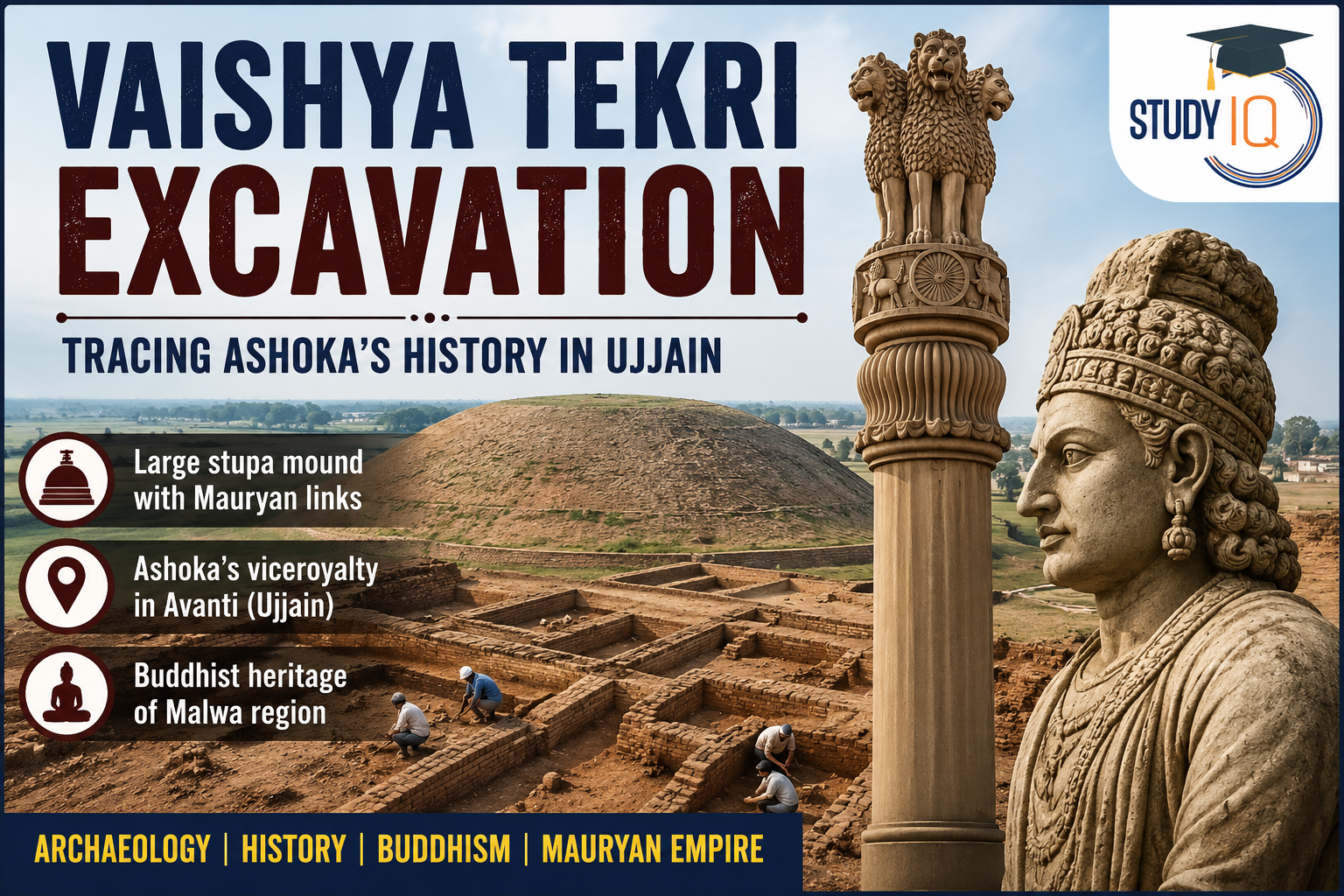
The fresh excavation at Vaishya Tekri in Ujjain, Madhya Pradesh, has renewed interest in the city’s association with Mauryan Emperor Ashoka and the spread of Buddhism in ancient Malwa. The site is believed to contain a large stupa-like mound, but historians caution that its definitive attribution to Ashoka requires stronger archaeological evidence.
Read Also: UPSC Daily Current Affairs 2026
Vaishya Tekri and its Archaeological Significance
Vaishya Tekri is considered one of the largest ancient mound structures in Ujjain. According to academic Peter Skilling, it is estimated to have a base of around 350 feet and a height of nearly 100 feet, making it substantially larger than the approximately 54-foot Great Stupa at Sanchi.
The site was excavated in 1938–39 by the Archaeology Department of the erstwhile Gwalior State. The discovery of large bricks and punch-marked coins contributed to its dating to the Mauryan period.
However, the earlier excavation was conducted nearly nine decades ago. Contemporary scholars therefore argue that its findings and interpretations need to be reassessed through modern archaeological techniques.
Ashoka and Ujjain
Ancient Ujjayini (modern Ujjain) was the capital of Avanti and an important commercial centre. Its strategic location connected northern India with western India and important coastal trade routes.
According to historical accounts, Ashoka was appointed viceroy of Avanti by his father Bindusara. His long association with Ujjain is important for understanding his administrative experience before he became emperor.
The city’s importance was not limited to trade and administration. Ujjain and the wider Malwa region also emerged as important centres of early Buddhism.
Ashoka, Vidisha and Devi
Traditions connect Ashoka’s journey to Ujjain with Vidisha, where he is said to have met Devi, the daughter of a merchant.
The tradition associates Ashoka and Devi with two children, Mahinda and Sanghamitta, who later became important figures in the transmission of Buddhism to Sri Lanka.
However, historical interpretations differ regarding the precise nature of Ashoka and Devi’s relationship. This highlights the importance of distinguishing between Buddhist literary traditions and independently corroborated historical evidence.
Vaishya Tekri and Kumbhar Tekri
The archaeological landscape around Vaishya Tekri includes Kumbhar or Kumhar Tekri, which has a distinct historical tradition.
The Chinese pilgrim Xuanzang, who visited India in the 7th century CE, recorded a tradition that a site near Ujjain marked the location of a “hellish prison” associated with Ashoka.
Earlier excavations at Kumbhar Tekri reportedly identified a burial-cum-cremation ground dating to the 3rd century BCE.
These accounts are significant, but they must be critically evaluated because Xuanzang’s account was recorded centuries after Ashoka’s reign.
Why Fresh Excavation Matters
The renewed excavation can help address several unresolved questions:
- Chronology: Can scientific dating establish the precise period of construction?
- Patronage: Is there direct evidence linking the monument to Ashoka?
- Buddhist landscape: Were monasteries, smaller stupas or cemeteries located nearby?
- Urban development: How did the religious complex relate to ancient Ujjain?
- Mauryan administration: What evidence exists regarding Ujjain’s political and administrative role?
- Cultural continuity: How did the site evolve from the Mauryan period to later historical phases?
Thus, excavation should not focus solely on the central mound. The entire archaeological landscape needs to be studied.
Need for Historical Caution
The identification of Vaishya Tekri as an Ashokan monument remains a matter requiring further investigation.
- First, the principal excavation was undertaken in 1938–39, and archaeological methodologies have advanced considerably since then.
- Second, large size does not by itself establish Mauryan origin or royal patronage.
- Third, the absence of confirmed Ashokan pillars or inscriptions at Ujjain limits the ability to directly associate the site with Ashoka.
- Fourth, later literary traditions, including accounts of Xuanzang, should be corroborated with archaeological and epigraphic evidence.
Therefore, the excavation should be viewed as an opportunity to test historical hypotheses rather than simply confirm established narratives.
Wider Significance
The Vaishya Tekri excavation has implications beyond the history of a single monument.
- Mauryan history: It may provide evidence about Ashoka’s administrative activities before his accession.
- Buddhism: It can improve understanding of the spread of Buddhism in Malwa.
- Urbanisation: Archaeological evidence can illuminate the growth of Ujjain as an ancient urban centre.
- Trade: Ujjain’s location on major routes highlights the relationship between commerce and cultural exchange.
- Heritage conservation: Scientific excavation can help protect archaeological sites from expanding urbanisation.
- Historical methodology: The project demonstrates the importance of corroborating literary traditions with material evidence.
Conclusion
The Vaishya Tekri excavation represents an important opportunity to reconstruct the Mauryan-era cultural landscape of Ujjain. Ashoka’s association with Ujjain is historically plausible and supported by several literary and contextual sources, but the precise attribution of Vaishya Tekri to Ashoka cannot be established solely on the basis of its size, local traditions or older excavation findings.
A multidisciplinary and landscape-level investigation, combining archaeology, epigraphy, scientific dating and historical sources, can provide a more reliable understanding of Ujjain’s role in the Mauryan Empire and the evolution of Buddhism in Malwa.

UPSC IAS Live GS P2I Foundation 2027 Pratigya August Evening Batch 2 (Basic)
 Child Marriage in India: Causes, Impacts...
 World Development Report 2026: The Promi...
 US Suspension of PERM Filings by Major I...














 WhatsApp