
Table of Contents
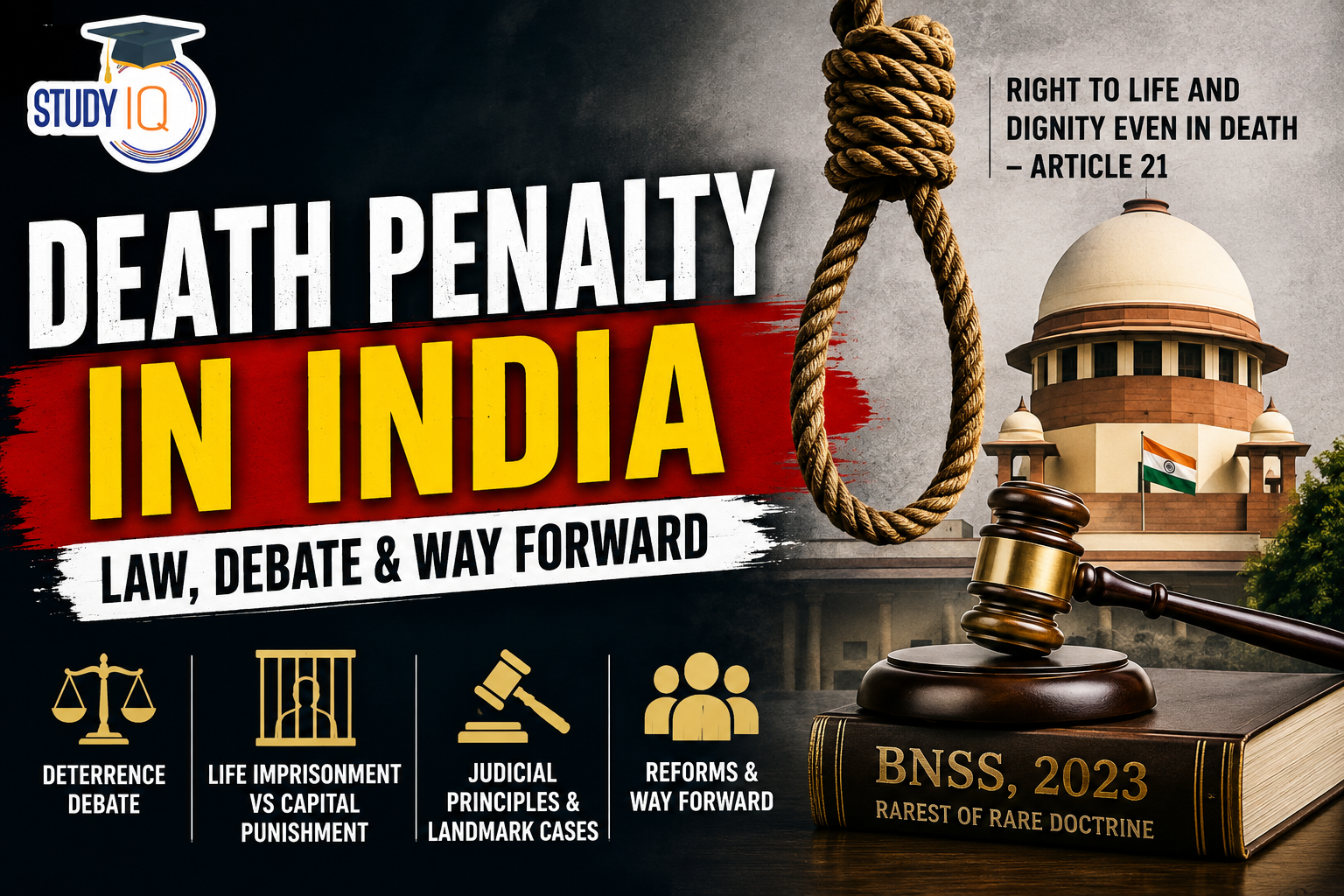
Death Penalty in India: Context
The Supreme Court recently upheld hanging as a constitutional method of execution, holding that the challenge against its scientific reliability and compatibility with the Article 21 right to a dignified death was not sustainable in light of Deena v. Union of India (1983) and Parliament’s decision to retain hanging under the BNSS, 2023.
Read Also: UPSC Daily Current Affairs 2026
What makes the death penalty an uncertain tool of deterrence?
- Weak Empirical Evidence: There is no conclusive evidence that the death penalty reduces crime more effectively than life imprisonment.
- Eg: The Law Commission’s 262nd Report (2015) found no conclusive empirical evidence to prove that capital punishment has a greater deterrent effect than life imprisonment.
- Low Certainty of Punishment: Deterrence becomes weaker when offenders cannot be sure that a serious crime will actually lead to execution.
- Eg: In Bachan Singh v. State of Punjab (1980), the Supreme Court restricted the death penalty to the “rarest of rare” cases, making execution an exceptional punishment.
- Delayed Punishment: Long trials, appeals and mercy petitions weaken the connection between the crime and its final punishment.
- Eg: In Shatrughan Chauhan v. Union of India (2014), the Supreme Court held that unexplained and excessive delay in mercy petitions can justify commutation of the death sentence.
- Limited Additional Effect: Life imprisonment already provides severe punishment and incapacitates the offender, making the extra deterrent effect of execution difficult to prove.
- Limited Rationality: Deterrence assumes that offenders carefully consider punishment before committing a crime, but many violent acts result from anger, impulse, intoxication or extremist motives.
- Eg: A crime committed during a sudden emotional outburst may occur without the offender calculating the possibility of receiving the death penalty.
What makes life imprisonment a different conception of justice from capital punishment?
| Dimensions | Life Imprisonment | Capital Punishment |
| Purpose of Justice | Seeks to punish and incapacitate the offender while preserving life. | Seeks retribution and proportional punishment through deprivation of life in exceptional cases. |
| Possibility of Reform | Retains the possibility of rehabilitation and behavioural change. | Ends any possibility of reform or rehabilitation after execution. |
| Proportionality | Expresses society’s condemnation through long-term deprivation of liberty. | Consider certain exceptional crimes sufficiently grave to justify the ultimate deprivation of life. |
| Reversibility | A wrongful conviction can potentially be corrected through appeal, review or release. | Irreversible: an erroneous execution cannot be undone. |
| Constitutional Philosophy | Allows punishment to be balanced with the values of life, dignity and reform under Article 21. | Permitted under Article 21, but only within the strict “rarest of rare” framework. |
| Individualised Justice | Allows continued assessment of the offender’s conduct, reform and circumstances during imprisonment. | Once executed, no further scope remains for reassessing the offender or circumstances. |
| Eg | Swamy Shraddananda v. State of Karnataka (2008) recognised imprisonment for the remainder of natural life as an alternative to death in appropriate cases. | Bachan Singh v. State of Punjab (1980) held that death should be imposed only in the “rarest of rare” cases when life imprisonment is unquestionably inadequate. |
Way Forward
- Mandatory Mitigation Assessment: Ensure strict compliance with Manoj v. State of M.P. (2022) by requiring comprehensive mitigation analysis before imposing the death penalty.
- Eg: High Courts can scrutinise whether trial courts collected adequate psychological, social-background and prison-conduct evidence.
- Uniform Sentencing Guidelines: Develop clear sentencing standards to reduce judicial inconsistency in applying the “rarest of rare” doctrine.
- Eg: A specialised Sentencing Council, on the lines of the UK model, could frame and periodically revise capital-sentencing guidelines.
- Scientific Investigation & Legal Aid: Strengthen forensic-based investigation and ensure competent legal representation from the trial stage.
- Eg:Article 39A requires the State to provide effective legal aid to accused persons unable to afford representation.
- Structured Life Imprisonment: Provide long-term or non-remissible life imprisonment as a clear alternative to death where permanent incapacitation is necessary.
- Eg:Swamy Shraddhananda (2) v. State of Karnataka (2008) recognised imprisonment for the remainder of natural life as an alternative to capital punishment.
- Progressive Legislative Review: Reassess the continued use of capital punishment in light of evidence, constitutional values and international trends.
- Eg: The Law Commission’s 262nd Report (2015) recommended abolition of the death penalty for ordinary crimes, retaining it for terrorism-related offences and waging war against the State.

 Financial Stability in India: RBI’s 5 ...
 Inter-Parliamentary Union (IPU): 153rd A...
 GST 2.0 and Decriminalisation of Tax Off...











 WhatsApp





