
Table of Contents
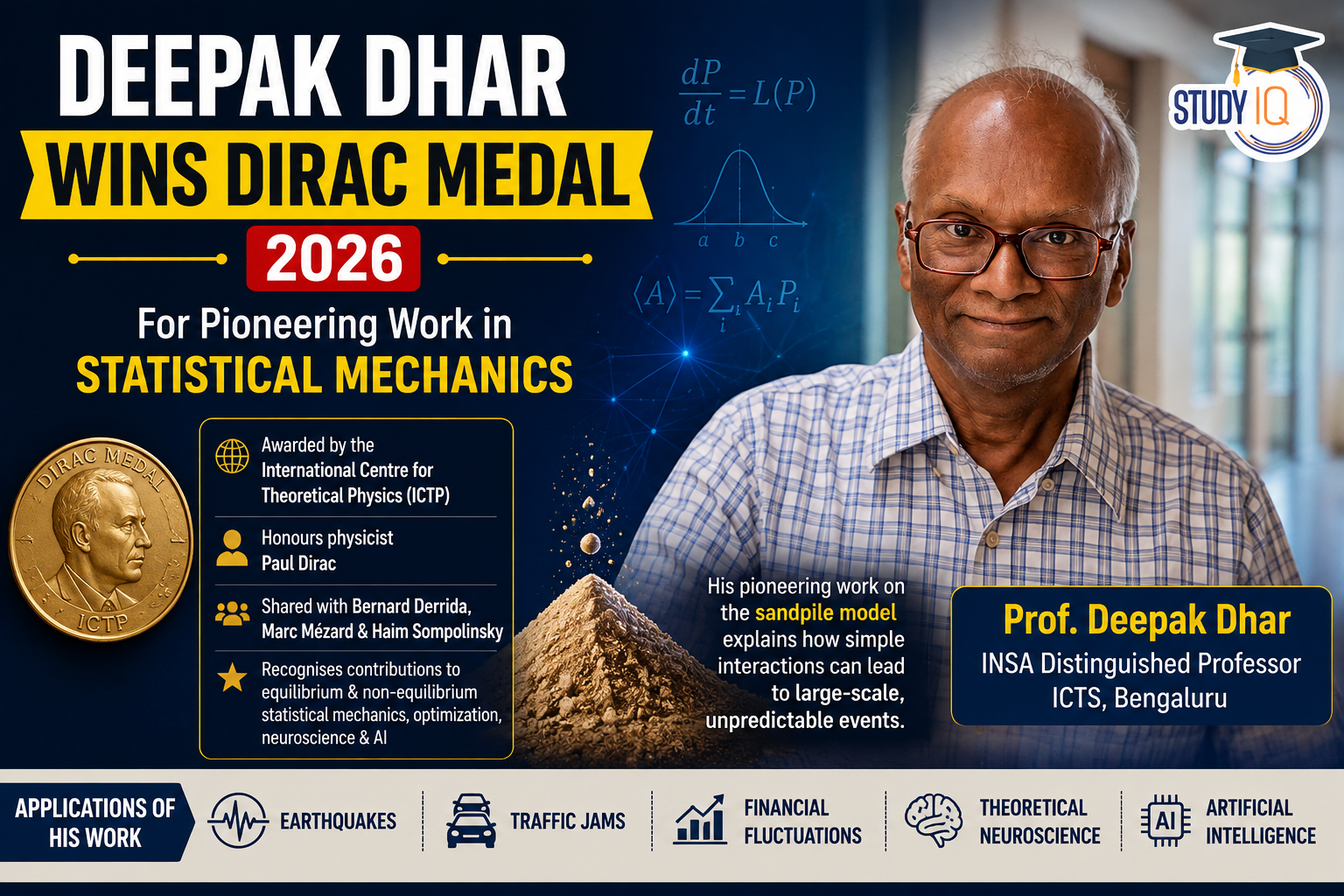
Indian physicist Prof. Deepak Dhar has been awarded the prestigious 2026 Dirac Medal for his pioneering contributions to statistical mechanics and complex systems. Dhar, an INSA Distinguished Professor at the International Centre for Theoretical Sciences (ICTS), Bengaluru, shares the honour with Bernard Derrida, Marc Mézard and Haim Sompolinsky. ICTS lists Dhar as a faculty member working in statistical physics.
The 2026 recognition highlights how concepts developed in statistical physics can be applied to understand complex and unpredictable phenomena across physics, biology, computer science, neuroscience and artificial intelligence.
Read Also: UPSC Daily Current Affairs 2026
What is the Dirac Medal?
The Dirac Medal is awarded annually by the International Centre for Theoretical Physics (ICTP) in honour of renowned theoretical physicist Paul Adrien Maurice Dirac.
First awarded in 1985, the medal recognises scientists who have made significant contributions to theoretical physics. It is presented annually around Dirac’s birthday, 8 August.
The award is regarded as one of the important honours in theoretical physics. ICTP notes that eight Dirac Medal recipients have subsequently won the Nobel Prize in Physics, underscoring the award’s significance.
Deepak Dhar and the 2026 Dirac Medal
The 2026 Dirac Medal recognises the collective contributions of:
- Deepak Dhar
- Bernard Derrida
- Marc Mézard
- Haim Sompolinsky
Their work has helped expand the ideas of equilibrium statistical mechanics into areas including:
- Non-equilibrium statistical mechanics
- Optimization problems
- Theoretical neuroscience
- Artificial intelligence
- Complex systems
This reflects the growing importance of statistical mechanics as an interdisciplinary framework for understanding systems containing a very large number of interacting components.
Who is Deepak Dhar?
Deepak Dhar is an Indian theoretical physicist whose research is primarily associated with statistical physics and complex systems.
He is an INSA Distinguished Professor at ICTS, Bengaluru. ICTS identifies his research area as statistical physics.
Dhar is particularly well known for his pioneering work on sandpile models, which became an important part of the study of self-organized criticality.
What is the Sandpile Model?
Imagine a pile of sand. If grains are added one by one, most additions may produce little or no visible change.
However, when the pile reaches a critical state, adding just one more grain can trigger an avalanche involving many grains.
This simple example illustrates a fundamental feature of complex systems:
A small change can sometimes produce a disproportionately large effect.
Dhar’s work on sandpile models provided an important mathematical framework for studying such behaviour.
What is Self-Organized Criticality?
Self-Organized Criticality (SOC) refers to a phenomenon in which a system naturally evolves toward a critical state without requiring an external mechanism to precisely tune it there.
In this state, disturbances of very different sizes can occur.
For example:
Small disturbance → small avalanche
but occasionally:
Small disturbance → massive avalanche
This idea has become influential in the study of complex systems and has been used as a conceptual framework for understanding phenomena ranging from earthquakes and avalanches to traffic congestion and fluctuations in financial systems.
Why is Deepak Dhar’s Work Important?
The importance of Dhar’s work lies in showing how simple rules and interactions can generate highly complex collective behaviour.
A system does not necessarily need complicated individual components to produce complicated outcomes.
This idea has implications far beyond traditional statistical physics.
1. Physics
Statistical mechanics traditionally studies systems consisting of huge numbers of particles and attempts to connect microscopic interactions with macroscopic behaviour.
Dhar’s work contributes to understanding how collective patterns and critical behaviour emerge from simple underlying rules.
2. Complex Systems
Complex systems often display emergent behaviour—properties that cannot be easily predicted simply by examining individual components.
The sandpile model provides a simple way of studying such emergence.
3. Earthquakes
The concept of criticality has been used to develop models for understanding how small changes in geological systems can sometimes be associated with much larger events.
4. Traffic
Traffic congestion can similarly emerge from relatively simple interactions between individual vehicles.
A small change in traffic flow can, under certain conditions, contribute to a much larger traffic jam.
5. Finance
Financial markets are complex systems involving millions of interacting decisions.
Statistical approaches can help researchers study fluctuations, correlations and sudden changes in such systems.
6. Neuroscience and Artificial Intelligence
The broader statistical-mechanics framework is increasingly relevant to neural networks, theoretical neuroscience and AI, where large numbers of interconnected elements can collectively generate sophisticated behaviour.
Dirac Medal and India
Deepak Dhar’s recognition is significant for India’s theoretical-physics community because it highlights the global impact of Indian research in statistical physics and complex systems.
His association with ICTS also reflects the growing role of Indian institutions in advanced theoretical research.
Dirac Medal 2026: UPSC Significance
For UPSC Civil Services Examination, the award can be linked to GS Paper III – Science & Technology.
Prelims Facts
| Topic | Key Fact |
|---|---|
| Award | Dirac Medal 2026 |
| Awarding institution | International Centre for Theoretical Physics (ICTP) |
| Named after | Paul Dirac |
| Indian awardee | Deepak Dhar |
| Institutional affiliation | ICTS, Bengaluru |
| Field | Statistical Physics |
| Important work | Sandpile model |
| Related concept | Self-Organized Criticality |
| Other 2026 awardees | Bernard Derrida, Marc Mézard, Haim Sompolinsky |
 US Treasury Yields at 25-Year High: Impa...
 National Coastal Mission 2.0 (NCM 2.0): ...
 New CAFE Norms 2027–32: Key Features, ...



 WhatsApp





