Table of Contents
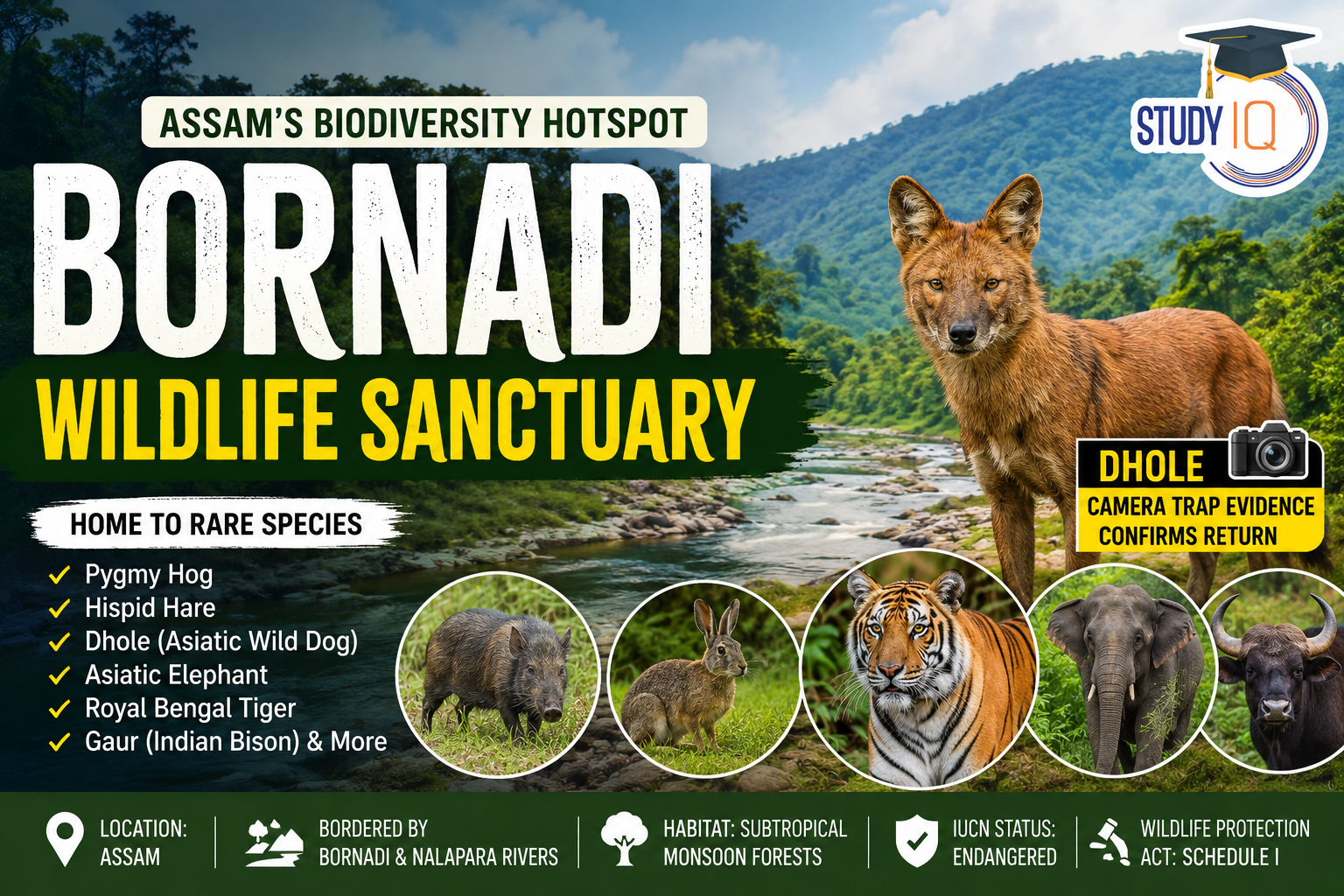
Bornadi Wildlife Sanctuary, located in Assam, has recently gained attention after camera traps confirmed the return of the endangered Dhole (Asiatic Wild Dog) to the protected area. The sighting is considered a positive indicator of improving habitat quality and ecological balance in one of Northeast India’s important biodiversity hotspots.
The sanctuary is renowned for protecting rare grassland species such as the Pygmy Hog and the Hispid Hare, while also serving as an important habitat for elephants, tigers, gaur, and several other mammals.
Read Also: UPSC Daily Current Affairs 2026
Why is Bornadi Wildlife Sanctuary in News?
Bornadi Wildlife Sanctuary was recently in the news because:
- Camera traps captured the Dhole (Asiatic Wild Dog) after several years.
- The sighting confirms the continued ecological health of the sanctuary.
- It highlights the importance of Assam’s protected areas in conserving endangered carnivores.
- The sanctuary is part of the Indo-Bhutan transboundary landscape, making it significant for wildlife movement between India and Bhutan.
About Bornadi Wildlife Sanctuary
| Feature | Details |
|---|---|
| State | Assam |
| Region | Eastern Himalayan Foothills |
| Landscape | Indo-Bhutan Transboundary Landscape |
| Named After | Bornadi River |
| Established For | Conservation of Pygmy Hog and Hispid Hare |
| Climate | Subtropical Monsoon |
| Forest Type | Tropical Semi-evergreen, Moist Deciduous & Dry Deciduous |
Location of Bornadi Wildlife Sanctuary
Bornadi Wildlife Sanctuary lies in Assam’s foothill region bordering Bhutan, making it an ecologically sensitive wildlife corridor.
Important Rivers
- Bornadi River
- Forms the western boundary of the sanctuary.
- Nalapara River
- Originates in Bhutan.
- Flows along the eastern boundary.
These rivers support the sanctuary’s rich biodiversity and provide vital freshwater ecosystems.
Key Facts at a Glance
| Particular | Details |
|---|---|
| State | Assam |
| Landscape | Indo-Bhutan Transboundary Landscape |
| Named After | Bornadi River |
| Western Boundary | Bornadi River |
| Eastern Boundary | Nalapara River |
| Purpose of Establishment | Conservation of Pygmy Hog & Hispid Hare |
| Major Forest Types | Semi-evergreen, Moist Deciduous, Dry Deciduous |
| Notable Species | Dhole, Tiger, Elephant, Gaur, Pygmy Hog, Hispid Hare |
| Dhole IUCN Status | Endangered |
| Wildlife Protection Act | Schedule I |
Why Was Bornadi Wildlife Sanctuary Established?
The sanctuary was declared primarily to conserve two of India’s rarest grassland mammals:
- Pygmy Hog (Porcula salvania)
- Hispid Hare (Caprolagus hispidus)
Both species depend on healthy tall grassland ecosystems, which have become increasingly threatened due to habitat degradation.
Climate and Vegetation
Bornadi Wildlife Sanctuary experiences a subtropical monsoon climate with high rainfall.
Its vegetation includes:
- Tropical Semi-evergreen Forests
- Moist Deciduous Forests
- Dry Deciduous Forests
- Riverine vegetation
- Grasslands
These diverse habitats support a wide variety of wildlife.
Wildlife Found in Bornadi Wildlife Sanctuary
The sanctuary hosts numerous endangered and protected species.
Mammals
- Pygmy Hog
- Hispid Hare
- Dhole (Asiatic Wild Dog)
- Asiatic Elephant
- Royal Bengal Tiger
- Gaur (Indian Bison)
- Hog Deer
- Wild Boar
- Leopard
- Barking Deer
- Sambar
Birds
The sanctuary is also rich in bird diversity, attracting both resident and migratory species.
Reptiles
Several snake, turtle and lizard species inhabit its forests and wetlands.
Dhole (Asiatic Wild Dog)
The Dhole (Cuon alpinus) is one of Asia’s most endangered wild canids.
Distribution
The species is distributed across:
- India
- Nepal
- Bhutan
- Bangladesh (historically)
- Myanmar
- Thailand
- Laos
- Cambodia
- Vietnam
- Malaysia
- Indonesia
- China (limited populations)
Habitat
Dholes inhabit:
- Dense forests
- Tropical forests
- Deciduous forests
- Scrublands
- Grasslands
- Pine forests
- Mountain ecosystems
- Steppes
In India, they are primarily found in:
- Western Ghats
- Eastern Ghats
- Central Indian Landscape
- Northeast India
Conservation Status
| Category | Status |
|---|---|
| IUCN Red List | Endangered |
| Wildlife (Protection) Act, 1972 | Schedule I |
Importance of Dhole in the Ecosystem
Dholes are apex social predators that:
- Maintain ecological balance.
- Regulate herbivore populations.
- Prevent overgrazing.
- Indicate healthy forest ecosystems.
- Enhance biodiversity by sustaining balanced food chains.
Their return to Bornadi Wildlife Sanctuary suggests improving habitat conditions and prey availability.
Ecological Importance of Bornadi Wildlife Sanctuary
The sanctuary plays several critical ecological roles:
- Conserves endangered grassland mammals.
- Protects Eastern Himalayan biodiversity.
- Serves as an important wildlife corridor between India and Bhutan.
- Supports large mammals including elephants and tigers.
- Preserves subtropical forest ecosystems.
- Enhances landscape connectivity for migratory wildlife.
Significance for UPSC & Competitive Exams
Bornadi Wildlife Sanctuary is important for:
- Environment & Ecology
- Protected Areas in India
- Biodiversity Conservation
- India-Bhutan Transboundary Landscapes
- Endangered Species
- Wildlife Conservation
- Current Affairs 2026
 Species in News: Cheetah | Project Cheet...
 Quantum Computing: RRI Scientists Demons...
 Artificial Intelligence in Warfare: How ...














 WhatsApp