Table of Contents
The Prambanan Temple, the largest Hindu temple complex in Indonesia, has once again gained international attention after the Prime Minister of India and the Indonesian President jointly inaugurated an international conservation and restoration project at the historic temple complex. The initiative highlights the centuries-old cultural and civilizational ties between India and Indonesia while emphasizing the importance of preserving shared heritage.
Prambanan is one of Southeast Asia’s most remarkable examples of Hindu architecture and an important cultural landmark recognized globally for its artistic excellence and historical significance.
What is Prambanan Temple?
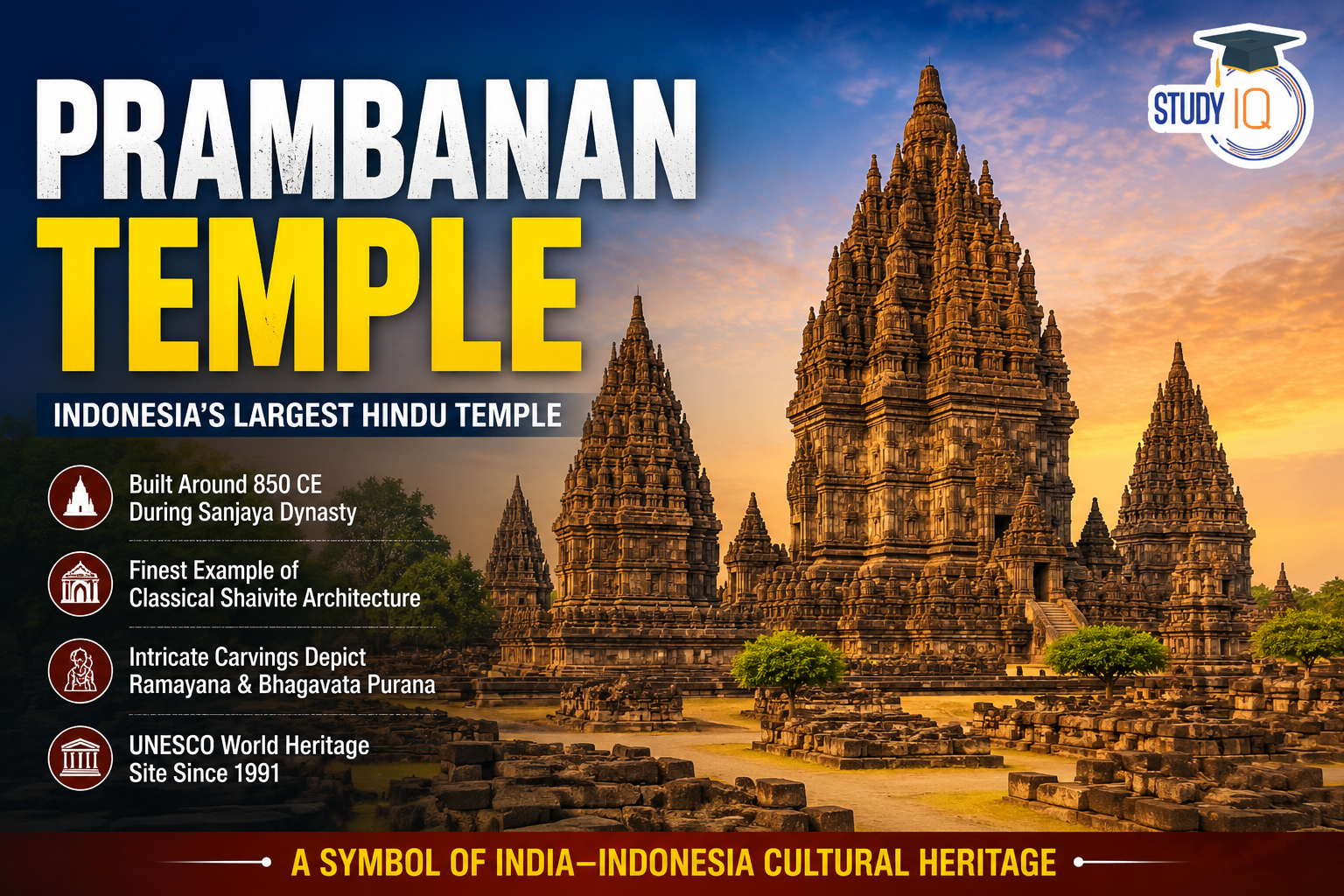
Prambanan Temple, locally known as Roro Jonggrang (Loro Jonggrang), is the largest Hindu temple complex in Indonesia and one of the most magnificent Hindu monuments in Southeast Asia. Dedicated primarily to the Hindu Trimurti—Lord Shiva, Lord Vishnu, and Lord Brahma—the temple represents the flourishing of Hindu civilization in ancient Java.
The temple complex stands near the border of the Special Region of Yogyakarta and Central Java, making it one of Indonesia’s most visited cultural and archaeological attractions.
History of Prambanan Temple
Prambanan Temple was constructed around 850 CE during the reign of the Sanjaya Dynasty, which ruled Central Java between the 8th and 9th centuries CE.
The complex was built when Hinduism enjoyed royal patronage in Java. It later declined following the political shift toward East Java and remained abandoned for centuries before restoration efforts began during the colonial period and continued after Indonesian independence.
Today, Prambanan symbolizes Indonesia’s multicultural heritage, where Hindu, Buddhist, and indigenous traditions have coexisted over centuries.
Architecture of Prambanan Temple
Prambanan is widely regarded as the finest example of classical Shaivite temple architecture in Southeast Asia.
Some of its notable architectural features include:
- Built using dry interlocking stone masonry without mortar, making the structure more resistant to earthquakes.
- The temple complex originally consisted of 240 temples, arranged in concentric square layouts.
- The tallest central temple is dedicated to Lord Shiva and rises to approximately 47 metres, making it one of the tallest Hindu temples in Southeast Asia.
- Separate temples are dedicated to Lord Vishnu and Lord Brahma, completing the Trimurti.
- The temple reflects advanced engineering, symmetry, and geometric precision characteristic of classical Hindu architecture.
Sculptures and Reliefs
One of Prambanan’s most admired features is its intricate stone carvings.
The temple walls beautifully depict scenes from:
- Ramayana
- Bhagavata Purana
These relief panels narrate stories from Hindu mythology and showcase the remarkable craftsmanship of ancient Javanese artisans. The Ramayana Ballet performed near the temple remains a major cultural attraction inspired by these carvings.
UNESCO World Heritage Status
Due to its outstanding universal value, Prambanan Temple received global recognition:
- Declared a UNESCO World Heritage Site in 1991.
- Designated as a National Cultural Property of Indonesia in 1998.
- Considered one of the world’s most important examples of Hindu religious architecture.
The temple continues to attract scholars, archaeologists, historians, and tourists from across the globe.
India-Indonesia Conservation Project
The recent inauguration of the international conservation and restoration project by the Prime Minister of India and the Indonesian President marks a significant milestone in cultural diplomacy.
The initiative aims to:
- Preserve the structural integrity of the temple complex.
- Promote archaeological conservation using international expertise.
- Strengthen India-Indonesia cultural cooperation.
- Protect the shared civilizational heritage connecting the two nations.
The project also reinforces India’s broader commitment to preserving cultural heritage beyond its borders.
Importance for UPSC and Competitive Exams
Prambanan Temple is relevant for UPSC Prelims and Mains under topics related to:
- Indian Culture Abroad
- India’s Cultural Diplomacy
- UNESCO World Heritage Sites
- India–Indonesia Relations
- Ancient Temple Architecture
- Soft Power and Civilizational Links
Questions may focus on the temple’s location, architectural style, historical background, UNESCO recognition, and India’s role in heritage conservation.
Key Facts about Prambanan Temple
| Feature | Details |
|---|---|
| Location | Border of Special Region of Yogyakarta and Central Java, Indonesia |
| Local Name | Roro Jonggrang (Loro Jonggrang) |
| Built | Around 850 CE |
| Dynasty | Sanjaya Dynasty |
| Religion | Hinduism |
| Main Deity | Lord Shiva |
| Architecture | Classical Shaivite Temple Architecture |
| Construction Technique | Dry interlocking stone masonry without mortar |
| Famous Reliefs | Ramayana and Bhagavata Purana |
| UNESCO Status | World Heritage Site (1991) |
| National Recognition | National Cultural Property of Indonesia (1998) |
Conclusion
Prambanan Temple stands as a timeless symbol of Hindu architectural excellence and the enduring cultural links between India and Indonesia. Its remarkable engineering, intricate sculptures, and UNESCO recognition make it one of the world’s most significant heritage monuments. The newly launched India-Indonesia conservation initiative further strengthens bilateral cultural relations while ensuring that this extraordinary monument continues to inspire future generations.
Latest UPSC Updates
| Resource | Link |
|---|---|
| UPSC Prelims Result 2026 | Check Here |
| UPSC Exam Calendar 2027 | View Calendar |
| UPSC Question Paper 2026 | Download PDF |
| UPSC Prelims Answer Key 2026 | Check Answer Key |
| UPSC Cut Off 2026 | View Cut Off |
| UPSC Syllabus 2026 | Read Syllabus |
| Daily Current Affairs 2026 | Read Updates |
| StudyIQ UPSC IAS Foundation 2027 (English) | Join Course |
| StudyIQ UPSC IAS Foundation 2027 (Hindi) | Join Course |
| StudyIQ UPSC IAS Foundation 2027 (Bilingual) | Join Course |
 Circular Economy in India: Benefits, Cha...
 EPFO Wage Ceiling Hike 2026: Social Secu...
 Daily Mains Articles 2026 – Updated Da...













 WhatsApp