Table of Contents
Context
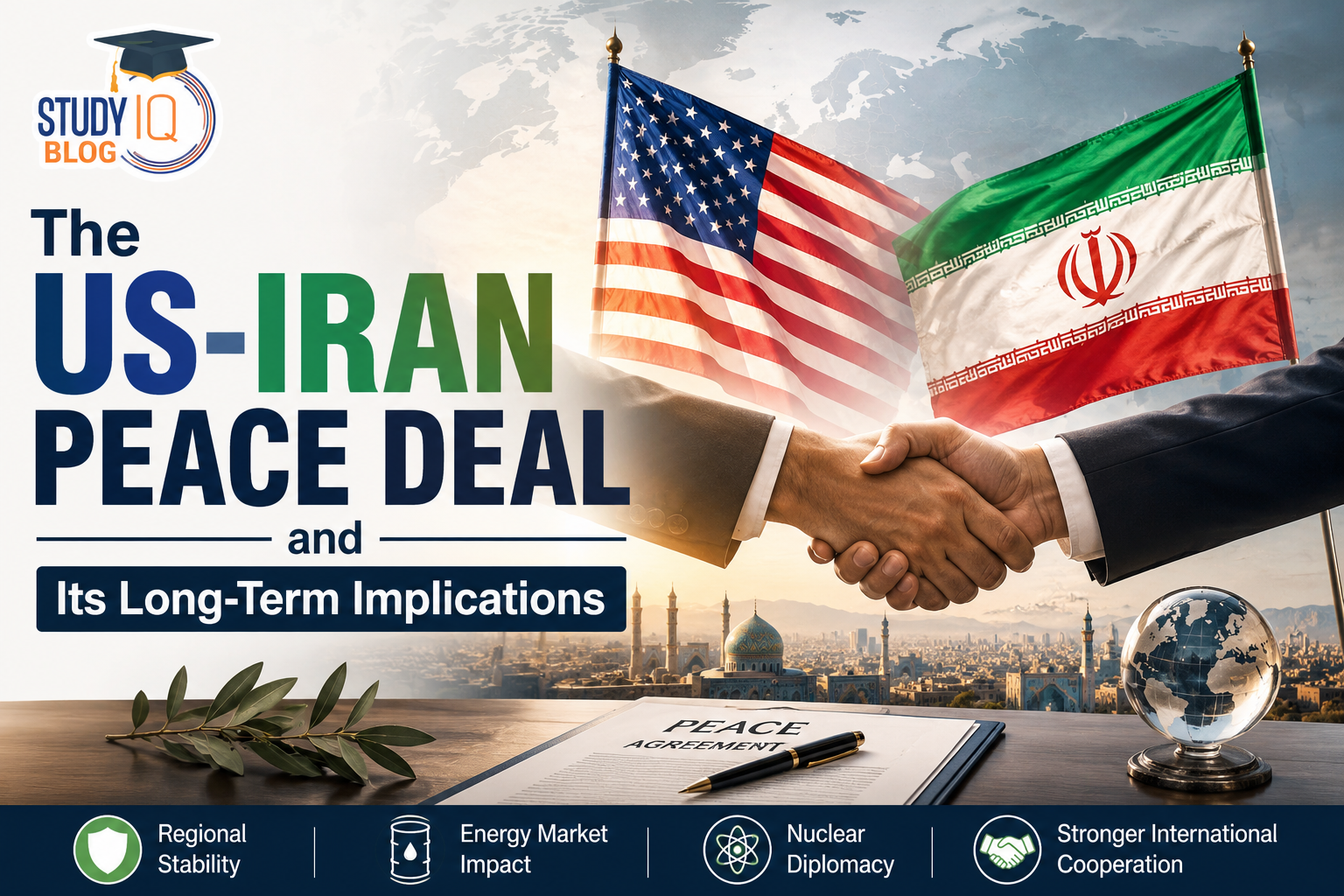
Iran and the United States signed a Memorandum of Understanding to end three months of direct hostilities. The deal opens a 60 day window for negotiations on deeper disputes.
What Does the MoU Actually Contain?
- Across the Board Ceasefire: The agreement mandates a permanent halt to all military operations, including the Lebanon front.
- Reopening the World’s Busiest Oil Chokepoint: Iran agrees to lift its blockade of the Strait of Hormuz for commercial shipping.
- E.g., The Strait carries about one fifth of all globally traded oil, and roughly 180 million barrels of crude were stranded on ships when the blockade was active.
- Phased Economic Relief: The US will release 24 billion dollars in frozen Iranian assets and temporarily waive oil sanctions.
- E.g., A separate 300 billion dollar reconstruction package for Iran is also under discussion, to be negotiated within 60 days.
- Nuclear Issue Deferred, Not Resolved: Iran commits to freezing enrichment at pre-war levels, but a comprehensive nuclear deal is pushed to later talks.
Why Does This Deal Matter Beyond West Asia?
- Limits of Military Coercion Exposed: The conflict showed that American air power and high-tech dominance could not force Iran into submission.
- A Shaken Gulf Cooperation Council states Confidence in USA: Gulf states feel exposed after suffering collateral damage and disrupted exports without adequate US protection.
- A New Iranian Deterrence Doctrine: Some Iranian leaders now see control over the Strait of Hormuz as more valuable than nuclear ambiguity.
- Risk of Resurgent Non-State Actors: A weakened Iran could loosen its grip on regional proxies, creating space for rival extremist groups.
- E.g., Analysts point to groups like the Islamic State and al-Qaeda as likely beneficiaries of any Iranian retreat from the region.
What Does the Deal Mean for India?
- Relief on the Energy Import Bill: Lower crude and LNG prices ease pressure on India’s current account and inflation.
- E.g., India sources about 50% of its crude oil, 70% of LPG, and almost 90% of LNG from West Asia.
- Resumption of Safe Maritime Trade: Reopening Hormuz allows Indian flagged vessels to resume normal transit without war risk costs.
- E.g., The Shipping Corporation of India led tanker Disha transited the Strait soon after the deal, carrying LNG from Qatar to Gujarat.
- A Chance to Revive the Chabahar Corridor: A durable settlement could restore the US sanctions waiver needed for India’s Chabahar port operations.
- Diaspora and Seafarer Safety: De-escalation reduces risk to the large Indian population working across Gulf states.
- A Lesson in Strategic Autonomy: The episode shows India must engage major powers as an equal partner rather than a dependent one.
Way Forward for India
- Diversify Energy Sourcing: Continue building alternative supply relationships beyond West Asia to reduce future vulnerability.
- E.g., India had turned to distant markets like Venezuela during the conflict, a trend worth institutionalising.
- Replenish Strategic Reserves: Use the current price dip to refill India’s Strategic Petroleum Reserve.
- E.g., Lower Brent crude prices after the deal create a cost effective window for stockpiling.
- Push Alternative Trade Corridors: Invest further in routes that bypass vulnerable chokepoints like Hormuz.
- E.g., The India Middle East Europe Economic Corridor (IMEC) offers a long-term hedge against future disruptions.
- Deepen Regional Partnerships: Expand engagement through platforms that give India a stabilising regional role.
- E.g., The I2U2 grouping with the US, Israel, and UAE offers one such avenue.
- Maintain Diplomatic Balance: Continue India’s calibrated approach of engaging Iran, Israel, and the Gulf states simultaneously.
Latest UPSC Updates
| Resource | Link |
|---|---|
| UPSC Prelims Result 2026 | Check Here |
| UPSC Exam Calendar 2027 | View Calendar |
| UPSC Question Paper 2026 | Download PDF |
| UPSC Prelims Answer Key 2026 | Check Answer Key |
| UPSC Cut Off 2026 | View Cut Off |
| UPSC Syllabus 2026 | Read Syllabus |
| Daily Current Affairs 2026 | Read Updates |
| StudyIQ UPSC IAS Foundation 2027 (English) | Join Course |
| StudyIQ UPSC IAS Foundation 2027 (Hindi) | Join Course |
| StudyIQ UPSC IAS Foundation 2027 (Bilingual) | Join Course |
 Anti-Goonda Bill 2026 Explained: Why Pre...
 Cool Leaders Award 2026: Winners, Global...
 Black Carbon and Himalayan Glacier Melt:...












 WhatsApp