
Table of Contents
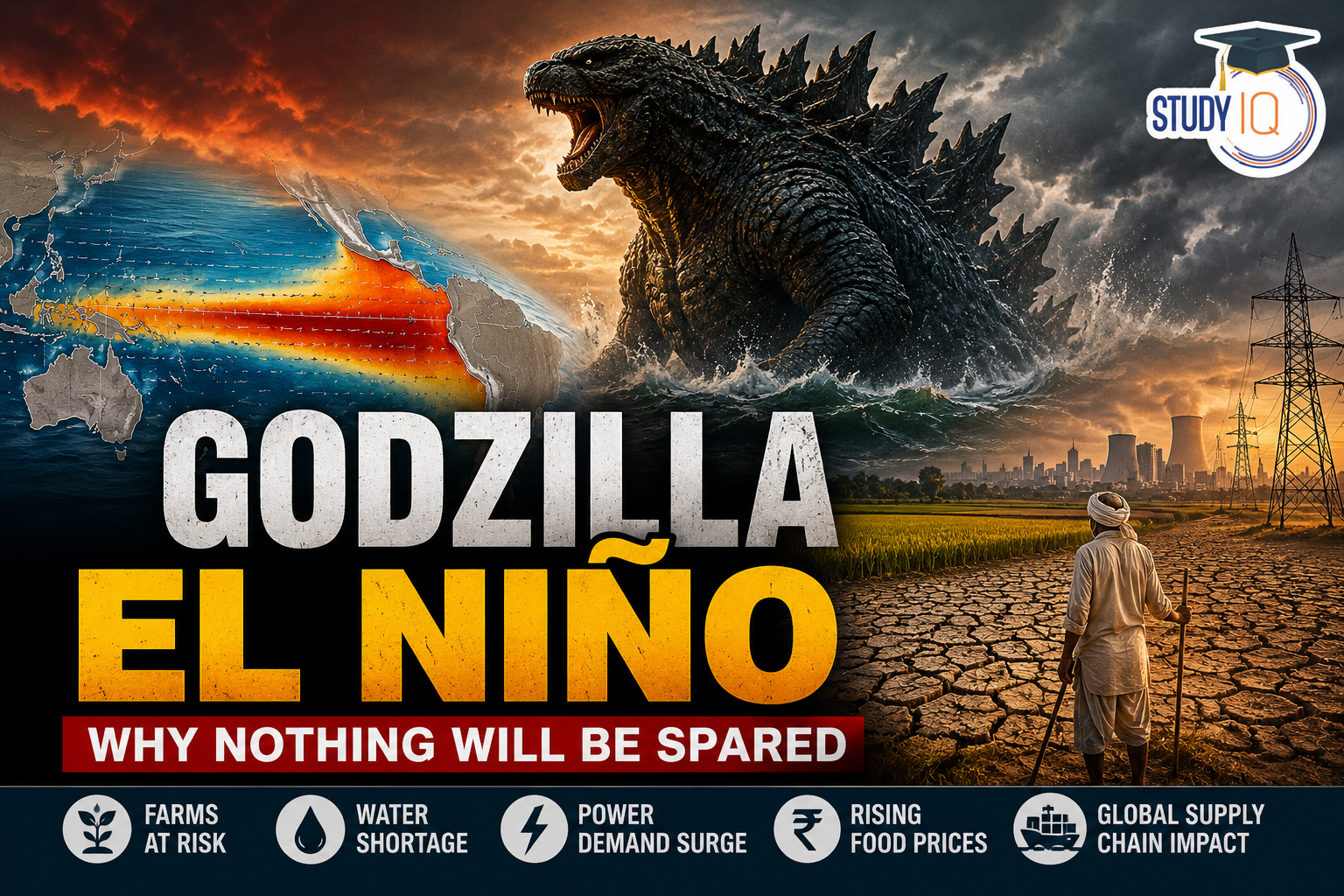
A powerful climate phenomenon known as El Niño is once again drawing global attention, with scientists warning that a potentially extreme version—often referred to as “Godzilla El Niño”– could develop in the coming months. While the phenomenon originates in the tropical Pacific Ocean, its effects can travel thousands of kilometres, influencing weather patterns, agriculture, water resources, energy demand, and food prices across the globe.
For India, where millions depend on the annual southwest monsoon, a strong El Niño event could have far-reaching consequences. From farms and reservoirs to city power grids and household budgets, experts believe that no sector may remain untouched if climate patterns intensify.
Read Also: UPSC Daily Current Affairs 2026
What Is Godzilla El Niño?
El Niño is a natural climate cycle that occurs when sea surface temperatures in the central and eastern Pacific Ocean become warmer than normal. This warming alters atmospheric circulation patterns, affecting rainfall, temperatures, and storm activity worldwide.
The term “Godzilla El Niño” is used informally by scientists and meteorologists to describe exceptionally strong El Niño events that can produce widespread climatic disruptions. Such events are rare but can have significant economic and environmental consequences.
Why Scientists Are Concerned
Recent observations indicate rising ocean temperatures in parts of the Pacific Ocean. Climate experts are closely monitoring these developments because stronger-than-normal warming could trigger an intense El Niño phase.
Global climate agencies have warned that the event could influence multiple sectors simultaneously, including agriculture, energy, transportation, water management, and food supply chains.
Impact on India’s Monsoon
The Indian economy remains heavily dependent on the southwest monsoon. Nearly half of the country’s agricultural land relies primarily on rainfall.
A strong El Niño typically weakens monsoon circulation, leading to:
- Below-normal rainfall
- Delayed monsoon onset
- Longer dry spells between rain events
- Uneven distribution of rainfall
If monsoon rains weaken significantly, farmers may face challenges in sowing and crop management, affecting agricultural productivity across several states.
Threat to Agriculture and Food Security
India’s major crops, including rice, pulses, soybean, cotton, and maize, depend heavily on timely monsoon rainfall.
A weaker monsoon can result in:
- Reduced crop yields
- Higher irrigation costs
- Increased dependence on groundwater
- Lower farm incomes
The impact does not stop at farms. Reduced agricultural output can tighten food supplies and push up prices of essential commodities. Food inflation, especially in cereals and pulses, could become a major concern.
Water Shortages Could Intensify
One of the biggest risks associated with a strong El Niño is reduced water availability.
Lower rainfall can lead to:
- Declining reservoir levels
- Reduced river flows
- Groundwater depletion
- Drinking water shortages in urban and rural areas
Many Indian cities already face seasonal water stress. An El Niño-driven weak monsoon could worsen the situation and increase pressure on water management systems.
Rising Heat and Record Power Demand
El Niño is often associated with higher-than-normal temperatures.
As temperatures rise, demand for cooling systems such as air conditioners, fans, and refrigeration units increases sharply. This places additional pressure on electricity networks and power generation infrastructure.
India has witnessed record-breaking electricity demand in recent years, and a hotter-than-normal year could push consumption even higher. Energy planners may face challenges in ensuring uninterrupted supply during peak summer months.
Impact on Global Trade and Supply Chains
The effects of El Niño extend beyond national borders.
Previous El Niño events have contributed to drought conditions in parts of Central and South America, affecting major trade routes and transportation networks. Disruptions to shipping and logistics can influence global commodity prices and supply chains.
For an economy deeply integrated with global trade, India could experience indirect impacts through higher import costs and supply disruptions.
Economic Consequences
A powerful El Niño event could affect multiple economic indicators:
- Higher food inflation
- Increased energy consumption
- Pressure on government relief measures
- Reduced agricultural growth
- Potential strain on rural livelihoods
The combined impact may influence household spending, business costs, and overall economic performance.
How India Can Prepare
Experts suggest several measures to reduce potential risks:
- Strengthening weather forecasting systems
- Promoting drought-resistant crop varieties
- Expanding micro-irrigation facilities
- Improving water conservation practices
- Enhancing renewable energy capacity
- Building climate-resilient infrastructure
Proactive planning can help minimise the effects of extreme climate variability and improve resilience across sectors.
Conclusion
The possibility of a “Godzilla El Niño” has become one of the most closely watched climate developments of 2026. Although uncertainties remain, scientists agree that a strong El Niño could affect everything from monsoon rainfall and crop production to water supplies, energy demand, and food prices.
For India, the coming months will be crucial. Governments, farmers, businesses, and households alike will be watching the skies as the Pacific Ocean’s warming waters shape weather patterns that may determine the country’s agricultural and economic outlook for the year ahead.
 UPSC Recruitment 2026: 212 Vacancies Thr...
 Nyedar Namlo, Arunachal Pradesh: Sacred ...
 Daily Mains Articles 2026 – Updated Da...













 WhatsApp





